Showing posts with label Subaru. Show all posts

9 Feb 2015

Cars For Non-Conformists

I like to think of myself as a non-conformist. I try not to fit in with the crowd or do what's expected of me. You might call this awkward behaviour but those of us who think of ourselves as non-conformists disagree - we're individuals. And to that end we don't buy what cars are expected of us.


Whilst the rest of the school-run parents used to pull into the car park in brand new monster SUVs I would drop my son at school in a 25 year old Mercedes 300TE with frilly, rusted wheel arches and gloriously gold paint.

I chose it not only because I was a bit short on budget back then but also because I thought it was brilliant, and hardly anyone else had one. I could have chosen a Ford Focus, but that would have been too sensible.

Conformists go with the flow. Non-conformists kick against the pricks, sometimes to the detriment of comfort, status and financial wellbeing.

If you want to be part of the herd the market has a car that is perfect for your needs. Middle manager in a large corporate with a pension plan, 2.5 children and a house in the 'burbs? Allow BMW to provide with a 3-Series on low rate finance and in a wide choice of colours and specifications.

But that would be conforming. Your Beemer might suit your lifestyle and your wallet but it would be largely the same car as all your colleagues and neighbours. As a statement to the world it says you are as boring as a celery sandwich.

Instead Mr Corporate could buy a Caterham, Morgan 3-Wheeler, Lotus Elise or even a Citroen C4 Cactus, Mini Cooper John Cooper Works or Ford Mustang if real world practicalities need to be taken into account - and he would stand out amongst his contemporaries as a man who does things differently in a world of worker ants. 

Similarly if you're looking to swim against the tide Infiniti, Subaru, Dacia and Alfa Romeo make cars like nobody else does. Buy one and you're already winning in the game of life. I can't promise they'll be any good though.

To really strike a blow for individuality you have to go back a few years when some car companies seemed to make cars for such small audiences it was amazing they didn't go out of business (although some did).

TVR (which did go out of business) made some of the most wonderful machines to grace the roads. Citroen (which is amazingly still in business) has made some of the most stylish, unique and plain bonkers cars ever. Buy a half decent XM, BX, DS or SM and everyone will know you do not conform to the conventional norms.  Saab made cars differently, until GM got hold of the company and blandified it.

Maserati makes rivals to Big German Three which are different for the sake of it and Mazda does the same against the rep-mobiles from Ford and Vauxhall.

If you're after a city car you could buy a boring (and crap, which is sad as the first one was different AND brilliant) Ford Ka or Citroen C1 or you could go against the flow and get a tiny, rear wheel drive (and engined) Renault Twingo.

But for those really unique and most definitely non-conformist cars we have to look to the cul-de-sacs that car companies sometimes build, and then stop building because nobody bought them. 

It might look horrible but the Mercedes-Benz R-Class was intended to create a new class of car, and failed. The R-Class is a standalone Quasimodo in a world of Esmeraldas and as such buying one is as non-conformist as it gets.

Vauxhall, purveyor of cars that are bought by the truckload, once made a kind of semi-luxury estate/hatchback with two individual rear seats that had plenty of legroom. It was called the Signum and nobody bought it, which is why it is as rare as a German comedian.

The Volkswagen Phaeton (vast, luxurious, same as a Bentley under the skin) was built to transport VW's board of directors but as you could buy the same car with an Audi badge on it no-one who didn't work for Volkswagen bought one.

I'm sure I've missed many interesting, unusual, unique and defiantly non-conformist cars. If you know of one let me know.

By Matt Hubbard


23 Oct 2014

2014 Subaru Forester & WRX STI Video Reviews

Matt Hubbard reviews the 2014 Subaru Forester and WRX STI


I recently spent the day with Subaru.  The location was a rather splendid hotel in Hampshire.  My morning was spent driving the Forester, a rather splendid, if not very economical, SUV. It's designed more for general country folk than school run mums. Here's my video review


The afternoon was spent in the WRX STI. It's fast, it's brutal and it looks outrageous.


By Matt Hubbard


8 Oct 2014

2014 Subaru WRX STI Review

Matt Hubbard reviews the new Subaru WRX STI

2014 Subaru WRX STI
2014 Subaru WRX STI

It's back and it's still brash.  The Subaru WRX STI is once more available in the UK due in part to a weak yen and strong pound. Thanks to that favourable exchange rate it's priced competitively too, at £29k.

The old Subaru Impreza STI was loved by many but bought by few.  Over the years it got uglier, morphed into a hatchback and eventually dropped the Impreza name (which now exists as a sensible, non-turbocharged hatchback).

In 2011 the fourth generation Impreza was launched in Japan and in summer 2014 the saloon version was badged WRX STI, given a 2.5-litre 4-cylinder boxer engine with a twin-scroll turbocharger (and a massive spoiler) and launched in various markets, notably the UK and US.

Its recent history might be confusing but make no mistake the new WRX STI is rammed with the old Impreza's DNA.  This thing is fast and it is raucous.

Let's start with the looks. It's not a pretty car but it is purposeful with big bulges around the wheels and angular shapes all over the body. Take a look at the photos, there's hardly a curve on it.

The enormous wing is 8mm higher than the last generation's in order to improve visibility from the rear view mirror and it succeeds in this regard, you don't notice it much in the mirror. But you do when you're standing outside the car.
2014 Subaru WRX STI
2014 Subaru WRX STI

It's a 4-door saloon with a spacious boot and full size rear seats.  All the seats are clad in Alcantara and leather and are super-comfortable and supportive. The driving position is superb with deep set pedals and a steering wheel that adjusts for reach and rake so much that short and tall drivers can get comfortable.

The materials used in the cabin are largely of a decent quality with leather, suede and aluminium in abundance.  It's a sporty cabin that's grown up since the Imprezas of old but not too much, with carbon trim and splashes of colour to add some pizzaz.

There is no satnav or infotainment system, although you can order a satnav as an option.  The standard stereo is a plain, old fashioned affair which will be swapped out in most cars for an aftermarket unit. It plays FM/AM and CDs and streams Bluetooth but you have to read the handbook to work out how to use it.

At the top of the dash is a second screen which displays various items such as a boost gauge, economy and time/date.

There is a dial aft of the gear level which controls the SI-Drive system - which alters engine modes. In most cars the difference between these is hardly felt but in the WRX STI it makes quite a difference. Next to that is a switch that controls the centre-differential lock.
2014 Subaru WRX STI

The dials are pretty funky and glow when you press the start button to fire up the engine.  The flat bottomed steering wheel is chunky (it's a multifunction wheel with such things as cruise control buttons - so modern) and the gear knob is in just the right place.

The engine sounds right, just as a turbocharged Subaru flat-4 should, but is quieter than expected. It revs to 7,000rpm and never gets particularly noisy.

Hit the road and the turbo doesn't kick in until 3,000rpm.  The engine is the same as in the old car and turbo-lag is plentiful. Happily the gearbox is a short-throw unit in both senses, the amount you move the stick is short and the difference between the ratios is short.

So, start off in 1st, pull the muscles in your neck as it shoots forward then change into 2nd as quickly as you can, then into 3rd at 50mph. Keep it above 3,000rpm and it's as brutally quick as you imagine a WRX would be.

Drive in a more serene manner and let the revs dip below 3,000rpm and acceleration is sluggish until it hits the sweet spot again.

This behaviour is a complete pain in an automatic, especially with a diesel engine, but the WRX STI's manual gearbox is pretty slick so you can keep it on the boil and, because it's a petrol, the power before the turbo kicks in isn't so bad.
2014 Subaru WRX STI
2014 Subaru WRX STI

Drive it like you stole it and the WRX STI is as much of a nutjob as the old Impreza.  It grips like glue, unless you want to break traction a little...

With a low centre of gravity and permanent 50:50 all wheel drive, and torque vectoring, the car refuses to lose grip in almost all conditions but push it that little bit into the area marked 'edge of the envelope' and it'll slide just a touch.

When exiting a sharp corner in a low gear with your foot planted the rear will shimmy for a nanosecond before the electronics gather it up.

The hydraulically assisted steering is heavy and has bags of feel and feedback. The grip with a touch of pliability along with the steering prowess makes for a great handling car.

To increase throttle response select SI-Drive to the maximum. In this mode you just need to tickle the accelerator and it flies off the line. From a standing start it's difficult getting a smooth getaway but in any other situation frenzied changing up through the gears is the order of the day.

In many ways the WRX STI is a bit old school.  The engine has turbo-lag, CO2 and economy are terrible and the sound system wouldn't have looked out of place in the 80s but its looks, responsiveness, comfort and general bad-boy image make it stand out from the crowd.

That crowd consists of the Merc CLA45 AMG and Golf R.  These two both have four wheel drive, more refinement and cost less to run but are more expensive to buy.  Neither has permanent four wheel drive and neither is quite so hairy.

Personally I'd take a Golf R over a WRX STI but their characters are far apart enough that some people will happily choose the Subaru, and they won't regret it.

Besides, in what other car could you get away with that blue paint and gold wheels and still look good.

Stats:


Price - £28,995
Engine - 2.5-litre, flat-4 (boxer), petrol, single twin-scroll turbocharger
Transmission - 6-speed manual
0-62mph - 5.2 seconds 
Top Speed - 159mph
Power - 296bhp 
Torque - 300lb ft 
Economy - 27.2mpg 
CO2 - 242g/km 
Kerb Weight - 1,534kg
2014 Subaru WRX STI
2014 Subaru WRX STI

2014 Subaru WRX STI

2014 Subaru WRX STI

2014 Subaru WRX STI

2014 Subaru WRX STI

2014 Subaru WRX STI


15 Sep 2014

For Cars Companies As For Rock Bands

I often write articles in my head during long journeys. Not many of these end up getting written and published as they're often rubbish or I forget what the crux of it was.  This time, however, the idea stayed with me and, in hindsight, it doesn't seem too mad.


The car industry is long established. The market is made up of a few majors players who have survived world wars, recessions, mergers, poor product and mega-recalls to exist in 2014.  Similarly music has a handful of stars who have defied the odds just by carrying on.  This column looks at the similarity between car manufacturers and their musical counterparts.

Let's start with an easy one.  Iggy Pop first came to prominence in the 60s. He was innovative and influential, his work appealed to a niche audience but everyone had heard of him.  His sound was spiky and raw but other musicians were influenced by his style, and even ripped off his songs, which helped grow the Iggy brand.  He would have faded away a long time ago had not several collaborations and outside influencers revived him at various points in his career.  For Iggy read Lotus cars. Both of them are still around today, everyone has heard of them and admires them but few buy the actual product.

Moving on to a bigger name - Porsche.  Again, hard edged but with more of a commercially accessible nature than Lotus.  Porsche has evolved glacially, growing steadily, until mega-success saw them become one of the biggest players in the worldwide car market - despite their core product, sports cars, being very much a niche.  Metallica has a similar career path to Porsche. They've been around a long time but have stuck at the same formula, with little derivation, yet they've grown to become one of the biggest bands in the world - witness their recent headline slot at Glastonbury for evidence of that.

Back to a smaller player - Subaru. Once a worldwide name they made a few disastrous choices and, despite the fact the cars are good, slipped into relative obscurity, just as Prince has done.  Both Subaru and Prince are still plugging away with new stuff but neither seems to be able to make their way back to the top.

The next pair have both seen huge success and have both been wildly hyped, for good reason as they were both great.  They were loved by journalists and the public alike and are still remembered fondly.  But that greatness has faded into a shadow of what it once was as the components of what made them brilliant have disappeared so that today only a fraction of the substance still exists. Guns N'Roses and Alfa Romeo - we all want you to be as good as you once were but sadly you are not.

How about Jaguar and Iron Maiden, surely I can't find a link between those two?  Oh, I can.  Both have several distinct phases to their careers.  Both had a period when they were considered the best in the world at what they did. Their stars shone bright and what they produced back then is still considered classic and brilliant.  Then due to infighting, lack of new ideas and trading on the same old same old for too long they fell into a period not so much of obscurity but certainly of inferior product and fallen sales.  But they both pulled through spectacularly to achieve a third phase with the best cars and music they've ever made, eclipsing their earlier work and making them more money than they ever had before.  It doesn't hurt that Maiden's drummer is a huge Jaguar fan and had a bespoke XKR-S built for him by Jaguar's SVO.

Volkswagen has been around for donkey's years. Aside from in the beginning they've never been particularly innovative but have always been there and have sold cars by the bucketload by sticking to a tried and tested formula to become one of the world's biggest brands, just like the Rolling Stones.

Another band who've been around for a long time and have ploughed the same old furrow is Motorhead.  Everyone's heard of them, but by not making mainstream product hardly anyone bought their records.  Perseverence and sheer will, with a large dose of belligerence, has meant they've never been signed by a major label and are still resolutely independent. Their core audience, though, adores them and keeps coming back for more despite the fact the formula is largely unchanged.  That's pretty much the formula that has kept Morgan in business for decades.

I could do a lot more of these but it is probably time to end. Despite what I said at the start of the article it probably was a mad idea. Hope you enjoyed it.
A detail from Nicko McBrain's Jaguar XKR-S

By Matt Hubbard


3 Sep 2014

Subaru Has Just Dropped The Price Of The BRZ

Good news for fans of the best handling, sensibly-priced, sports car on the planet, Subaru has just dropped the price for the base model BRZ.


The Subaru BRZ/Toyota GT86 is one of the best handling cars I've ever driven.  Check out my Subaru BRZ review here.

At launch the BRZ cost £25k.  Now Subaru has revealed the BRZ SE, which still gets most features you'd want, for £22,495.

The SE has cruise control, sports seats, limited slip diff and climate control etc.  Upgrade to £23,995 the SE Lux and you get heated leather and Alcantara seats.

The above prices are of the manual version, automatics cost £1,500 more.

Bargain.

By Matt Hubbard


1 Sep 2014

Back To Skule - Five SUVs Worth Considering For The School Run

It's September once again, the school holidays are over and you've got to get up that bit earlier and take the kids to school in the family car.  Here are five SUVs that will make the school run that bit easier.  Click on the car's name for a full review.


Range Rover Evoque


The Evoque is one of the very best SUVs because it delivers the benefits of an SUV (tall driving position, extra space, off-road ability) without compromise and with dollops of style. For a stick in the mud such as me who prefers the driving position and cornering ability of a normal car the Evoque is the one to have.  It's a little expensive but the engine is great (although more thirsty than the official stats would have you believe), the interior is best in class and it looks great.  It also has a Range Rover badge on the boot but costs half what a real Rangie would set you back. Buy the 5-door for practicality.

Toyota RAV4


The old RAV4 looked drab and was a bit basic. The new RAV4 is light years ahead in every area.  On paper the Toyota RAV4 is no better car than any other mid-size SUV but drive one for a while and you really start to appreciate the small details that add up to make it a much better than anything else in the price range. It has no rough edges, no annoyances or things you would want to change. It could do with leather seats as standard but that's the only fault I could find with it.


Volvo XC60


The XC60 is probably a bit more expensive than you would expect but this is all part of Volvo re-aligning itself as a premium brand. The XC60 is typical of any modern Volvo in that the interior is amazingly accomplished, the tech is better than anything short of an S-Class, the ride is refined rather than sporty and the engines (now Volvo is building its own) are superb. Go for the D4 which delivers 50mpg on a run.


Mercedes-Benz GLA


When I first saw the GLA I didn't like it, when I drove the GLA I was expecting to hate it - but I didn't. It really is a great little car. It's basically a beefed up A-Class so has that car's space but the interior feels better and the GLA looks better than the A. Its interior is almost as good as an XC60's, its engine returns more mpg than almost all the competition, it drives more as a car than an SUV and it's a Mercedes-Benz. Just don't buy one in white which makes it look more drab than it should.


Subaru Outback


The Outback is the outsider. It isn't a classic SUV but is a jacked up estate car masquerading as a sort-of SUV. However it is quite brilliant. Jeremy Clarkson called the old Outback the 'perfect car' and, having owned two, I wouldn't disagree. This generation is a bit duller on the outside but is more accomplished elsewhere. Of all these SUVs the Outback is the one I bonded with the most. Its only real let-down is an utterly crap infotainment system which has Bluetooth but is almost impossible to use, and doesn't have DAB. Otherwise it pretty much is the perfect SUV.


By Matt Hubbard


17 Apr 2014

Are Car-based Pick-ups Extinct in the UK?

Since the beginning, the motor industry has been endlessly evolving. New concepts arrived and caught on like a drought fuelled wildfire, whilst others dithered and face extinction. Adding substance to Darwin's theory of evolution, albeit in a different context, is a brilliant example by David Ross about the extinction of car-based vans in the UK market. To summarise, a once affluent market sector dwindled and became extinct, with the exception of the novelty Mini Clubvan.

Another sector of the market which faces similar problems is the car-based pick-up. Once upon a time, manufacturers loved to subject their hatchbacks to a Frankenstein style metamorphosis into a hybrid hatchback-come-pick-up truck. These 'Hick-Ups' tended to display great practicality, ideal low-loading ride heights and the driver appeal from the model which it butchered. All of the following were inspired by key American designs, including the Chevrolet El Camino and Ford Ranchero.
Ford P100 Pickup-up
Although sometimes awkward in proportions, Hick-Ups and Sick-Ups (Saloon-based pick-ups) were rather popular among business users. A perfect example of the popularity of these vehicles was the Ford P100. Originally based on a Mk5 Cortina, the later Sierra based design became a sales sensation between 1988 and 1992. Until recent years, many wandered the streets of Britain far-and-wide, however rust and age has finally began to diminish their frequency.
Volkswagen Caddy

Volkswagen also had their own variation based on the legendary Mk1 Golf chassis. Originally a design experiment, also featuring an estate version, the US market demanded the pick-up. Once arriving in Europe with the Caddy nameplate, the handy man´s Golf enjoyed undeniable success. Similarly to Ford's P100, the Caddy has enjoyed a fond modifying following and would later become and outright van model.
Subaru 284
Subaru fans will fondly remember the Subaru 284, an all-wheel-drive saloon/hatchback based pick-up, which exists in ridiculously small numbers to this day. A lesser-known spiritual successor to the Subaru 284 was the short-lived Proton Persona-based Jumbuck.
Vauxhall VXR8 Maloo


Past examples need-not just be mundane and utilitarian, for the recently deceased Vauxhall VXR8 Maloo was enough to blow anyone's mind. Based upon General Motors Australian division's Holden HSV Maloo Ute, Vauxhall's import created what became a final hurrah for this entire genre of Hick-Ups and Sick-Ups. No sensible business user could ever justify 425bhp from a thirsty V8 with a £50,000 price tag. Bonkers as it was, the VXR8 Maloo was certainly iconic in Britain - although extremely rare. Indeed Australia too, whereby the shifting of production of the Commodore to China on a front-wheel drive platform forces global extinction of the Holden Ute.

Many will wonder what caused this species to die out. An asteroid? Disease? A great flood? Similarly to the Honest John article from last August, the development in commercial vehicles is squarely to blame. Nowadays, van design has evolved to be on-par with regular no-commercial models. Interior qualities have increased, driver comfort has become more plush and road handling has become safer and infinitely more enjoyable. As Darwin theorised, it's simply survival of the fittest. Hick-ups and Sick-ups were becoming dodos in a world of eagles.

You might also like: Spotted - BMW 3-Series Pick-up

By Mike Armstrong


27 Mar 2014

The Legends Are Back - The New Subaru WRX STI And Mitsubishi Evo X

Mitsubishi and Subaru. Two colossuses of world rallying who dominated the stages for years (a long time ago) are both back with top flight cars that are surely made for rallying.


First it was Subaru.  The Impreza, synonymous with Richard Burns, Colin McRae and Carlos Sainz, slowly turned from a screaming nutter-mobile into a rather boring hatchback.  Its most recent incarnation has a 1.6 litre engine and does 0-60mph in 12.3 seconds.

But at some point the Impreza we love and cherish became the WRX and even that got a bit staid and so-so and for a while wasn't available in the UK.

Then Subaru announced the WRX STI and said it would be available from 1 May and it'd cost £29k. The world rejoiced (probably).  The new WRX STI looks like a fast Subaru should and has a 2.5 litre boxer engine that punts out 296bhp, allied to a 6-speed manual gearbox.
Subaru WRX STI
Subaru WRX STI

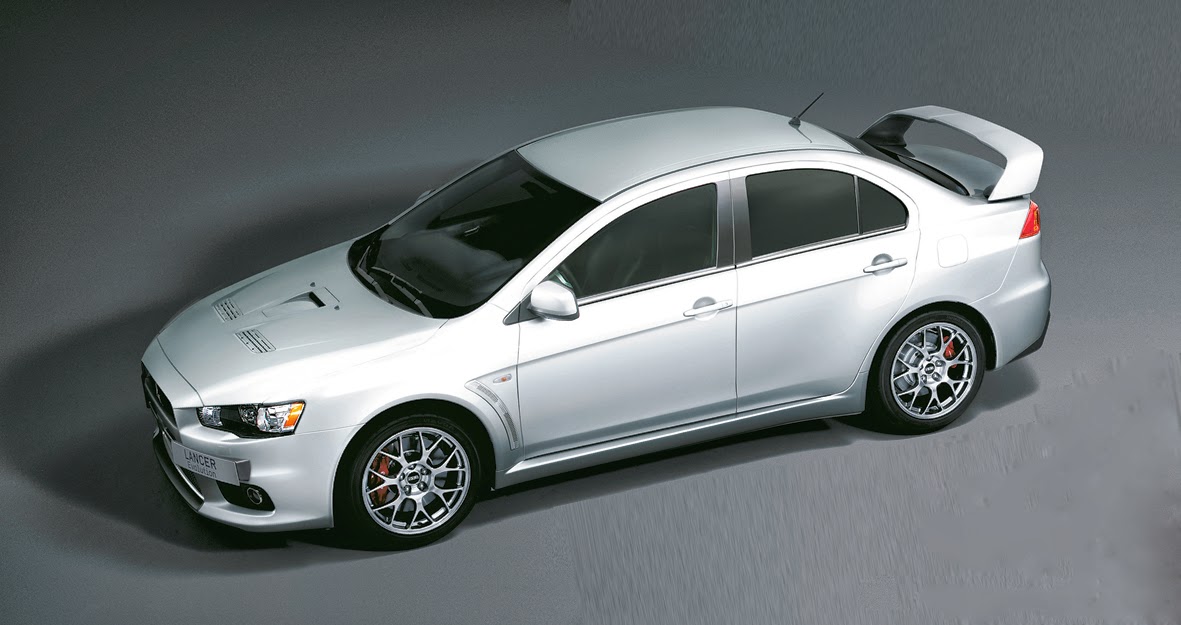
Then it was Mitsubishi, who announced yesterday that it would be launching a 40th anniversary special edition Lancer Evolution X FQ-440 MR which produces 440bhp from its turbocharged inline-4.  It'll cost £50k, has a suitably daft name and will only be available in Frost White.
Mitsubishi Lancer Evolution X FQ-440 MR

For a generation of petrolheads Subaru and Mitsubishi entered the coolest cars in the coolest form of competition and had the coolest drivers.  Then as world rally went in decline so too did the car buying public's appetite for mental Japanese saloons.

Nowadays WRC comprises Ford, Hyundai, Citroen and Volkswagen - all very admirable efforts but none has the kudos of Subaru or Mitsubishi.

So what plans do these two ex-giants of world rally have for their new nutter-bastard motors?

Subaru has announced it will take the WRX saloon car racing. On race tracks. Mitsubishi has announced...nothing.

No, no, no, no, no, no, no.  This is not good enough. We the petrolheads and race fans of the world want, need to see the new Evo and WRX on the stages in the world rally championship.

We want to see these twin Japanese titans take on the Polo, Fiesta, DS3 and i20, spewing mud, ice and gravel and sliding sideways around tarmac hairpins on tiny roads on the edge of some sheer cliff face with a big name driver at the wheel.

This is what the Evolution X FQ-440 MR and WRX STI deserve. And, frankly, so do we.  Please see to it Mitsubishi and Subaru.

By Matt Hubbard


24 Mar 2014

Why Sports Cars Are Ace

The first sports car was arguably a Vauxhall.  In 1910 Vauxhall Motors built three versions of a car called the C-10 which was designed to run in the Prince Henry Speed Trials in Germany.


In 1911 the car was launched to the public as the Vauxhall Prince Henry.  It was 4 metres long, weighed 1250kg and produced 60hp.

Later in 1911 a company called Austro Daimler released a replica of the Vaxhaull Prince Henry and called the it the Prinz Heinrich.   The Austro Daimler version was subtly altered from the Vauxhall version by the company's chief designer Ferdinand Porsche.

The Prince Henry was a convertible but sports cars can either be open tops or coupés.  Incidentally the word coupé is the French word for cut.  In the 19th century some horse drawn carriages had four seats.  Those at the front faced backwards and those at the rear forwards.  Carriages that had the rearwards facing seats removed and the body shortened were called coupés as the body itself had been cut to make the carriage smaller, lighter and faster.  A coupé which had no roof was known as a coupé de-ville.

Ever since then sports cars have come along in leaps and bounds and today Porsche is perhaps the name most synonymous with sports cars.

Most car manufacturers produce at least one sports car and some produce nothing but sports cars.

Sports cars have always been popular but unfortunately few people actually buy one so they have are also something of a niche product.  By their very design sports cars are considered impractical by many drivers.  The rear seats are either non-existent or tiny, the engines are usually built for speed and some people don't like to sit so low to the ground.

Defining what a sports car is can be difficult.  It's almost easier to say what isn't a sports car.  A diesel is not a sports car.  A front wheel drive car is not a sports cars.  Just because it has coupe in the name does not necessarily a sports car.  Not all convertibles are sports cars.

By those definitions an Audi TT is a sports car but a TT TDI is not because it has a diesel engine. It is merely a diesel coupé (or convertible).  Same goes for a front wheel drive TT.  Mercedes' SLK is a definitive sports car, but not with a diesel engine.

Similarly a BMW X4 or X6 may be called a coupé by the manufacturer by they are most definately not sports cars.  A Golf convertible is not a sports car as it is front wheel drive.

In 1981 the Toyota Celica went from being a four door saloon to a rear wheel drive coupe and it turned into a sports car.  In 1985 a new Celica was launched. It looked more sporty than the old model but was front wheel drive.  It then ceased to be a sports car and was merely a coupé.

But being a rear wheel drive coupe or convertible is not enough.  The rather rakish Rolls Royce Wraith is a rear wheel drive coupe and the Bentley Continental is a four wheel drive convertible and coupe.  Both are laudable cars but neither is a sports car.  They are too big and heavy.  They are grand tourers, as is the Maserati GranTurismo.

A sports car is low, a sports car is rear (or possibly four) wheel drive, a sports car is light, a sports car is impractical, a sports car handles better than a saloon, a sports car looks good and makes the driver feel good, a sports car attracts the stares of passers by and a sports car is desired by the man or woman in his or her company eco-box saloon.

Many sports cars are powerful and ultra-fast.  Some, such as a Porsche 911, are designed to go round a circuit quickly and others, such as the Jaguar F-Type are designed as much for the sense of joie de vivre they engender on the occupants as the speed they are capable of.

Some sports cars don't have much power yet hold just as much credence in the sports car genre as their more powerful brethren.  A 63bhp Suzuki Cappuccino is every inch a sports car as is the 130bhp Mazda MX5 and the 200bhp Subaru BRZ.

People buy a non-sports car for various reasons.  Some like SUVs because of the high riding position but I find being low down gives more enjoyment and is more empowering on the road than sitting up high with all the other clones.

Some buy a car for its space, but if you don't actually use those rear seats or boot that much then why lug around all that extra weight with it's impact on efficiency, handling and economy?

Some buy a car for it's low tax and economy.  Sports cars can be economical if you look around.  A BMW Z4 sDrive18i might not be the most dynamic but it is a sports car yet it returns 41mpg and produces 159 g/km of CO2.  And it does 0-60 in 7.9 seconds.

Lotus make some of the best sports cars on the planet.  The £29k Lotus Elise does 0-60 in 6 seconds, returns 45mpg and produces 149 g/km of CO2.  That's more efficient than even the most economical SUVs, and it'll put a big smile on your face every time you get in it.

Sports cars are brilliant.  They bring enjoyment, they look great and they give one a sense of inner peace.

I urge you to ditch that econobox and buy a sports cars.  There's one to suit every budget.

I've driven lots of sports cars.  You can find all the reviews here.  My favourites are the Lotus Evora,  Jaguar F-Type V8 S, Subaru BRZ, Porsche 911 and my own Porsche 924S.

By Matt Hubbard


19 Feb 2014

The Top Ten Best Handling Cars I've Driven

In the last couple of years I've driven more than a hundred cars.  Prior to that I must have driven more than 40.  Here is my top ten best handling cars.


Handling, to me, doesn't necessarily mean how fast a car can go round a corner.  It's something a little more ethereal than that.  Handling is about steering feel and sharpness, the sensation communicated through all those parts of the driver that touch the car, the warning the car gives you before it loses grip completely, how fast it loses that grip and the grip level itself.  Handling is a combination of factors that deliver a sensation that you can push a car to the very edge it's limits - and have fun whilst doing so.

1 - Porsche 911 (991) Turbo


I drove this on track at Silverstone in late 2013.  In my review I said: "The confluence of active aero, ceramic brakes and rear wheel steering means you can drive heroically. The rear wheel steering is not felt on turn in or through the corner but come out of a corner, mash the throttle and you feel the rear end moving. It adds a degree of emotion, never mind speed, to driving the car. Nail a corner exit and the Turbo rewards with a squatting and sliding of the rear end and a perfect punch on to the next straight."

2 - Lotus Exige S Roadster


I drove the Exige on track at Hethel in 2013.  All Lotus' handle heroically well but the Exige is numero uno: "The Exige S Roadster is an amazing car at the limit. You can feel it moving around underneath you, yet all the while it stays on the road and pointing the right way."

3 - Jaguar F-Type S


I drove the F-Type on the road in 2013.  It's not an outright track car but it's amongst the best on the road: "It corners magnificently but its true skill is in mid-corner direction changes. Give the direct steering a flick one way or anther in a corner and you can feel the chassis turn on its axis with very little in the way of pitch. It feels alive, agile and controllable."

4 - Renaultsport Megane 265


I drove the Megane in early 2013 on the road.  It's my favourite front wheel drive car:  "Amid the frantic delivery the chassis copes well. Scream into a sharp corner, change into 2nd as you enter, foot heavily on the brake pedal, turn in, foot on accelerator, ESC copes with tyre slip, tiniest amount of wheelspin from inside wheel, eyes on next apex. Never revs. Don't look down."

5 - BMW 435i M Sport Coupe


I drove the 435i in late 2013 on the road: "The 435i's chassis allows you to feel where the front and rear of the car is going, and to work with it. Rounding corners or roundabouts and the rear wheels want to push the back out just a tad. You feel it and apply just enough throttle to lean on the rear. From the outside this angle of oversteer would be invisible but it's satisfying and rewarding to work with."

6 - Mercedes-Benz C63 AMG Black series


I drove this in 2012.  It's the best handling Mercedes I've ever driven: "...when you reach the open road, the C63 AMG Black series basically turns into a race car. Precise steering, instant throttle response, brakes that stop in an instant and never fade. But a race car without a harsh ride and banging and rattling as you feel every bump in the road with your spine. This is a race car that smooths out the imperfections and cossets your ego."

7 - Lotus Evora


I had an Evora on a weekend long test in late 2013: "Feedback through steering, and seat of the pants, is scalpel accurate. Combine this with the fact the car isn't too wide and it makes for an ideal road hooner whereby placement is accurate and confidence is high."

8 - Porsche 924S


This is my own car. It's amazing fun to drive: "You feel the road through your fingertips, your feet, your bottom. You communicate with the 924. This is when you know you are not in a Volkswagen but a true Porsche."

9 - Subaru BRZ


I had a BRZ on a week long test in summer 2013: "The BRZ is the best car I've ever driven for sheer naughty mucking about in a car. Its toolkit of fun is chock full. It feels light, like you can throw it around, yet you never get out of control. The car will oversteer through power alone in the first three gears. It responds nicely to a Swedish flick."

10 - Porsche Cayman


I had a Cayman on a four day test in Autumn 2013: "That interactivity runs through the entire driving experience, from the firm seats, the noisy cabin, the bolt-action gearbox, the need to manage the engine yourself, the ride quality. In an era when electronics are taking over the Cayman is a, or possibly THE, driver's car."

By Matt Hubbard


12 Feb 2014

2014 Subaru Outback Review

Matt Hubbard reviews the Subaru Outback 2.0D SX Lineartronic

2014 Subaru Outback

Way back in 1994 Subaru released the Outback.  It was an offshoot of the Legacy estate with increased ride height and chunky, plastic body panels.  It looked good but was something of an oddity.  It did, however, create a new niche which the Audi Allroad and Volvo XC70 soon joined.

Then in 1998 the Legacy was revised and a new version of the Outback was launched.  It had a 2.5 litre flat-4 engine, a greater range of colours of panels and bodywork, a twin sunroof, frameless windows, had a hard-wearing but comfortable interior, permanent four wheel drive and 184mm of ground clearance.

I loved that Outback so much I bought one.  Purchased in 2004 it was a 2001 model with automatic transmission, red paint and gold panels.  That might sound a horrid colour combination but it worked well.  Take a look, there's a photo at the bottom of the article.

A few years later I bought another Outback.  There are very few cars I've owned which I look back on wistfully but the Outback is one.  It was a fantastic do-anything car which was comfortable, could off-road, cruise and even handled well.

Clarkson even called it 'the perfect car'.

In 2003 the Legacy was revised again and thus a new Outback was borne.  It was more modern and better, but some of the lustre of the Outback name had been lost.  It didn't look quite so individual.

In 2009 the latest Outback was launched.  It has recently been upgraded.  This was my test car.  It has a lot to live up to.

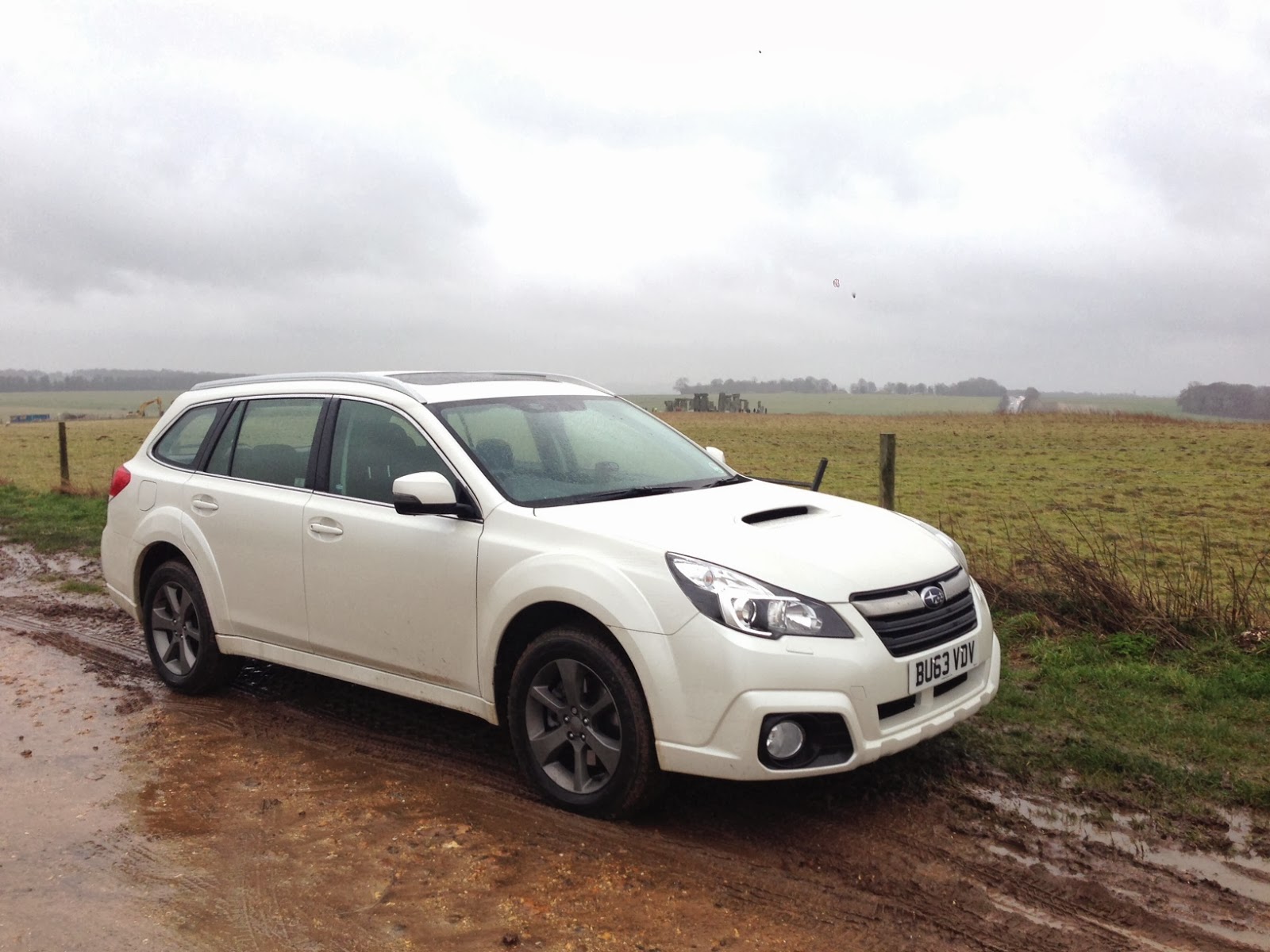
Gone are the different coloured body panels, gone is the twin-sunroof, gone are the frameless windows and gone, in this version, is the flat-four petrol. It was painted white.

The test car had a 2-litre, flat-4 diesel engine mated to a CVT gearbox.  Sacrilege, surely?

When first viewed the Outback looks much more 'normal' than the older models, although it is much more angular and chunky than the 03-09 version.

It sits tall (only 42 mm lower than a 5-door Range Rover Evoque) but it isn't until you put it next to another car you realise this.  Its jacked-up estate silhouette fools the mind into thinking it isn't so high.

It is a lot longer than most mid-size SUVs.  At 4,801mm long it is 436mm longer than an Evoque 5-door, and has a wheelbase of 2,741mm - 81mm longer than the Evoque's.

An Evoque, Outlander or Qashqai has a smaller boot and rear seats than the Outback, but more headroom which, frankly, is wasted space.

In other words in the space stakes the Outlander is a better proposition than a mid-size SUV, as it always was.  And at 220mm it has just as much ground clearance as most mid-size SUVs.
2014 Subaru Outback

Whilst it may not have been modern or fashionable enough to retain the plastic body panels, and in a different colour, the Outback does lose something without them.  Otherwise it's a fine, handsome car. More chunky and purposeful, less bland like something crafted by wind-tunnel technicians.

On to the interior.  First, the bad stuff.

The interior is spacious and, unfortunately, Japanese.  The older Outback never had European levels of interior design and use of materials but it was bright and the seats were either leather or half leather, half suede.  And they were comfy.

The 2014 Outback succumbs to the curse of acres of black, elephant hide plastic and the leather (black) that is used is Japanese, rather than Euro, spec, i.e. not as good.  The interior design is more conservative than funky and the seats are awful.

The infotainment screen is tiny and it doesn't have satnav or digital radio, and the Bluetooth integration is such a pain to use it is unworkable.  In a week with the car I didn't manage to hook up my iPhone5 to the car's Bluetooth.

Now, the good stuff.

You start to put up with all of the above.  The car's positives outweigh its negatives.  Over the course of the week it grew on me more each day.

The layout and design of the interior is functional.  Nothing, other than the Bluetooth, is confusing and everything falls to hand.  The interior is actually better than a Mitsubishi's or Toyota's but not as good as a Honda's.

The lack of satnav is fine because most manufacturer's factory fitted satnav systems are terrible.  Just buy a TomTom and you have a superior system.

The sound from the audio is clear and fulsome, never crackling or reaching the limits of its capabilities.  To play music from your phone you need to attach it via a cable.

Without satnav the screen doesn't need to be big (although the Subaru BRZ has a great info screen).

After a few days with the car the interior had grown on me.  I liked it.  It's good to spend long journeys in.  Although I never really got used to the seats.

Oh dear me, no.  The lumbar support is too high, the material used is slightly nasty and it takes an age to find the right position.  The old Outback seats were great but these aren't.  I found a position that was tolerable, stuck with it and coped without too much discomfort, but they could be so much better.

The Outback's rear seats are huge and are more comfortable than the front.  There is leg and shoulder room for three six-footers.

The boot is also vast, although being so large and flat your shopping bags tend to empty themselves on the way home from the supermarket.

When you get in to drive it the door closes with a generic thunk rather than the wafty whump of the old, frameless windowed Outback.
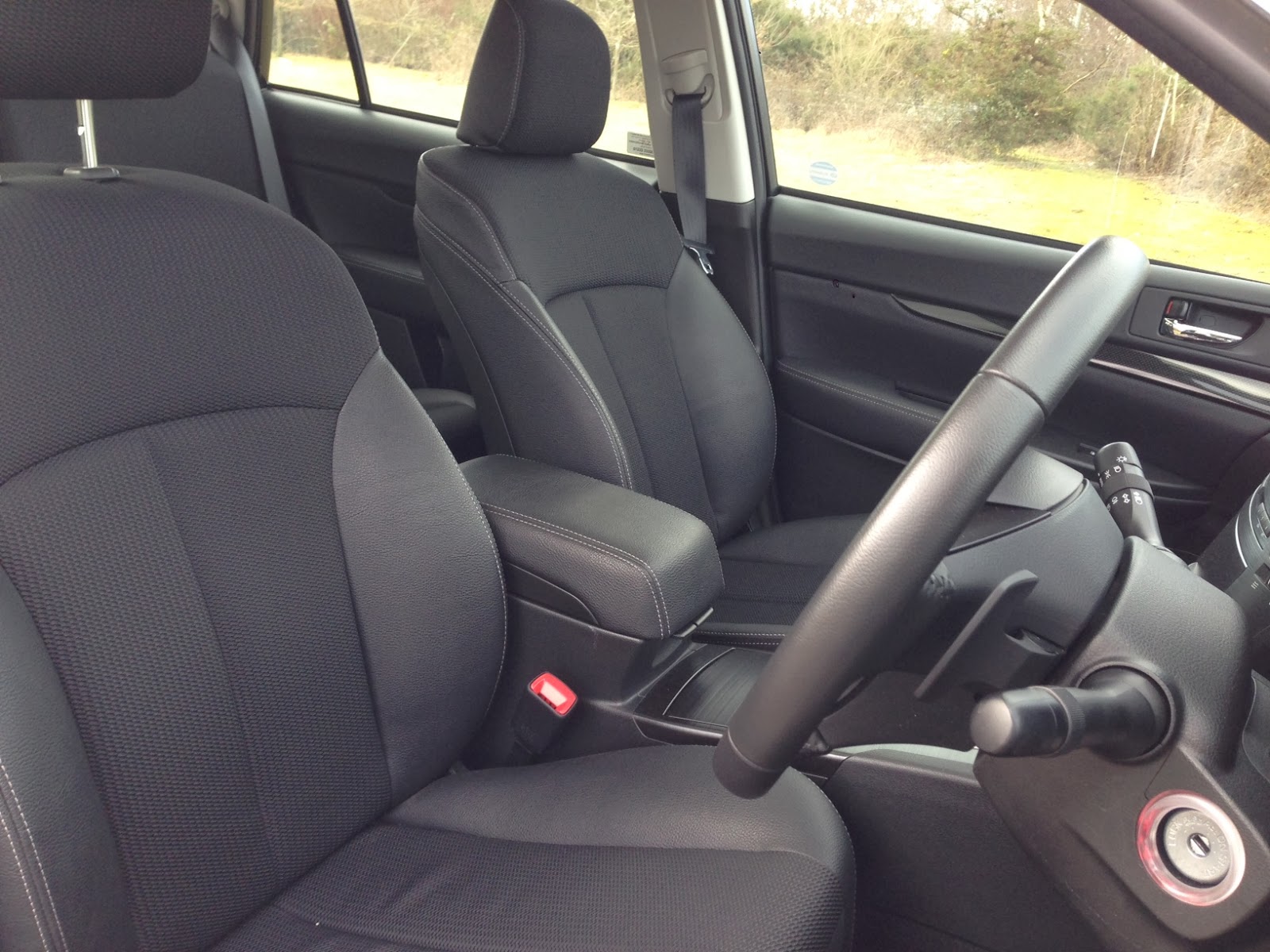
2014 Subaru Outback interior

The ignition requires the insertion of a key, which is becoming something of a rarity in modern cars.  Turn the key and the flat-4 diesel fires up.  You would expect it to sound like a flat-4 but it doesn't.  It sounds like any other 4-cylinder diesel.

The CVT gearbox feels like any other automatic gearbox.  You can use it as a fully automatic or use steering wheel-mounted paddles to shift through seven 'gears'.

It's one of the better autos mated to a diesel engine on the market.  Kickdown, gear changes, engine revs are all fine.  You never get the feeling you'd do much different if you were using a manual gearbox.  It can be a tad lazy sometimes but generally it is a superb unit.

The engine might not sound different to most other diesels but it does feel slightly different to use.  Turbo lag is almost non-existent and most of the power comes early in the rev-range.  It's got 148bhp and 258 lb ft of torque which is enough to take it from 0 to 60mph in 9.5 seconds.

The engine and gearbox combination suit it well.  There's more than enough power to pull away from the lights sharply, and to overtake.

The official fuel consumption figure is 44mpg combined.  In a week of varied driving over hundreds of miles it did 38mpg, which is pretty good for a 1,600kg car.

The driving experience is better than in an SUV.  Whilst it might ride quite high most of the weight is low down (having a flat-4 engine helps) so it goes round corners well.

In fact it feels much like the old Outback to drive.  The combination of long car with low centre of gravity and a relatively short wheelbase makes it feel nimble.  I had some good fun throwing the Outback around roundabouts and back roads.

It's in the driving experience where the Outback connects with its predecessor.

It'll off-road too, with permanent four wheel drive and ground clearance aplenty.

The 2014 Subaru Outback is a gizmo free, practical, economical, spacious and loveable car.  Yes, loveable.  I bonded with it just as much as I did my old Outback.  I forgave its foibles and enjoyed it for what it is, a no-nonsense load-lugger that rewards you the more you drive it.

It's a better bet than almost any mid-size SUV.

Thoroughly recommended.

Stats:


Price: £31,495
Engine: 2.0 turbocharged diesel, flat-4
Transmission: CVT automatic
0-60mph: 9.5 seconds
Top Speed: 120 mph
Power: 148 bhp
Torque: 258 lb ft
Economy: 44.8 mpg
CO2: 166 g/km
Kerb weight: 1,573 kg
2014 Subaru Outback

2014 Subaru Outback

2014 Subaru Outback

2014 Subaru Outback

2014 Subaru Outback

1998 Subaru Outback in red and gold


Review by Matt Hubbard


3 Feb 2014

2014 Subaru Outback 2.0D SX Lineartronic - Short Review

I've got 2014 Outback on loan for a week.  Here are my first impressions.

2014 Subaru Outback

I have to state that I love Subaru Outbacks.  I've owned two (a '99 auto and an '01 manual) and remember both fondly.  It's one of those cars that was seemingly thrown together by the manufacturer in order to try something new but happily turned out to be the perfect car.

The old Outback took a Legacy estate, jacked it up somewhat, added plastic body panels in a different colour, gave it twin sunroofs and a better interior with half leather, half suede seats.  It was four wheel drive, as was the Legacy.

The current Outback is still based on the Legacy but some crucial details have been changed.  The body panels are now colour coded, it only has one sunroof, the windows have frames (the old ones were frameless) and it has a diesel engine.

It's still four wheel drive though, and has a 220mm ground clearance - more than a Mitsubishi Outlander.

I asked Subaru if I could borrow an Outback because it used to be the perfect alternative to an SUV and I wanted to find out if it still is.

I suppose the frameless windows had to go but the old, unique, sound it made when a door was closed has now gone and is replaced with a generic thunk.  The colour coded bodywork and lack of twin sunroofs are less forgivable.  They were an essential part of the Outback repertoire and as such the latest model looks a tad too same-same.

It does succeed, though, in making most SUVs seem irrelevant.  It's a superior car on the road to any other jacked up mid-sized 4x4 and, with it's ground clearance and four wheel drive, is just as good off-road as most.

Add to that the huge boot and oodles of legroom in the back and it provides a pretty compelling alternative to the discerning motorist who wants lots of space and occasionally has to drive across a muddy field.

The 4-cylinder boxer engine is fine and has plenty of grunt.  Its 150bhp is the same as in the old 2.5 petrol engines but this model is heavier so it does feel as though an extra 20bhp would come in handy.

The Lineartronic gearbox is a CVT (continuously variable) unit, but you would't know it.  It feels like any other slightly lazy auto but with a reluctance to change up sometimes.

The only let-downs (aside from the singular sunroof and bodywork) is that the seats are pretty awful and the info screen and entertainment system lacks when compared to its competitors.

It can't be hard to make seats that are comfy and supportive. The old Outback had superb seats but this one's squeeze and support in all the wrong places which, after a journey, left me with a bad back.

Subaru haven't bothered with a satnav or digital radio.  The info screen is tiny and the Bluetooth is impossible to work.  If you forget to bring your smartphone cable to connect it up you have to listen to FM (stone age) or a CD (prehistoric).

Otherwise it's as ace as the old Outback.  Oh, and so far it's returned 37mpg which is a lot more than the old petrol model.

I'll follow up with a full review soon.

Stats:


Price: £31,495
Engine: 2.0 turbocharged diesel, flat-4
Transmission: CVT automatic
0-60: 9.5 seconds
Top Speed: 120 mph
Power: 150 bhp
Torque: 258 lb ft
Economy: 44.8 mpg
CO2: 166 g/km
Kerb weight: 1,573 kg
2014 Subaru Outback

2014 Subaru Outback

2014 Subaru Outback

2014 Subaru Outback

2014 Subaru Outback

2014 Subaru Outback

2014 Subaru Outback

By Matt Hubbard


22 Nov 2013

Subaru at the Tokyo & LA motor shows

Graham King looks at what Subaru has brought to the Tokyo and LA motor shows

Subaru’s been busy this week with major launches in both Tokyo and LA.

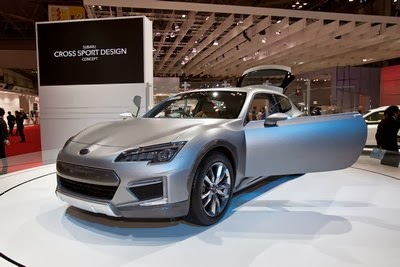
First up is the Cross Sport Design, a compact SUV concept. I don’t know about you, but to me it looks a lot like a ruggedised BRZ shooting brake. Perhaps now that Toyota has the convertible FT-86, Subaru will get its own spin-off?
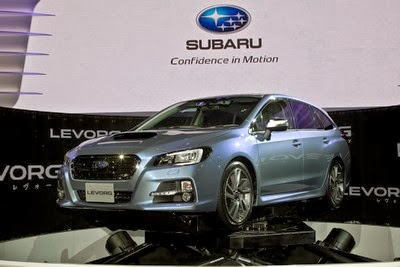
The Levorg goes on sale in Japan early next year. Power comes from brand-new 1.6- and 2.0-litre direct-injection, turbocharged flat-four engines, developing 168bhp and 296bhp respectively. I’m assuming it’s spun off from the same platform as the new WRX, which we’ll come back to: it seems to be a similar size and the front is more-or-less the same.

Meanwhile in LA...

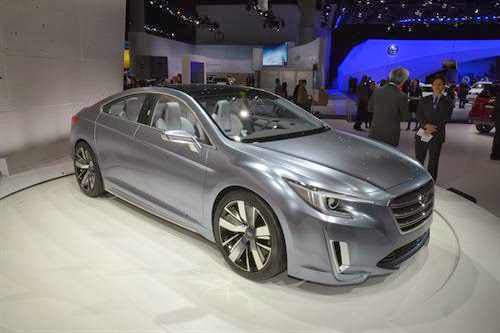
The clue is in the name of the Legacy Concept: it’s the concept for the next Legacy. Behind the motor show glitz, the basic shape seems realistic enough. We’ll find out when the production version breaks cover at some currently unspecified time.

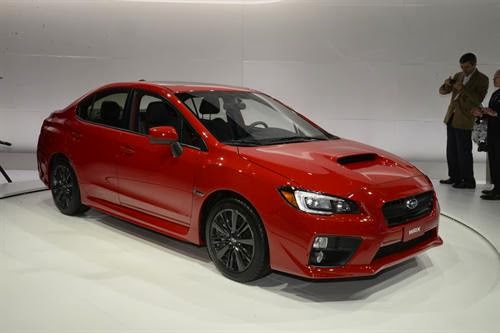
The big news from Subaru is of course the new WRX. Mechanically it’s more of the same, with a new 2.0-litre, direct-injection turbocharged Boxer ‘four’ putting out 268bhp. Symmetical All-Wheel Drive, Vehicle Dynamics Control and Active Torque Vectoring keep everything under control. But all that has been largely ignored, because every hack in the world has been banging on about the WRX’s styling.

I won’t deny that it’s a bit dull-looking and doesn’t live up to WRX concept from earlier this year. But that was a coupe and the production car is a saloon, of which there’ll be much more prosaic versions. So, while there are elements of the concept about the front, the rest of it was always going to be very different. And besides, with the exception of the late-Nineties two-door, it’s not like any other WRX was ever a looker.

Article by Graham King


24 Sep 2013

Vauxhall Astra VXR vs Subaru BRZ - shoot out

I've spent a few days and driven a good few miles with each of the Vauxhall Astra VXR hot hatch and the Subaru BRZ coupe.  It's time for a face-off.  It's time for Astra vs BRZ.

Round 1 - Is it a sports car?

This is a tough one.  The Subaru looks like a sports car, but the Astra is faster and outperforms it on the track.  The BRZ gives away 76bhp to the Astra, however it's also 150kg lighter.  Both have limited slip differentials with the Astra's on its front driven wheels and the Subaru's at the back, because it's rear wheel drive.  Both have 6-speed manual gearboxes but the BRZ's is better.  The winner is the BRZ because it feels more like a sports car.

Winner - BRZ

Round 2 - How fast does it goes Mister?

The Astra has 276bhp and does 0-60mph in 5.9 seconds.  It also has a top speed of 155mph.  The BRZ has 200bhp and does 0-60mph in 7.6 seconds.  Its top speed is a measly 143mph.  The Astra's turbo makes sure it outperforms the BRZ's naturally aspirated boxer engine in every speed and acceleration test.  Both cars LSDs ensure they get away from the line like a scalded cat.

Winner - Astra VXR

Round 3 - Can you drift in it?

The Astra sticks to the road like glue.  It has torque steer in the first 2 gears but otherwise its front wheel drive, slightly nose heavy configuration, allied with decent tyres, mean it refuses to oversteer unless pushed very hard.  The BRZ will oversteer if you ask it even very quietly.  Sure it doesn't have enough poke to hang its tail out in anything above 3rd gear but at lowish speeds the BRZ makes even a rubbish driver look like a drift king.

Winner - BRZ

Round 4 - Would it be any good as a race car?

In my review I said the Astra VXR is so planted to the road and so damn fast it felt like it could compete in a BTCC race in standard trim.  Obviously it would get slaughtered but it really does feel super-fast.  It doesn't waste any effort in getting up to speed and getting round corners.  The BRZ would be a bit of a comedy effort - it's light but its engine would need beefing up to race, and the tyres would need swapping out for a set of sticky slicks.  The Astra wins, but the BRZ's gearbox is better.

Winner - Astra VXR

Round 5 - Do people stop and stare at it?

Both cars attract stares, but from different crowds.  Petrolheads stare at the Astra because they know it is such a potent, but slightly unfashionable car.  Most 'normal' people don't give it a second look.  The BRZ is such a pretty little thing, and it's a coupe.  It gets stared at by most people with a passing interest in cars, and people with an eye for beauty.  The fact it almost looks like a smaller Maserati GranTurismo doesn't hurt its chances.

Winner - BRZ

Round 6 - Does the engine sound any good?

The Astra VXR engine has an inline-4 and a turbocharger. It emits a low wuffle at idle and low revs which disappears on the go.  The BRZ engine is a naturally aspirated flat-4.  The Astra stands no chance.  The Subaru's engine isn't loud but it sounds great, as all boxer engines do.  Add in the fact the BRZ has a sound pipe which comes into the cabin just beside the clutch pedal and we have a clear winner.

Winner - BRZ

Round 7 - Is it practical?

The Astra is a hatchback with decent sized rear seats, lots of cubby holes and a big boot.  The Subaru is a coupe with a normal boot that's quite shallow because it's rear wheel drive, and tiny rear seats.  The Astra has an armrest and the Subaru doesn't.  Basically the Astra can carry 4 in comfort and you can put your dogs in the boot (although the lip is quite high and narrow) whilst the Subaru is strictly a 2+2 with space in the boot for a couple of squishy suitcases.

Winner - Astra VXR

Round 8 - What's the interior like?

These cars come from different philosophies, and from different continents.  The Astra's interior is European high quality and feels refined, but lacks a decent touchscreen.  The Subaru's interior is Toyota-spec and feels pretty cheap but has a touchscreen that does everything (bar DAB radio).  The Subaru's seating position, and seats, are better than the Astra's compromised hatchback position.  Ultimately though the Vauxhall floors the Subaru.

Winner - Astra VXR

Round 9 - What are the stats?

Astra VXR - Price £26,995, 0-60mph in 5.9 seconds, 276 bhp, 295 lb ft, 34.9 mpg, 189 g/km CO2, 1475kg
BRZ - Price £24,995, 0-60mph in 7.6 seconds, 196 bhp,  151 lb ft,  40.9 mpg, 181 g/km CO2, 1202kg

Winner - Subaru BRZ

Round 10 - Which one would you buy?

I drove the Astra first.  Once it had gone back to Vauxhall I asked myself that question and thought it was almost as good as the Renaultsport Megane 265.  Having driven the Subaru I've come to realise it wipes the floor with all the hot hatches because it was specifically designed for a purpose rather than adapted from a standard car.  The Astra is very good, but I'd prefer the BRZ as a daily driver and as a fun car - even though it's not as fast.  It's just more fun.
Winner - Subaru BRZ

The result

Vauxhall Astra VXR 4 points, Subaru BRZ 6 points

Subaru BRZ wins