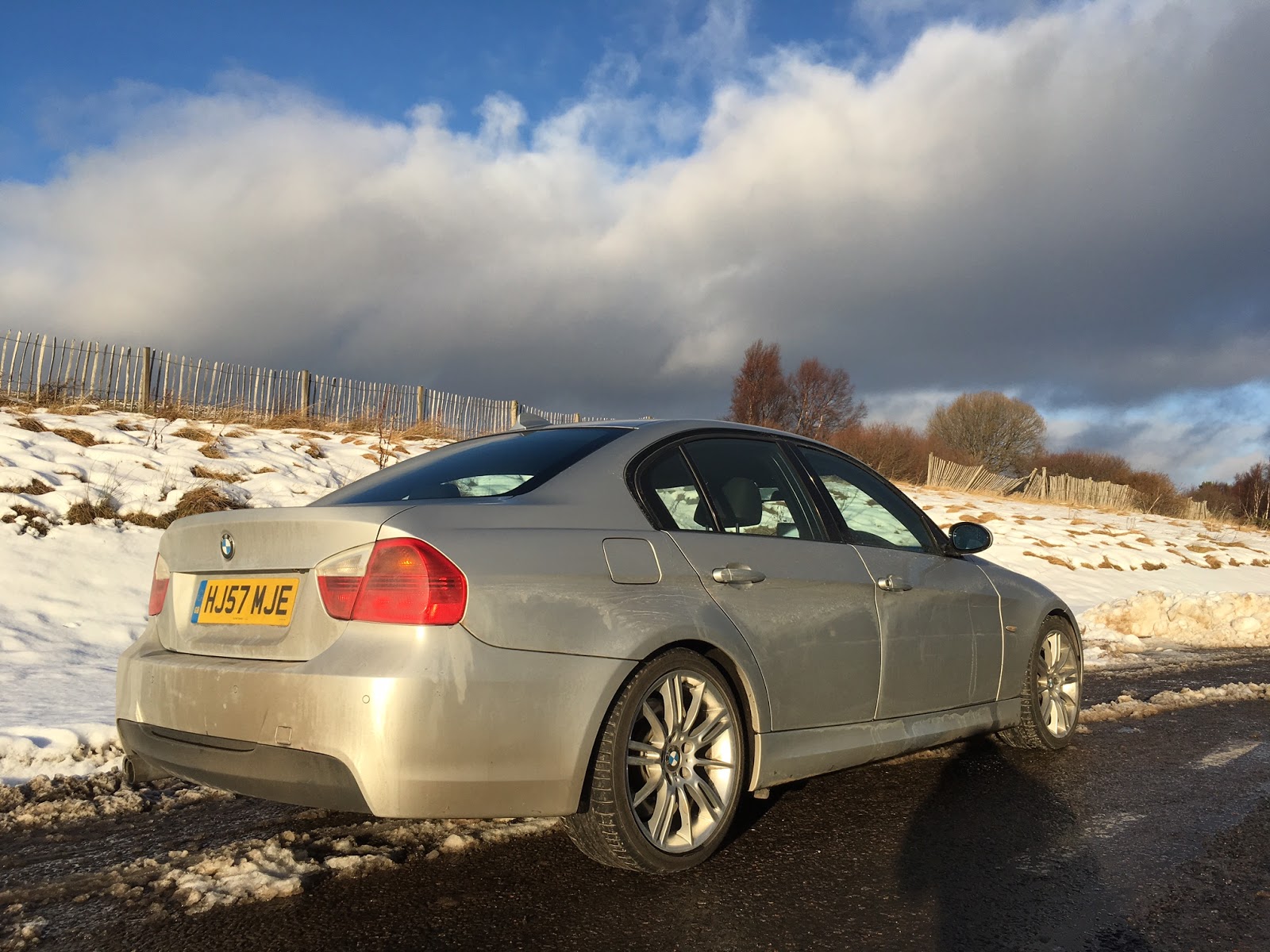
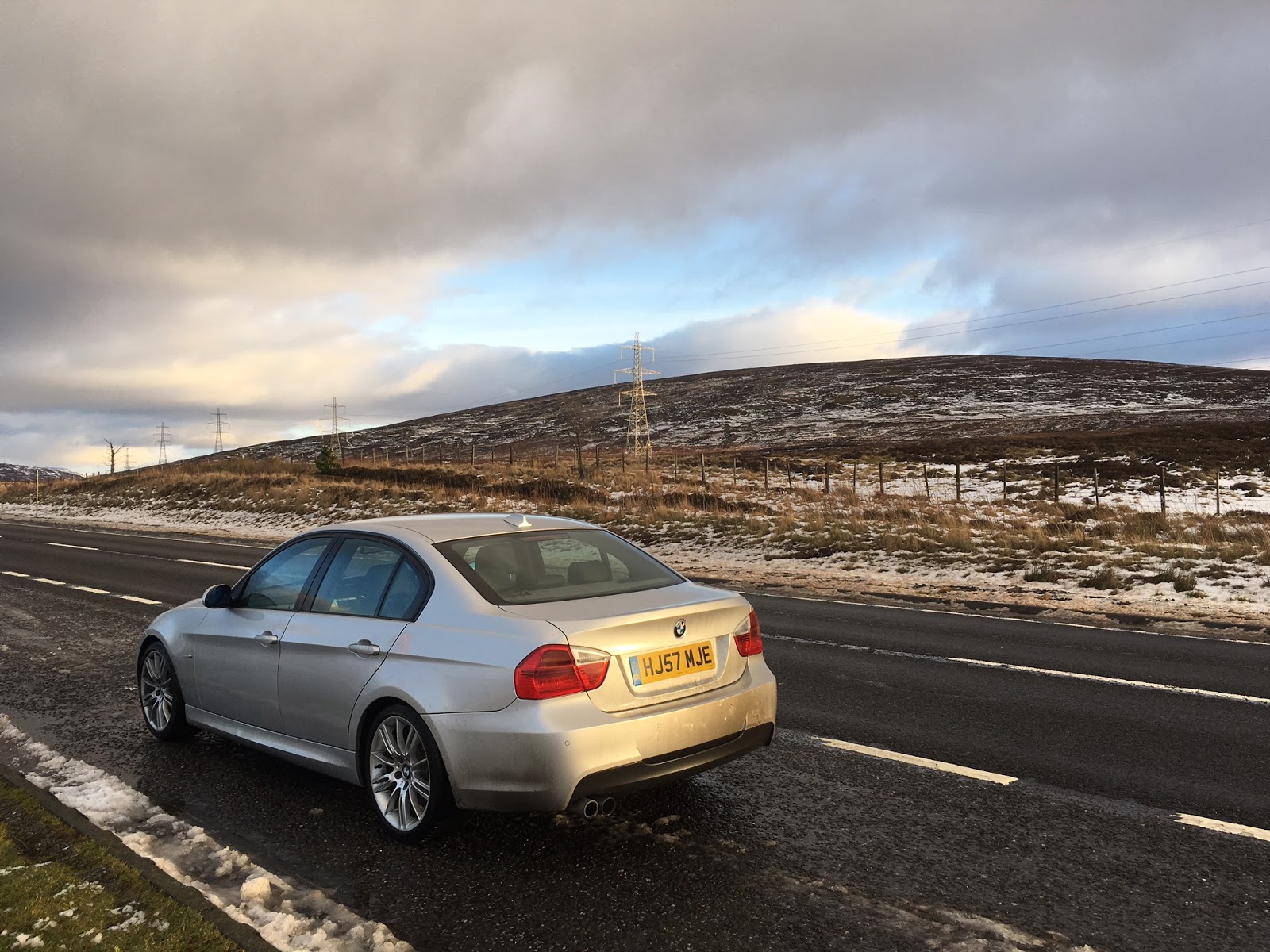
Showing posts with label Blogs. Show all posts

21 Jan 2021

Witnessing the aftermath of a horrific crash

 I left home early to get to Yorkshire in time for the survey I was due to attend. It had snowed the night before but though the garden had looked pretty in white at 11pm it had almost all melted by 7am. At 8am I was in my car, heating on, heated seat on, windscreen cleared. 

I reversed out of my drive and drove slowly down the road which was still covered with a patchy layer of white. It's a long cul de sac which sees little traffic, and slopes downhill to the end so whenever we've had snow or ice you have to be careful not to slide inexorably towards the scene of a collision.

Safely out of the village I hit the busy dual-carriageway A-road which took me eastwards. The sky was grey and the dirty water on the road was being kicked up by HGVs and large SUVs piloted by small people. 

Unavoidably two abreast at 50mph there were a few occasions when the sheer volume of spray caused by the intersection of juggernauts and Audi Q8s temporarily reduced visibility to nought. You hold your breath, slow a little - but not so much that the car behind panic brakes and causes a concertina crash - and cover the brakes. 

The journey continued in this vein until I reached the motorway. The M56 east and then the M60 heading past Stockport and eventually north around Manchester and towards the M62.

The skies were clear but the spray continued to impede vision. I would avoid the SUVs and HGVs wherever possible. Some people drive right in their wake, seeing nothing but giant tyres and a dirty cloud of spray. I hold back, wait for my chance to pass. Visibility is key in these circumstances. You need to understand what other drivers are doing, what you think they are going to do, where they are going, whether they are on their phone, in a temper, in a dream.

One large woman in a red Fiat 500 with wheel trims sat on my bumper for a mile. I could not move over due to traffic, would not speed up due to spray and could do nothing but keep my eye on her and anticipate what she might do and what I could do if a hazard ahead caused an emergency brake. Eventually I moved left and she passed, her eyes looking down at something on the dash instead of the road, to do the same to the next driver.

We were all happily moving along at pace when I saw a disturbance ahead and to my left. I was in lane four and something was going on. I could detect it in the micro-movements of vehicles around me

I slowed a little to avoid debris in the road, a piece of black plastic. Then an articulated lorry moved across from lane two and went to stop, blocking lanes one and two. Everybody was slowing. My mind was in emergency mode. Time slowed.

I saw a car, a white or silver Honda I think. Only its passenger side still existed. It had hit been hit at an almighty speed by something unstoppable. It was stationary and facing towards me on the hard shoulder. The HGV that had swerved had been blocking the road to stop traffic from getting close. This was deadly serious. Whoever had been in the Honda must be dead. I knew it.

Maybe five cars were stopped by now. People were racing to the remains of the Honda. There were enough on scene. Me stopping wouldn't help anyone. I carried on.

I couldn't get the thought of the Honda out of my mind. I thought about all the people impacted by losing a loved one. I thought about a pet dog waiting for its mum or dad to come home. I thought about children who did not yet know a parent had been killed.

I forgot the name of everyone I was at the survey with. I kept having to look at my notes. My brain was numb. I've never seen anything like that before.

I drove home in the afternoon in even worse conditions. The stupidity and arrogance of dozens of drivers in sleet and freezing rain amazed me. I beeped my horn at several who just drifted across lanes because they were on the phone.

And all day I thought of that Honda. 

I got home and checked the North West Motorway Police twitter account. They mentioned it briefly. People who had seen the crash were distraught. One lady and I who had seen it comforted each other. Another lady said her son was in the car and she was worried how he would be at school after having seen it. One man wrote "Went past just after it happened. Loads of public literally ripping the roof off the car. Hope everyone is OK."

Literally ripping the roof off the car.

As with everything I will eventually forget what I saw, but the family of the victim(s) won't. And neither will their pets.

By Matt Hubbard


23 Jan 2020

Cars - A Manifesto

The car is under attack. Politically, socially and environmentally it is hated by a certain type. A certain type that is vocal and has people in power and the mainstream media on their side. The bureaucrats, the cyclists, the zealots and the Followers Of Greta. People in positions of power look down their collective noses at the plebs in their tin boxes. Ordinary people should take the train they say. Ordinary people should cycle they say. Ordinary people belong on buses they say, as they tap their chauffer on the shoulder and are whisked off to yet another meeting about how to stop the masses thinking for themselves.

The printing press allowed people to be educated. Before the printing press only monks and scholars would read. Books were written but copies could only be created by hand, painfully slowly. Johannes Gutenberg’s printing press in the 15th century allowed information to be shared and ideas to be spread amongst the general populous. It provided for a step change in human evolution and ushered in the Age of Enlightenment which in turn provided the foundations for modern society.

Similarly the industrial revolution, the invention of the aeroplane and air travel, the creation of the internet and, of course, the automobile provided similar Gutenberg revolutions.

It was the creation of the automobile which allowed society to move beyond the physical restrictions of their origins. The farm and factory workers of the 19th century could only travel overland by walking or by horse for their work, to visit relatives, to explore the world outside their immediate environs. The introduction of the train in the latter part of the 19th century allowed for faster travel but it was incredibly restrictive in terms of where and when the trains ran.

Humans have to work around the train network, while cars work around the humans who drive them. Trains start and stop in predetermined locations at predetermined times - even if that is inconvenient. That has always been and is still the main issue with trains. I can drive the 20 mile journey from home to work in 30 minutes outside of rush hour and 45 minutes during rush hour. Using public transport would involve a one hour walk to the train station followed by a 53 minute journey on one train, a 16 minute journey on another train and a 10 minute walk from the station to the office. 45 minutes in the car versus 2 hours 20 minutes on public transport.

The car revolutionised society in terms of where we live, where we work, where we shop, the shape of our houses, the shape of our roads, the size and shape of our towns and villages. The car improved our lives beyond the imagination of the most forward looking Victorian. It changed how we dress, how we meet partners, how we spend our time, how fast we can access medical facilities. It made every single aspect of our lives better.

And yet we are told in the 21st century that cars are somehow bad. That cars are killing us. That we should move away from the car and into the various forms of mass transit that are provided for us by the benevolent state. Mass transit, don’t forget, that can’t even pay it’s own way. That is massively subsidised by people who don’t use it for those that do. Car drivers are paying for train users. The local butcher driving to work in a village in Lancashire is paying for the London banker, who earns ten times more than him, to take the train to work.

Why do the anti-car crowd adopt this mindset? It’s been coming for a long time. It wasn’t long after the invention of the car that someone was killed. In 1869 Mary Ward was riding in a steam car built by her cousins when she fell out on a bend and was run over. She died immediately. Nowadays around 1.25 million people per year die on the roads. In the UK it is around 1200 a year. This is a seemingly intolerable number, until you think about the benefits that cars bring to society and how many lives would be lost were cars not to exist.

Yet cars are becoming ever safer. Crashes become ever more survivable. In 1973 a journalist called Richard S Foster could see the direction that safety legislation was heading and wrote a short story called A Nice Morning Drive, published in Road & Track magazine. It was a prescient piece which described a society where cars had become 2700kg MSVs - Modern Safety Vehicles - which were designed to withstand 10mph head on impacts undamaged. The drivers of these MSVs become lazy and stupid and the crash rate increased by 6% every year, to which the legislators decided that shortly in the future MSVs would have to withstand 110mph head on impacts undamaged.

When asked why modern cars are so big and heavy a VW executive is reputed to have said that if you were to remove the entire safety and emissions components from a Touareg and place them on the floor next to it you would have something of the same weight and cost as a VW Up! Modern cars aren’t becoming MSVs, they already are.

Legislation drives safety regulations. It dictates the shape, height, weight and cost of our cars. It bulks them out and it beefs them up. Small cars have to be designed to withstand the impact of a 2.7 tonne Range Rover Sport. So they become less small and less cheap and more ugly.

All of this is done in the name of safety yet the humans who drive these increasingly huge and heavy cars receive no training and are not penalised for antisocial, dangerous driving. We are increasingly policed by camera and computer which catches only those who don’t pay their tax and drive a little too fast. Meanwhile the drunk, the drugged up and the frankly stupid get away with it.

In August 2019 Harry Dunn was riding his motorcycle when an American diplomat called Anne Sacoolas, driving on the wrong side of the road, smashed into him head on in her Volvo XC90 SUV. The XC90 weighs 2300kg and is pretty much the safest car on the road. Unless you’re outside it and have been smashed into by it. Then it is absolutely, catastrophically deadly. Sacoolas fled the country and escaped justice.

But what punishment would she have received? On 8 March 2018 the journalist Henry Hope Frost was riding home on his motorcycle when he was hit head on by a taxi driver called Tahir Mehmood who was driving his Toyota Prius on the wrong side of the road. Mehmood was found guilty and received a £670 fine and sentenced to 200 hours unpaid work.

The state controls every aspect of cars and car safety but allows complete idiots to drive cars on the public roads and when they kill other road users they get away almost scot free.

We need a government-led campaign of compulsory education and training. Driving should be a privilege enjoyed only by those competent enough to engage in it without endangering the lives of others.

And then we turn to the other issue of the modern age. The environment. Cars are bad for the environment, they say. Therefore cars should be banned. I tend to the persuasion that I will listen to arguments on all sides before forming an opinion. Some people are unable to do this. In the 21st century we in the West live in secular societies. Religion, which once bound the populace together and formed our structures, laws, meaning and entire reason for being, is gone.

Some people are simply unable to exist without a belief system that guides them, leads them and tells them how to think, behave and organise their lives. These people have been looking for a new Messiah and they have found one. In fact they’ve found several. The teachings of Marx, Greta Thunberg and political organisations such as the European Union as well as an ideological view of the world where people are designated good or bad by their race, sexual orientation, class, heritage and thoughts. Let’s call them Lemmings.

Let’s digress for a moment. Back to New York in the 1870s. Just as the car was being invented, but hadn’t yet become popular. New Yorkers were taking over 100 million trips a year by horse and by 1880 there were 150,000 horses in the city. Each horse would excrete 10kg of manure per day. That’s over 100,000 tons of manure and 10 million gallons of horse urine per year on New York city streets. Whatever we use for transport is polluting in some way. It is unavoidable.

Back to the present and in 2019 a man called Harry Miller was visited by police at his work place. He was told he was being investigated for transphobic hate crimes in the form of a tweet he had written which contained a limerick. When asked if this was actually a crime he was told it was not. The police then told his co-workers he was ‘dangerous’.

This Lemming mindset has infiltrated all aspects of the establishment. The police, the academia, the civil service, large and medium corporations, HR professionals, the press, silicon valley and the heads of all quangos and government organisations. And it is an inherently anti-car mindset. Cars represent freedom and individuality of the individual. In a car you can go anywhere you want at a reasonable cost.

The Lemmings do not like this. The EU bureaucrats, the Whitehall mandarins, the cyclists, the Cult Of Greta and the Town Planners say that cars emit so much CO2 that it is causing the earth to warm at an unprecedented rate and that because of that all cars need to stop polluting immediately or else the earth and all life on it will die (despite the fact that 400 million years ago CO2 levels in the atmosphere were five times higher than they are now).

And so the Lemmings who are in charge of writing the regulations that we must abide by have created a system of laws where in order to meet their stringent, legally binding, emissions targets cars are becoming yet more large, heavy, expensive and boring. And small cars are, perversely, persecuted even more so by the Lemmings and are being subject to such massive fines that each VW Up! sold in the EU in 2020 will be subject to a £2,400 fine.

So the buyer of a 950kg car with a 1.0 litre engine is punished far more than the buyer of a 2700kg car with a 3.0 engine, and a hybrid electrical system - which pays no fine because it can travel 30 miles on electric power.

Meanwhile standard petrol and diesel cars are becoming cleaner and cleaner all the time, without the ‘help’ of the State and its Lemmings. Each car would require less energy and less material to create were it not for having to fulfil safety and emissions regulations which mean that each car that is created uses a whole lot more energy, materials and rare earth elements.

It is as if they are doing it for political reasons rather than for safety and environmental reasons. The socialists in plain clothing who create our laws are moulding a society where the car is becoming so expensive, so vast, so ridiculous and so technologically advanced and therefore disposable (just like all other modern tech) that they can then criticise cars for being vast, ridiculous and polluting. They can demonise the car for being the thing that they created.

And think of all the other areas where cars have been marginalised. Town Planning creates towns and cities that are so car unfriendly that cars become stranded in islands, trapped between red lights, ultra low emission zones, single occupancy lanes and fast disappearing car parking spaces. New houses are built with too few spaces and more and more new houses are built with allocated parking. Allocated parking is a hideous modern invention which removes the car and the house from each other so that the car is emotionally removed from the occupant. It is out of sight and unloved. Bought as a commodity to provide cheap, convenient transport, then left out of sight and out of mind. It's almost as if this is done on purpose by the people who design our housing...

Private car drivers are being banned and priced out of towns and cities whilst the rich and the Lemmings are happy that the roads are quiet so they can let an Uber take the strain whilst a white van delivers their new kitchen, fresh scallops to their favourite restaurant and huge, polluting HGVs build the massive, dehumanising, concrete and steel skyscrapers which make metropolitan liberal elite even richer and happier.

So now cars cannot fit in standard parking spaces because they are too big and cannot be driven on roads in cities because for years transport planners have spitefully created a road network which penalises cars.

Reducing CO2 is a reasonable aim and one that can be achieved with proper planning and regulation but because those who have created the regulations hate the concept of the private car they have created a system which will destroy it if it goes unchecked.

CO2 can be reduced by making cars smaller and lighter and more efficient. Safety can be achieved by technology other than airbags and crash structures and more and more heavy steel. Carbon monocoques can protect occupants and education can prevent crashes from happening in the first place rather than making all cars withstand all crashes.

People will not be able to afford cars. They will not be able to insure cars because the car insurance industry is a corrupt scam. They will not be able to fuel cars because 65% of the price of fuel in the UK is tax, which pays for trains and buses. They will not be able to drive cars in places where they need to because they will be banned or priced out. They will not be able to park cars because they will not fit in the spaces available. Cars provide social mobility because they are cheap and convenient.

We are told electric cars are the future. But electricity storage is hopelessly backwards in terms of energy intensity compared to fossil fuels, and to hydrogen. Electric cars are even heavier than conventionally fuelled cars yet have tiny ranges and hopelessly long ‘refuelling’ times. 75% of the mass of the entire universe is hydrogen. And if used as a fuel it emits nothing more than water vapour from the exhaust pipe. Yet as a fuel it is marginalised. Hydrogen should be the future of transport but is ignored by the Lemmings because hydrogen is too conveniently ‘good’.

Motoring journalists are, one by one, being stricken with Stockholm Syndrome. They are starting to revere and praise the very thing that will kill off their profession - the electric car. They are given electric cars to test and they report back that this week's model is fast, refined and comfortable and, yes, the range is small and, yes, it takes forever to charge and, yes, a lot of the chargers don't actually work and, yes, costs twice as much as a petrol car and, yes, could be seen as impractical but as petrol and diesel cars will kill us all then we'll all learn to love them.

It’s a war being waged by them against us. By those with an ideology that favours their belief system - that of a weak mind - over yours and mine. They despise us and they do not want us to have the freedom that the car provides. They want to price and regulate the car out of existence for their own political ends.

For the first time in human history we are being told to go backwards. To devolve instead of evolve. To travel less and to do less. We are being told to take the bus when there is no bus available from where we are to where we want to be, and we are told to take the train when the train costs five times more than the car for the same journey.

But there is a light at the end of the tunnel. The people are fighting back. The people are getting sick of the bureaucrats and the Lemmings and the elites. The people are voting to rid themselves of the EU, to reject Marxism and to embrace a new, populist capitalism. We need to make clear to our politicians what we think. We need to keep a check on them and make sure that they continue to support the car. To spend billions of pounds on roads instead of railways.

The car is the device by which people were freed from the chains of poverty. And long may it continue. Because if it doesn't we will all be in trouble.

Footnote - The song Red Barchetta by Rush is based on A Nice Morning Drive


By Matt Hubbard

26 Sept 2019

A Tale of Golf, LSD and Chinese Rubber


A couple of years ago I owned a Golf R with the DSG gearbox. I sold that and bought a BMW for a few months as an interim measure, and then in spring this year bought a 2013 Mk7 Golf GTI with manual gearbox. The GTI is a Performance Pack model and comes with a limited slip differential and a few extra hp over the standard GTI.

It has 230bhp and 258lb ft of torque which is more than enough for a front wheel drive car. I've done several thousand miles in the GTI, and did Land's End to John O'Groats in one day in it. 852 miles in 15 hours. It proved itself fast and comfortable.

Despite being less powerful than the Golf R, and only being front wheel drive rather than four wheel drive I've enjoyed driving the GTI far more than the R.

The cars are almost identical inside, though the GTI has leather seats where the R had cloth. The ride is very similar - well damped if a little harsh on bumpy surfaces. Driving at pedestrian speeds you'd struggle to find any difference in the cars aside from the gearbox.

But put your foot down and the differences between the cars show themselves. The R was insanely fast and gripped like a limpet. It was fitted with Pirelli P Zeros and would corner well with little slip. It would understeer under power but this was controllable. I toured all round Europe in it and it was never less than fast and fun.

But when I first drove the GTI I realised what the R was missing. Soul.

The GTI has more power than grip available. This means you have to work with the car to apply the power so it's not lost through slip and spin. In the dry you can be quite rough with the throttle. It would wheelspin in first and second gears. In corners you could feel a tiny slip of the inside wheel before the LSD locked the axle and both wheels would pull at the same speed.

Combined with the precise manual gearbox it was an absolutely involving joy to work with.

Until it rained. In the rain it was a menace. And this was because when I bought the car it was fitted four brand new Chinese tyres, or ditch finders. And when the roads were wet their ability to clear water and find grip was found rather lacking.

In the wet you could spin the front wheels in third gear. I've had wheelspin, and sideways slip, on an open Scottish B-road at speeds in excess of 70mph. Exhilarating and scary at the same time.

It got to the point when it just wasn't funny. On a motorway roundabout I poked the throttle on a wet day and, because the locking diff did its stuff, both front wheels just span and caused the car to understeer halfway into the next lane.

So I finally got round to fitting some decent tyres and what a difference they made!

Last weekend the GTI was treated to a fresh set of Goodyear Eagle F1 Asymmetric 5s and, by heck, they're an improvement. It's rained almost constantly since and I've driven around 100 miles largely on the country lanes between home and the office.

In the wet the Golf is now an absolute joy to drive. You can feel and control sideways slip. It still spins and first and second gear but in third it holds on to the road. You have to ease the power on, be careful changing from first to second and concentrate hard as you reach the red line - a small crest or patch of shiny surface can cause wheelspin.

But it's predictable now whereas with the ditch finders it would just be hopeless. In a corner when you push on the power you feel the LSD engage and you use it's action to pull the car round the corner. It'll still understeer if you're brutal with the throttle but that's the point. It is involving and you have to use your skill and ability as a driver to get the best from it.

The R is sold as a more prestigious model than the GTI but the R is digital whereas the GTI is analogue, and I prefer analogue.

By Matt Hubbard


2 Jul 2019

Land's End to John O'Groats In One Day In Three Epic Cars

I had been driving for three days non-stop and had covered 1500 miles. On that third day I had left the northern coast of Scotland at 9.30am. I only crossed back in to England at Gretna at 5.30pm. I was completely worn out but still had three hours driving that day, and four more hours the next day...

Scotland is huge. Far larger than you imagine. I've visited it many times and you can get really lost in the place. You do see other people but not very often. Unlike most of England northern Scotland is not flat. In fact it undulates quite a lot.

The result of this is that the roads are half empty and twist and turn with the scenery. And because Scotland is an exposed, windswept place and wasn't part of the UK when the Inclosure Acts were in place farmers weren't forced to create small fields with high hedges around the outside.

And this means you can see where you're going. Which means that driving round Scotland for fun is a really enjoyable experience. If that's your kind of thing.

I don't need much of an excuse to head to Scotland for a drive. And neither does Hannah, a friend who would visit regularly in her Porsche, and then decided she would actually move there earlier this year. So she sold her house in the Home Counties and bought a converted church in Moray.

We had both previously driven from John O'Groats to Land's End in one day and thought it would be a good idea to do the trip again, but the 'proper' way round and in the summer. And this time we would do it in convoy.

So we set a date - the last weekend in June - and asked if anyone else would like to do the trip with us. One person answered the call. A chap called Pete, from Hull.

Hannah organised the accommodation and I organised the route (it wasn't hard, there really only is one way to do it) and we drove down to Cornwall. We met Pete and headed to the excellent Old Success Inn in Sennen Cove for dinner and a pint. We all gelled and discussed the day ahead.

I suggested we start at exactly sunrise - 5.16am - and attempt to get to John O'Groats before sunset at 10.24pm. We all agreed. With an early start ahead of us we headed for an early night.

Land's End

Through thick fog the three of us met at the Land's End visitor centre. We took a photo at the famous sign post and drove the cars around to the front of the centre, under the big sign, for photos and the start.

All three of us are petrolheads and our cars reflected this. Hannah drives a Porsche Cayman GT4, Pete a BMW M2 and me a Golf GTI. My GTI is a 2013 model with 230hp and a limited slip differential. The other two have a lot more power and are rear wheel drive!

I've owned the Golf since March and have really grown to like it. The LSD makes a huge difference and the power feels plenty for a front wheel drive car. The dealer who sold it me fitted it with brand new tyres which is great but they are a cheap Chinese brand which are not great. They're fine in the dry but in the wet are about as effective as Diane Abbot in a maths exam.

At 5.16am precisely we started. We were all absolutely buzzing. Despite the fog visibility was reasonable and we enjoyed careening round the Cornish lanes. Within a couple of hundred yards you are on the A30 but at this point it is a single lane and very twisty. I led and drove as fast as felt safe.

After the rush of the lanes we arrived in Penzance. At this early time the roads were almost deserted and we made good progress. I was in the lead and was taking the racing line where possible - white line to white line, cross the middle line where visibility allowed - to keep efficiency up.

We passed urban areas of Cambourne and Redruth where the A30 is more dual carriageway than motorway with roundabout after roundabout. 

That this trip was a convoy meant I had others to keep an eye on but it was apparent after a very short amount of time that Pete and Hannah were expert drivers. We were flowing well. We all indicated when necessary, kept appropriate distance without lagging too far behind and had good lane discipline. 

I had created a 22 hour, 291 song playlist and as we hit the open countryside - hardly visible in the fog - Gimme Shelter by the Rolling Stones was playing at max volume. My eyes were on stalks, checking for any hazard. 

Hannah was running in the middle of the pack and her GT4 looked epic in the mirror.

We had been messaging each other before the trip on WhatsApp and I thought I'd see if we could use the app to make a three way call. It worked and we chatted away about the roads, how happy we were to be finally underway after talking about the trip for months and about when we'd need to stop. 

None of us had set off with a full tank of fuel. From full my Golf will has a range of 400 miles on a good run but the Porsche and BMW would only manage 300 miles, and probably less at a decent pace.

As we passed through Cornwall and into Devon the fog lifted and we were greeted by fantastic views and open roads. We decided to by pass Exeter services, which are bloody awful and very expensive, and stop at the next.

Which turned out to be Cullompton. We fuelled up, bought food and drinks and left again at 7.20am.

I have never in my life travelled the length of the M5 and M6 without being stuck in traffic at least once but the next few hours were a dream. We saw other cars but the roads weren't busy. Amazingly the other driver's lane discipline wasn't too bad either.

We continued driving in tight formation, taking it in turns to lead, to be in the middle and to hang at the rear. Both the M2 and GT4 looked great in my mirrors and through the windscreen.

I was still on a high. Energy levels right up there. The road beneath my wheels was rendered smooth by the Golf's chassis. Music pumping. Big smile. Moving high and moving fast. Machines clean, so sweet and mean.

The sun was out and parts of Europe were enjoying the hottest day on record. England was warm but not scorching. I sat low in the seat, enjoying the buzz. Sunglasses. In the zone. Keep us on the road.

We chatted some more. Hannah and I knew each other only through social media before the trip. We'd spoken and messaged but only met once, at the Sunday Scramble at Bicester. Neither of us had met Pete in real life before the trip.

So we talked and talked. About our jobs and cars and life. Pleasant and enjoyable. Good company and good cars.

Charnock Richard

It was 11.15am and we had travelled 371 miles. The cars needed fuelling and we all needed a stretch and a refresh. We parked up and rolled out of our cars - Pete and I almost literally. Hannah, who's car was the most extreme of the three with bucket seats and harness seat belts was much more limber.

We swapped stories of what we'd seen and how we were doing and how we were all amazed at how little traffic we'd encountered.

It was good to walk around awhile. I bought a sandwich and we were robbed blind at the petrol station (£1.49 a litre!)

And then after just a short stop we were off again.

And after a few minutes we stopped. There was a crash on the M6. Arse. Hannah and I were using a satnav app called Waze which didn't suggest any alternative but to sit in the traffic but Pete was using his BMW's satnav and it reckoned we could save twenty minutes by turning off, so we did.

We followed a few local roads and then were stuck in urban dual carriageway hell. It took fifteen minutes to get out of a particularly busy junction, along with half the M6.

But then we found a quieter route and trundled through a place called Bamber Bridge which had some fairly interesting shop names. We all giggled at the Exotic Sunbed Lounge, guffawed at the Pump and Truncheon pub and laughed at the Blonde on Top - a hairdressers.

After a queue to get back on the M6 we were finally back on our route and up to speed.

Lancashire turned to Cumbria turned to the beautiful Lake District. And then we were in Scotland. The scenery didn't change dramatically. The motorway is a thin ribbon of tarmac cutting through massive, open, rolling scenery. Green from plenty of rain and just enough sunshine.

Happily the sun was out for us. The weather had been kind. After the fog burned off in the early morning we had only seen sunshine. But as we stopped again in Hamilton there were warnings of rain ahead.

It was 2.30pm and again the cars needed fuel and the drivers needed a break. We had covered 551 miles and were all beginning to feel a little weary.

We had continued to talk during the trip and all of us felt like it was the evening, even though it was early afternoon. It was almost a surprise that it wasn't. It was a kind of jet lag caused by a very early morning and nine hours on the road.

We got going again. Almost 300 miles to go but miles covered on Scottish roads. Our blistering pace would be slowed a great deal. Our sat navs said we would be at John O'Groats by 8.10pm - almost six hours away.

It is around Stirling that the motorway finally ends. It peters out from three to two lanes and the blue signs stop and the green ones start.

And then you are on the A9 and in average speed camera hell. The scenery is great and the road quite lovely but the average cameras castrate what could be a good drive. Drivers on the A9 don't think. They just comply. Cruise control set to 60 or 70 depending on whether it's single or dual carriageway and drone on and on and on.

Finally after two hours of this rubbish we were free. We passed through Inverness and our pace picked up.

Our energy levels picked up too. I had listened to an audiobook through the speed cameras but that was turned off and huge slabs of Metallica pumped through my speakers as Pete took the lead and I gamely followed, Hannah's Cayman in my mirrors.

The weariness and aching bones were gone and we developed a second wind, invigorated by the scenery, the roads and the Scottish air. We passed through a town and saw several people wearing kilts and tam o'shanters. Hannah and I argued on the phone whether a chap we had seen was a full ginger or a strawberry blonde.

The M2 and Cayman GT4 sounded awesome. I could hear both of them under acceleration. Throaty, growling roars. They also handled better than my Golf. They cornered flat and true whilst I had to be creative with the width of the road and aware of my grip levels.

The road became more winding and challenging. These were the drivers roads we had been seeking, We stopped for a break and photo op on the Dornoch Firth Bridge and that would be the last time we would stop. It was 6.30pm and we still had almost two hours to go.

The rain which had been threatening decided to set in. Sometimes drizzle, sometimes heavy. It affected our visibility and our grip levels. Hannah's rear slid a little and my front end slid a lot as I powered out of a corner and the tyres lost grip.

Teeth were gritted and eyes were on stalks. The drive was good and the cars looked, felt and sounded amazing. I don't think we could have picked three better cars for the job.

As the miles counted down so did the anticipation. We drove fast and we drove well. Everyone within their comfort zones. Everyone enjoying themselves.

John O'Groats

After a particularly intense final half hour we were finally there. John O'Groats. We parked up right next to the sign and hugged and high fived and jumped around. We took photos and savoured the moment.

And then it was over. We had driven 842 miles and we had arrived at 8.08pm, more than two hours before sunset.

We three had essentially been strangers before we started but we had bonded during our trip and after we dumped our stuff and met in the local pub for pints (and wine) and dinner we felt a mutual sense of satisfaction. That we had done something adventurous and extraordinary.

The next day we set off to our various homes. We met for coffee in Perth, hugged again and went our separate ways.

I decided to add an hour or so to my journey and avoided the dreadful A9 and took the incredible Old Military Road through Braemar where my car received a damn good thrashing and I thoroughly enjoyed myself. I drove the entire day and arrived at my brother's house in Cheshire at 8pm.

As I said at the start Scotland is huge.

When I finally arrived home on the Monday I had covered 1655 miles, been in the driving seat for 30 hours 17 minutes and averaged 34mpg. And made two good friends.

By Matt Hubbard


25 Jun 2019

4 Old In-Car Features that the Younger Generation Won’t Quite Be Able to Comprehend


Every generation goes through a significant amount of change as new innovations or social attitudes replace those that have come before. However, the speed of which society is evolving seems to be increasing exponentially due to advances in technology and continuing globalisation.

In the motoring world, we haven’t quite reached the stage of having flying cars as we were promised in ‘Back to the Future’, but vehicles have changed significantly over the last few decades. Here are a few features of driving that the younger generation may find it hard to understand. Hopefully, wheels will make it onto this list in the next decade or so!

A to Z maps

Remember having to think about how you were going to get to a location before starting the car? A to Z maps had to be studied in advance and directions written down before any unknown journey commenced. As the internet evolved and home printers became common place, studying the A to Z eventually give way to printing off directions from the world wide web. Now we just tap a postcode into our sat nav or smartphone and off we go. They say in-car technology distracts us from the road, but trying to look at a map or reading scribblings from a piece of A4 on the passenger seat didn’t make driving particularly safe in the old days!

Wind-down windows

Now-a-days, everything from opening a garage door to a can of beans can be done at the push of a button. This also includes car windows. However, not that long ago, all four passenger windows and, sometimes, even the sun roof had to be manually opened using a crank handle. This made it particularly awkward for drivers when they were pulled over, as the police officer had to patiently wait whilst the offender slowly struggled to wind down the window.

This eventually evolved into buttons in the front and crank handles in the back (maybe because kids have more energy!), but in most modern vehicles all passenger windows are controlled by the simple press of a digit. No wonder we are getting fatter as a nation!

Cigarette lighters

Surprisingly, it wasn’t that long ago that smoking cigarettes was so socially acceptable that you could light up anywhere, including inside public venues such as cinemas and restaurants, and cigarette lighters were included as standard in most vehicles. The lighter its self is no longer a feature in modern cars, but the power socket still remains. It is also still referred to as the cigarette lighter by those of a certain age, but it is mainly now used to charge smartphones.

A cigarette lighter did, however, make an appearance recently in a modern movie. In the first Deadpool film, the Marvel anti-hero dispensed of one of his adversaries in an in-car fight by making him swallow one whole. Anyone under 30 must have wondered where the glowing metal stub came from!

Cassette players

Currently, CD players in cars are slowly being phased out as more and more drivers connect to Spotify through their infotainment systems via Bluetooth. Therefore, the days of raffling through every CD case in the car to find the desired album (because every disc has been put into the wrong sleeve) are almost behind us.

In-car Mini Discsplayers came and went quicker than Usain Bolt over 100 metres, but prior to this came the in-car cassette player. Young people will never understand what it is like to have to flip over a cassette half way through an album or to drive whilst wrestling with an 80m magnetic tape worm!

About The Author:

Flexed Car Leasing are specialists in 28 day car leasing. To lease a car with all the mod cons from 28 days up to a year, please visit the Flexed website!


1 Apr 2019

Somebody Almost Killed Me On My Ride Home Today - By Not Being Observant


I'm a very experienced motorcyclist. I only passed my test when I was 32 but I've spent the following 16 years riding on average 8,000 miles a year.

I ride in winter and in the rain. I commute and tour and ride for fun on a weekend and summer evening. On the bike I constantly think about my skills and how I can improve them. I know my limits and I enjoy pushing them so I can understand more about the bike and myself.

I'm a fast rider and, I think, I'm a safe rider. I concentrate and think and observe and react according to conditions and hazards and other road users. But sometimes you cannot prepare for an event and it just smacks you right in the face and you have to deal with it there and then.

On my commute home today somebody almost killed me - and he didn't even know about it until it was too late.

My commute is 15 miles of roads that are tree lined, winding, poorly paved and with elevation changes. I'm often stuck behind people trundling along at 40mph in a 60mph limit. I will overtake as soon as is safe. When the traffic comes to a stop for a set of lights or roundabout I will filter past them.

I'm confident and happy to ride quickly if conditions allow. On the way into work this morning I overtook a car who was ignorant of his surroundings, and the fact I was in them until I appeared in front of him, and beeped his horn in anger. I ignored him in his ridiculous Audi Q8 and sped off.

This kind of thing happens often. Car drivers in their steel safety cages - unaware and detached from their environment in their own little bubble. They look down at their phones - I see dozens of them every day - and rely on peripheral vision and driver aids to steer them right. And if they do crash their cars are safe enough to save them from major damage.

We bikers have to be on red alert at ALL TIMES.

Unfortunately on the way home I wasn't quite on red alert. The road was clear and dry and the light was good. Perfect riding conditions. I was happy and I let my mind wander just a little. I was thinking of things other than my immediate surroundings.

I was travelling at 60mph and there was nothing ahead of me except a junction on the right and a parking area on the left - the one in the image above. I observed that there were no cars parked on the left and no-one was waiting on the right.

But then all of a sudden there was something. A grey Honda CR-V. It didn't stop, pulled right on to the road ahead of me. I was travelling at 27 metres a second and he was pulling out of the junction at 5mph.

I first saw him with about 70 metres distance between us. Me doing 60mph and him slowly pulling across the right hand carriageway and into mine at walking speed.

The following three seconds happened in slow motion.

My brain allowed me to think and do several things at once.

The first - pull the brake lever HARD. But not grab it - it has to be progressive. My tires are in good condition and are a good brand but 300kg of bike and rider being pulled to a stop with a contact patch the size of a credit card means no matter how good the rubber the way you brake counts as much as how hard you brake.

Get the initial bite right and then you can pull as hard as you like. Grab at the lever and you can lock up, skid and fall down. If I did this I'd probably die.

Once the tyre was engaged with the road and started to compress - half a second at most - I pulled at it for all my life.

And it did feel like my life could be stopped short. The driver was totally unaware and was not giving me space either side. By the time I arrived at him he would be diagonal across the lane, just short of fully straightening up.

I thought about heading to his right but then if I did go down I could be hit by an oncoming car - and that would certainly be fatal.

I thought about heading to his left but the bank was steep and dusty and this would affect grip. I would certainly fall down and may end up overtaking him whilst falling over and possibly ending up under his wheels.

Instead I opted to stay in the middle where the grip would be at its highest. And it is most efficient to brake in a straight line.

As all this happened, as I hurtled toward the rear of the Honda, I thought about my son at home. What he would think and how he would react if someone called at the door and told him his Dad had been killed. I thought about my dog and what would happen to her if I wasn't around.

All of this happened in three seconds and 75 metres. My teeth gritted, my eyes on stalks I came within 12 inches of the CRV's rear bumper.

Immediately the "emergency mode" my brain had been in turned to "red mist". I overtook the Honda, by this point doing 40, and gesticulated at him. The driver, a middle aged Asian man, had obviously not seen me. He had no idea why I was waving my arms and ranting at him.

He had pulled out of a side road and not looked to see if there was anybody coming. Attempted murder by total ignorance.

After forcing him to slow to a crawl, further arm gesticulation from me and blank and bewildered  faces from him I realised he really had no idea what was going on. I sped off but after half a mile found somewhere to pull over and stopped for five minutes to compose myself.

He passed me and I waited a while. By then I'd calmed down and thought I ought to put some distance between him and me.

I reflected as I rode home. I take risks every time I go out on the bike. You can be the best and most experienced motorcyclist in the land but there will always be someone waiting to kill you with their ignorance.

All you can do is be as prepared as possible. I'll never stop biking just because of uneducated ignoramuses. I just have to resolve to manage my response to them as best as possible.

By

Matt Hubbard


28 Sept 2018

Why I Hated My BMW 320d And Wanted To Sell It - And Then Fell In Love With It Again


I'd bought the 320d. I'd justified it to myself. I was going to keep it. I owned it outright and I didn't want to make any monthly payments. I liked it. So what if it had 200,000 miles on the clock. It ran well and it was comfy and fast and drove well. I'd made my peace with it.

But it had started getting slower. It had started to feel a bit clogged up. All was not well. But I put it out of my mind. I continued using it day to day, short trips and long trips.

Until...

Until a light came on the dashboard, between the speedo and the rev counter. And it was accompanied by a bong. Or maybe a chime. Whatever it was it was not good.

I could have Googled it but I took a photo and put it on Twitter.  The answers came back straight away. All the same.

DPF. Diesel Particulate Filter. Uh? What the hell was a DPF? So I Googled that. It was not good. To cut a long story short a DPF is a filter somewhere in the exhaust system that filters out all the diesel particulates (that as a motorcyclist I can feel in my eyes when following an older bus or taxi in London).

This terrified me. What had I done by buying a diesel? Maybe I should sell the car and buy a petrol. This was a sorry state of affairs.

I went online. Halfords promised to clear out your DPF for a mere £85. Phew! I booked an appointment and a mechanic friend took it there to see if he could learn anything. Sadly not, they said it would take 4 hours so he went for a very long and boring coffee. 4 hours later it was done. £85 poorer but the DPF light had gone out. Job done, scare over.

The next day the DPF light came on again.

I did some more investigation. I consulted many forums where many ill-informed people gave many opinions on what to do, or not. Sell it they said. It's knackered they said. Don't buy a diesel they said. A new one would be £1500 they said.

Not helpful. I did my own investigations. I could buy a new one off eBay for £800. Or alternatively there was a company in Maidenhead who would clear it through for £250. This looked a good and sensible solution, but would it work?

I asked my mechanic friend to call them and book an appointment. We agreed that he would remove the DPF - even though we had no idea where it was or what it looked like - and take it there, get it cleaned and then reinstall it. Great theory but would it work out?

Meantime I had started to hate the car. It let me down and I don't like being let down by mechanical machinery. I like reliability. I talked myself into buying a Mk5 Golf GTI. I spent every waking hour searching Autotrader and eBay.

The BMW started driving terribly. It went into limp mode a few times and would only drive at 25% power.

I discounted 95% of GTIs on sale. Wrong colour, too many miles, not enough history, no cruise control, no heated seats, the dealer sounded like a cowboy (80% of them), too far away, weird stains on seats, not clean enough, mods I didn't like.

But I found one. It was 80 miles from home. The seller sold it really hard. I wanted a discount but he wouldn't give one. I pushed, he pushed back. OK I agreed, I'll come see it and will probably buy it. It looked amazing. So one evening after work my mechanic friend and I travelled 2 hours and met the seller and his car.

Rewind...

Earlier that day my friend had jacked the BMW up and removed the DPF in under 2 hours. It was much easier than expected. He drove it to Maidenhead and it was thoroughly cleaned. It had been blocked almost solid. No amount of recharging by Halfords would have fixed it. Only a deep bath and jet clean with detergents could fix it, and fix it they did. It cost £180 (trade rates) and my friend reinstalled it in an hour.
The Diesel Particulate Filter

The Golf looked fabulous. But a little too shiny. A little too clean. I drove it. It was nice but not as spectacular as I'd been led to believe. The timing belt hadn't been changed for 50,000 miles. This was a concern. I actually preferred the BMW's driving experience. I asked that if I bought it would he consider not cancelling the tax until the next day. He refused.

I thought this was mean spirited but I did agree to buy the car. Some part of my mind was saying no but another part said yes. We agreed the price - the price he had asked - he was so confident he could sell it for the full price. I used my banking app and it didn't work. Hmmm? I phoned my bank. The funds wouldn't clear until the next day.

Snap. That was it. There and then I realised I had done the wrong thing. Fate showed me what I should have seen already. I walked away.

We drove home and only then did I start to realise quite what a difference there was in the BMW. It pulled stronger than it had ever done. The DPF had obviously been quite blocked when I bought it and this had only got worse until it got to the point it started to produce warnings.

By the time we were home I decided I would keep the BMW. I actually loved it and I should never have gone to see the Golf.

But actually I should have. It had been a cathartic experience and I learned lessons. I know I have some kind of syndrome. I call it impulsiveness and I've always had it and it's cost me a fortune in cars I've bought and sold and lost money on. Whatever it is and whatever trendy name might be applied to it matters not.

As soon as something went wrong I wanted rid of the BMW. It took the experience of realising the grass wasn't greener with the Golf to realise I preferred the BMW in the first place and that I shouldn't have gone looking for something else. I should have just fixed it and been done but I couldn't help it. It's for this reason I bought a Yamaha R1 and crashed it and it's for this reason I bought a Porsche 911 and lost £5,000 when the engine blew almost immediately. Sometimes I just cannot help myself - no matter what anyone says.

But, whatever. Lessons learned. I had the BMW and I liked it again.

But there were a few things that needed fixing if I was to keep it. It had satnav via a TomTom but it needed Bluetooth. CDs are too 2000s for me. I need to be able to play music from my phone. I had been using the aux-in cable but saw on the Honest John website a review of Bluetooth units. They recommended the Anker Roav Bluetooth Adapter. They gave it 9/10 so I ordered one.

It arrived the next day and was a plug and play affair. It just needed a USB connection for power and an aux-in port and both are under the armrest. Once plugged in I connected my phone and, honestly, I was amazed. The sound quality is fantastic. I get in, start the engine and press the button on the unit and music plays from my phone. Perfect.
The Bluetooth Adapter

The next job was to fix the headlights. They were pathetic. I had replaced the bulbs with upgraded xenon bulbs but they were still pathetic. The lights only lit a short amount of road ahead of the car. I investigated the mechanical adjustment but it seemed to do nothing. It was obviously broken.

Mechanic friend was booked to take the front end of the car apart so he could remove the headlight units and hopefully bodge a repair. This he did earlier today. It took two hours to get the headlights out. Once off the car we could see the adjuster on both lights had been sheered off the actual light unit at some point in the past so that the light's default setting was to point at the floor.

He fixed them by using Q-Bond adhesive. An amazing engineering bodge that has worked. It took an hour to put it all back together and once it had gone dark I took it for a test drive.

Instantly I knew things were better. The road ahead was lit - a little too much. I was headed for a quiet country lane but had to follow a Citroen Xsara Picasso doing 25mph and weaving around the place. He beeped me a few times as my lights were illuminating the inside of his car.

I stopped and adjusted the lights and drove on. A few cars flashed their lights at me so I stopped and adjusted some more. I repeated this a few times and finally was happy I had a setup that worked and no other drivers flashed their lights at me.
Fixing the headlights

And that was it. I finally had a car that did everything I wanted. The DPF had been fixed and thereafter it was reliable. It had a sound system that worked to my liking and headlights that would light the road ahead.

And so we are. I like my car. It may not have cost much and it had a few faults and they have been fixed. It has been made good and how I like it.

So now I love it and I don't want another car.

I hope it stays this way. I cannot say my impulsive nature won't cause me to want to sell it and buy something newer and faster and perhaps not as good but I will do my best not to do so.

By Matt Hubbard


3 Sept 2018

My First Experience Riding A Motorcycle Off Road


My brother had said he fancied doing a motorcycle off road day. I think at the time I said something like "Yeah OK" and promptly forgot about it whilst he organised the whole thing. He did some research, decided the best one was the Yamaha Off Road Experience in mid-Wales and booked two places on the one day experience. Along the way he booked a hotel and sent me emails with all the information.

And then a few days before the actual event I thought I'd better look at the paperwork. Blimey! I said. It's a four hour drive from home and it starts at 9am - I'm not getting up at 4am. So I booked a really cheap B&B room in a place called Rhayader in deepest darkest mid Wales, just 15 miles south of Llanidloes.

And then I thought I ought to get in to the spirit and decided I'd ride there on my motorbike. You can see in the picture below that my own motorbike, a Triumph Tiger, is actually a kind of off roader. There's no getting round the fact that it is classified as an adventure bike. I bought it because it's comfortable to sit on and ride (I do 7,000 miles a year on it) and because it has a big aluminium box on the back (called a top box) which can swallow enough stuff for a weekend away.

But, unless you include a brief spin across Salisbury Plain, I'd never ridden it, or any other bike, off road.

The fact I had zero experience off road played on my mind as the day approached. I'd heard riding a motorcycle off road is a brutal, intensive and tiring experience. I'd heard tales of constantly falling off the bike and picking it back up, of getting stuck in mud, of being miserable. Would I enjoy it? Would It hate it? I had no idea.

And so after work on the Friday I checked and rechecked the Tiger. It had new tyres and I'd squeezed everything into the top box. I set the satnav for the hotel and left at 6.15pm.

The journey was pretty epic. An hour of M4, cross the Severn crossing, turn right at Newport on to the A449. After half an hour of dual carriageway the road became smaller and more twisty. And the scenery became more spectacular. I rode through the Brecon Becons, I rode up mountains and down mountains, round lakes, and through villages. It was warm and bright and brilliant.

Darkness descended and the road got even more twisty. My eyes were on stalks as I went this way and that following the snake-like contours of the A470 until finally I arrived in Rhayader at 9.45pm.

The room was spacious and comfortable. I necked a couple of beers and slept well.

At 8.30am I set off for Yamaha Experience Centre. It's so isolated the nearest postcode is half a mile away. It's a few miles west of Llanidloes and you have to set the co-ordinates into your satnav. I'd checked it out on Google Earth and found it easily enough and rode into the farmyard where it's based.

The site is literally a working farm. I was directed to park the Tiger in a massive cow shed and met up with my brother and the rest of the people who were on the course. We all gave our various waist and chest and feet sizes and were given boxes of kit, a pair of huge boots and a helmet.

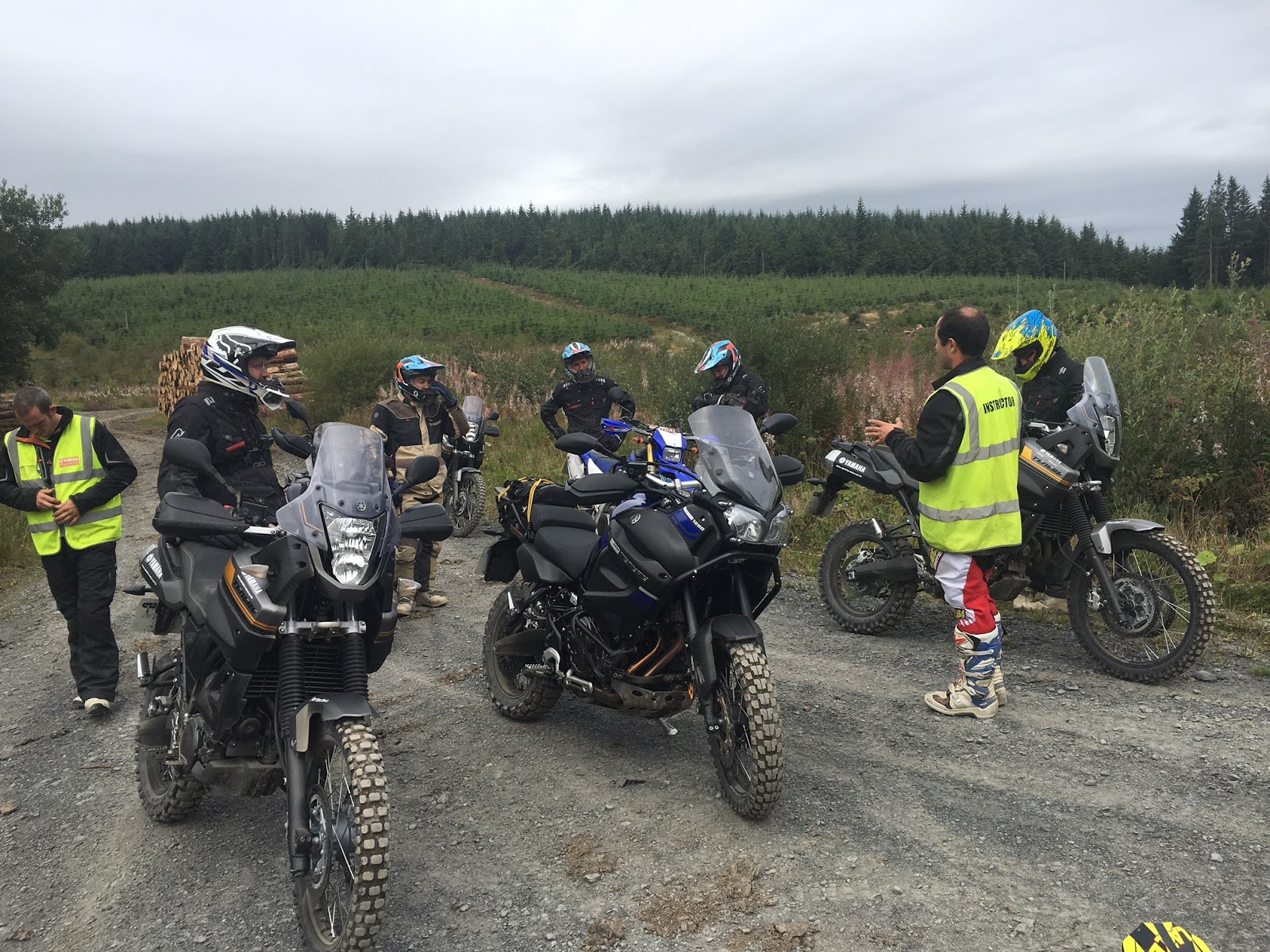
Once fully togged up in off road gear we assembled in the farmyard and inspected the bikes. There was a long line of hardcore trail bikes which were for another group who arrived just after us. Our row of bikes was a little more eclectic.

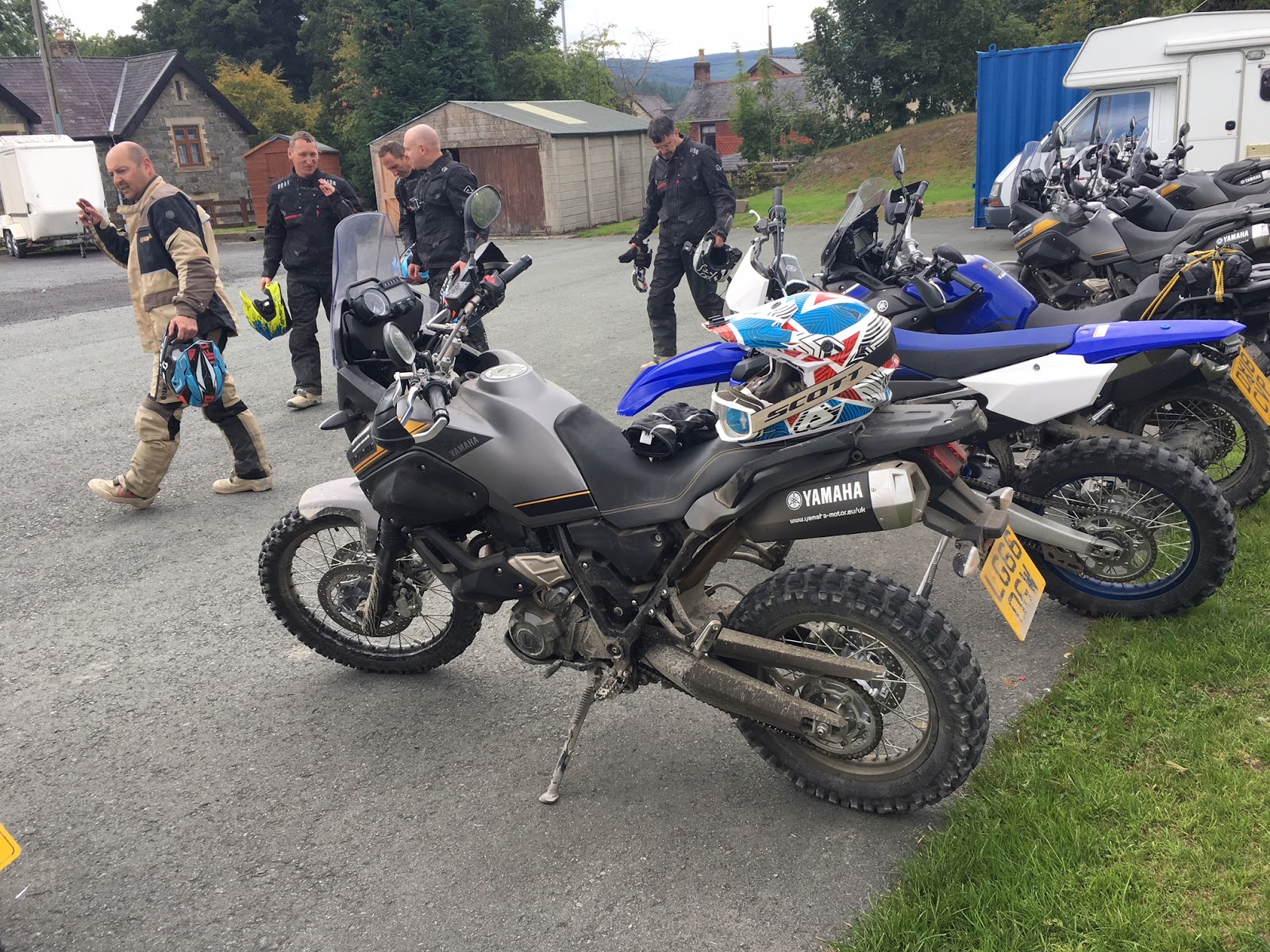
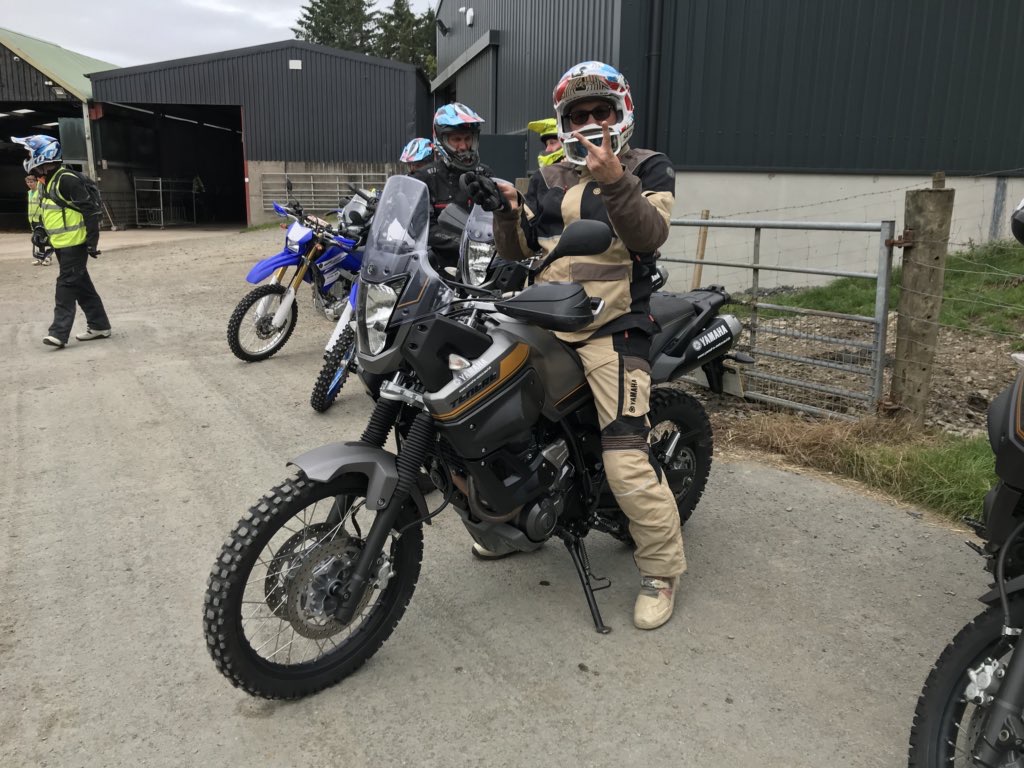
My brother, rather sensibly, had elected for the slightly less hardcore option and booked the Ténéré Experience. A Yamaha Ténéré is an adventure bike. It's road legal and has knobbly tires and a low revving, torquey engine. There were two 1200cc Ténérés and four 660cc Ténérés . As well as these there was a smaller, lighter WR 250R and a WR 450F.

There were six riders in our group plus two instructors. The lead instructor was Dylan Jones, a vastly experienced Enduro rider.  Dylan spent 30 minutes talking us through the bikes and their specs and capabilities as well as describing the format of the day and what to expect.

So far so good. My initial worries about off road riding were being to dissipate. The whole set up was professional. The bikes were obviously maintained to a high standard and the instructors knew exactly what they were doing.

Most bikes did bear a few battle scars though - and Dylan duly explained how to pick up a bike if one of us were to drop it.

Eventually we all chose bikes - I went for a 660 Ténéré and my brother a 1200 - and we set off in single file behind Dylan.

The roads around the farm are all single lane. The tarmac is old and dusty. The corners are sharp and often steep. We rode at 20 to 30mph getting used to our bikes and loosening up. My Ténéré felt odd compared to my own bike. The seat was a similar height, which is quite tall compared to most bikes, but the bars felt closer and higher. The engine was strong but vibey and it didn't like revving high. It had a sweet spot of between 1500rpm to 4000rpm and outside of that it complained gruffly.

After ten minutes on the road we turned on to a gravel track. We carried on, through the amazing Welsh countryside and into the Hafren Forest. The tracks got a little rougher and it felt less like farmland and more like wilderness.

Dylan parked up at a junction and we all came to a stop. Engines off and he explained that we would be riding in a loop taking in a few very sharp corners, some seriously rough ground and riding around some debris left by loggers.

He told us how to stand on the pegs and what we should be doing with the engine, clutch and bike in general.

We all felt ready for this as he led us slowly around the route. The bike was suited for standing on the pegs but I had to bend a little too much for comfort so I kind of swapped between standing and sitting. We spaced out and took the route at our own pace. It was undoubtedly tough but within a couple of circuits we all mastered the basics. We carried on round this loop a few more times, exploring different techniques and lines.

Eventually we stopped again and water bottles were handed out. We were all grinning and chattering away about our own experiences, what we found hard and easy. There was one particular section I found hard and it wrenched my arms and shoulders a little as I struggled to keep the bike upright. But I had become better at it each time I arrived at it and this simple incremental improvement felt hugely rewarding.

After the debrief and rest we headed off again on a longer ride at higher speeds round dusty, rough trails. We spun the rear wheels a little and controlled tiny slides and felt amazing.

Then we stopped by a place where a tiny track met the trail - disappearing into the forest. Dylan explained it was downhill, possibly slippery and there were a couple of sharp corners. We headed down one by one.

Standing up where possible it was first gear, very gentle braking, concentrate intensely on the track ahead. Where did it go, where precisely did I need to place the wheel, how would my body position affect the bike? All these things and more. I caught the front brake and slid a little on a very sharp downhill hairpin but let go the brake and reapplied it in an instant - this time more progressively and controlled and saved myself from an embarrassing spill.

At the bottom we were elated. Did we want to do it again? Yes! So we did, only better.

And that's how the morning continued. A decent ride at a fair old lick along some dusty trails followed by a tight and tricky section with some gravel and bumps and logs and rocks and hills and puddles and trees and sweat and concentration and smiles.

For lunch we headed to a small country pub in a small country village and ate a hearty meal and pints of coke and lemonade.

And in the afternoon we did it all again, only this time we did more and faster and harder. We swapped bikes and swapped stories. I had a go on the much smaller and lighter WR 250R. Its power band was smaller but it was more fun, and easier to use, on the rougher sections.

My brother rode the 660 Ténéré and the 1200 Ténéré. He reckoned the 1200 was pretty capable on the rough stuff - its weight and electronics and plush suspension taking care of some of the tougher terrain.

I had one crash, a fairly slow motion affair. I was really chuffed with myself. I'd successfully ridden down the steepest, slipperiest hill of the day. Right at the bottom was a sharp right hander and I kept it in too high a gear on the 250. It stalled and the rear wheel locked and I went down. No damage to me or bike.
I rode two bikes on the day

There were a couple of other spills. In the morning we all went into a forest section one by one. One lad stalled at the top of a slope and the rider behind, already committed to the slope had to avert and they ended up side by side like fallen dominoes. No-one was injured and the bikes were fine.

As the afternoon wore on I started to feel weary. We'd been well looked after by the instructors but the toll of riding all day was starting to make itself felt in my limbs.

After half an hour or so of non stop riding round amazing trails I slid to one side as I stalled again. I was fine but exhausted. I took stock and had a chat with the instructor. We were only a mile from the farm, he said, and would be back to base soon.

At around 4.30 we rode into the farmyard. Filthy, sweaty and exhausted, but happy and with a sense of achievement.

I'd mastered the art of off road riding and I'd had a brilliant day. I was glad my brother had decided to do it and organised it. My initial fears hadn't played out at all.
My own Triumph Tiger 800 XCX

The team at the Yamaha Off Road Experience were fabulous. The bikes were prepared well, the level of instruction was tip top and mid-Wales provided a fantastic playground as well as some amazing views.

That night we stayed in a local hotel. We downed a few cold beers, ate another large meal and swapped off road biking tales.

The next day I rode the four hour journey home on my Tiger. A perfect way to finish a wonderful weekend of biking.

By Matt Hubbard


25 Jan 2018

Are we really ready to make the change from petrol and diesel to hybrid cars?

We are at an automotive crossroads. How we power our cars, and the nature of cars themselves is all set to change. Even the design of our cars is changing. But do we, the consumers, really want what our legislators and manufacturers tell us we will have?
I’m not convinced we do.

When I was very small, back in the 70s, my Dad drove a petrol car - an E21 BMW 320. My mate lived on a farm and his Dad drove a tractor which ran on diesel. Our milkman drove an electric milk float. If you woke up at 5am you might catch a glimpse of him trundling along at 5mph. It was perfect for short journeys at low speed and, crucially, it was quiet.

This situation carried on into the 80s and 90s - except by this point Dad had swapped the BMW for a series of Jaguars (he only broke the chain with a Lexus CT200h which was crap so he sold it and bought a new XE).

And still, in this era, petrol was for cars, diesel was for tractors and trucks and electric was for milk floats.

When I started driving in 1988 the only thought was of a petrol car. Diesel was not even an option. So I bought a Nova Merit 1.0. I started my first job later that same year, for an engineering company in Manchester, and 90% of the staff had a company car. Every single one was petrol, and the size of the engine dictated your position in the company - Orion 1.3LX (minion), Sierra 1.6GL (lower management), Sierra 2.0 Ghia (middle management), Granada 2.8 Ghia X (the boss).

I drove that Granada once and it was much slower than expected, and the leather creaked. Not a patch on Dad’s XJ6.

Fast forward to 2002 and the birth of my son. Thinking I ought to save some money and buy a practical motor I purchased a VW Passat estate 1.9TDi 110 SE. It was the first diesel I had ever driven. 110 meant it had 110 bhp and this was not enough. It was the slowest, most boring car I had ever experienced. I hated it, even though it returned 50mpg no matter how hard I drove it. I sold it and bought a Subaru Outback.

So that was my diesel experience until 2015 when I leased a Volvo XC60 D4 for two years. It was a lovely car and the engine was great but I much prefer the 306bhp petrol engine in my current Golf R.

And there we are - 2018. The car was invented in 1886 and became a transport solution for the masses just twenty years later. For over a hundred years the most popular engine has involved a mix of petrol and air being exploded to push pistons up and down. Nowadays diesel as a fuel is just as popular as diesel engines have almost caught up with petrol in terms of power and refinement.

For the vast majority of motorists the choice is still between petrol or diesel. For a small percent it also includes a hybrid. For a yet smaller group who don’t drive very much or very far the choice also includes electric cars.

Over the past decade or so the popularity of diesels crept ahead of petrol but when Volkswagen were found to have cheated emissions tests the UK press and government massively overreacted. Diesel was bad, taxes went up and people wanted petrol cars again.

But still nobody really wants a hybrid car. Hybrid cars have two power units - one petrol or diesel and one electric - and two energy storage systems - a fuel tank and a bank of batteries. This makes hybrid cars heavy and extra weight is inefficient.

According to SMMT in 2017 2,540,617 cars were registered in the UK. Of these 13,597 were electric and 106,189 were hybrids. So 4% of all cars registered were hybrids and 0.5% were electrically powered.

The most efficient hybrid car is a PHEV - Plug-in Hybrid Electric Vehicle. But to use one of these you need access to an electrical point, which a great many households don’t.

Yet the government continues to steamroller us towards using them.

We have a massive network of fuel stations which deliver a tank of petrol or diesel in around two minutes. That’s between 300 and 800 miles of motoring. We do not have any kind of network of electrical chargers. Those that do exist often do not work.

My car is quite inefficient - if you consider fuel used for distance covered inefficient. It’s actually mighty efficient at converting fuel used to achieve incredible speed in a very short amount of time. Anyway, it does around 33mpg on a long run and last week I drove 380 miles in a single day. I left home at 8am, drove to a meeting 190 miles away, sat in the meeting for four hours and drove home. On the way home I stopped for fuel and carried on until I arrived into the welcoming paws of my dog, Kes, at 7pm.

If I had used an electric car I would have been 3 hours late for the meeting and poor Kes would have had to wait - alone, hungry and sad - until 11pm for me to arrive home.

This is why I (and many, many others) consider electric cars to be totally impractical and the weight penalty and requirement to charge them means hybrid cars are also impractical in 2018.

Oh and then there’s the issue of second hand cars. Hybrid and electric used car values are lower than the equivalent petrol or diesel cars. Servicing of hybrids by non dealers is almost impossible. Batteries reduce in efficiency over time and cannot be serviced. People on low incomes buy old cars and need to be able to service them cheaply.

But the government and manufacturers think we’ll all be buying hybrid and electric cars exclusively by 2040. This is daft.

Current battery technology means they do not store enough electricity, cost too much, weigh too much, take too long to charge and use rare earth metals (of which there is an impending crisis in terms of supply and cost).

Until there is a step change improvement in battery technology then battery cars will be silly and impractical - and so will hybrids.

So, bearing this in mind, how are we to reduce the impact of our cars on the environment?

The answer seems to be in a mix of things. For a start petrol and diesel engined cars need to become more and more and more efficient. Not just the engine but the whole car.

A fast, comfortable car can be built and designed to weigh 800kg yet the market dictates that our cars are becoming bigger and heavier. People now want SUVs and crossovers and they want all sorts of technological gubbins that they don’t need. SUVs require more height and more height means more weight in all areas. More height also means more drag. All of this means more fuel is used.

We should really be driving small, light, aerodynamically efficient hatchbacks and coupes instead of big, fat SUVs.

Electricity isn’t the only future fuel. Hydrogen is a really interesting one. It can be used to fuel an internal combustion engine, is the single most abundant element in the universe (around 75% of all mass that ever has or will exist) and the only emission from the exhaust pipe is water. Hydrogen engines currently cost about 50% more than petrol but with a few years R&D this cost will reduce. The biggest problem is fuel storage. As a gas it needs to be stored at 5,000 psi and as a liquid…well, it boils at -253°C.

Battery technology will eventually become the dominant force. This will come about through solid state technology but this is years away.

For now the only real solution that suits us ordinary people is petrol and diesel. Change will be needed as emissions regulations are tightened up - and these will become impossible to achieve if we all drive fat, heavy SUVs.

The government and manufacturers still reckon they will push us all into hybrids and EVs whilst we, the public are not ready for this.

The public have been pushed around by governments for years but this time I think the legislators will have a real fight on their hands. The public has a recent history of not doing what they are told to do by governments and bureaucrats.

How will this all end up? Who knows…

By Matt Hubbard


14 Feb 2017

30 Years In the Past - The Porsche 924S Experience


Go to find the keys in the key drawer. Fingers scrabble around and find the BMW key - big, chunky, buttons, no actual key. Nope. Volvo key - sleek, chunky, buttons, no actual key. Nope. There's only one left. Round, slim plastic bow out of which sticks an actual steel shank with teeth cut out. Yep.

Walk out of the house and see the lines of the 924S. Slim, low, lithe, aerodynamic, rubber spoiler, no headlights, small wheels, big tyres, huge glazed hatchback, copper colour in need of a good clean. Dirt straked behind the rear wheels. No excessive size or weight.

Use the real key to unlock the passenger door. The driver's door lock is irritable and won't open from the outside, only in. Open the impossibly thin and light door. A modern door has heft and weight and noise and certainty. The old Porsche's door has daintiness and narrowness, hope and a light mechanical noise when opened or closed.

Lean in and across and survey the overwhelming brown-ness of the interior. The seats saved only by white pinstripes. Pull the clasp on the driver's door and push it open.

Close the passenger door and walk around to the driver's side and slide in. A modern car is built for everyone. A Porsche 924S is built for the median. Too tall and you won't have headroom. Too fat and your legs won't fit between the unadjustable steering wheel and mildly adjustable seat. Too short and you won't reach the pedals.

Fit it and you sit in the best driving position in the world of motoring.

Take in your surroundings. Three dials in front. Speed, revs, engine temperature, fuel and just three warning lights - low fuel, low oil, low battery.

In the centre are three more dials. Time (analogue), oil pressure, alternator output. Nothing digital, nothing unnecessary, nothing that makes a noise. Except the engine and indicators.

Put the real key in the real ignition barrel and turn it. The engine makes half a turn and barks into life. Strong and real it isn't enhanced by electronic sorcery and flaps, instead it transmits what it is - exploding fuel and metal parts rubbing together, helped by oil. You hear the tappety sounding engine and the waffle of the exhaust note over anything else.

Modern cars alienate you to sensations other than those prescribed by their makers. The 924S fails to mask noise, smell and sights. The glazed area is huge. The mirrors are tiny but you just need to turn your head to check the blind spots. You see the white smoke of the cold engine exhaust billowing up and around the hatch window. You smell the exhaust. You hear everything going on outside.

The gear stick is firm and its action precise and mechanical. It vibrates in tune with the engine. Release the handbrake - its position down between the door and the seat. Select first gear and ease the clutch up and the throttle out and pull away.

Easy does it whilst the engine is cold. It feels bulletproof but it is 30 years old after all. It's never been rebuilt, subject only to regular servicing. You hear the engine from the front and the exhaust from the rear. A strange sensation to those used to modern machines.

The ride is relatively soft - the big tyres ironing out pot holes and speed bumps - but it doesn't roll in corners. The balance of the car is fabulous. A product of lack of weight and clever distribution of that weight.

Engine is warmed up, check dials and see everything is well and carry on.

The throttle pedal has a false limit. Once you feel you've reached the end of its travel push a little harder and access another inch.

In second gear when you press the accelerator hard the car will lurch forward. It's not fast but it feels swift and will spin the rear wheels in first or second. It has no traction control and no ABS but it doesn't really need it. Lightness has many advantages one of which is a lack of inertia compared to heavier modern cars.

Push on and enjoy the mechanical symphony of driving the machine, pushing it to its easy to find limits. There's a real sense that you control the car - which is often missing in modern cars.

At speed and the noise increases. The exhaust noise overwhelms the engine noise. In short doses it's a good, boomy, large bore, 4-cylinder racket. On enthusiastic drives you use it instead of a rev counter to precisely place engine revs. On longer journeys you turn up the tinny stereo to mask its roar.

In corners the car pivots around a point just rear of the front wheels. You respect the power and the balance and use your controls to adjust everything accordingly. To do so well is both easy (because of the car's inherent abilities) and satisfying.

It's at its best on smoothly twisting back roads but is fun on faster A-roads. Overtaking needs to be anticipated and brings another level of satisfaction when accomplished. See the gap, drop down a gear, hear the engine scream as the revs rise, mash the accelerator, make the move.

Open a window and exhaust fumes make their way into the cabin. They all do that - something to do with the shape of the rear end. Open the sunroof as well and the fumes come in and then out again so you breath sweet fresh air instead of carbon monoxide and nitrogen.

Barreling along in the 1986 Porsche 924S is a fabulous, fun experience. It brings the elements to you. It gives you experiences modern cars hide from you. There's nothing false or fake about the car - only raw reality.

By Matt Hubbard


1 Jan 2017

Trip of a Lifetime: John O'Groats to Land's End in One Day

Before Christmas I was wondering what on earth I was going to do in the black hole that is the few days between Christmas and New Year apart from drink and eat to excess. I'm really not a fan of winter and short, cold, rainy days make me feel quite miserable. I needed something to take my mind off it all. I needed a challenge!

One disgustingly dark and horrible December morning I was sitting on the 7.25am from Theale to Paddington reading the latest Guy Martin book. Guy is a human dynamo with boundless energy and a need to fill every hour of the day with danger and excitement. I'm not in the same league as him in terms of activity but I had had a pretty action packed 2016 as far as I was concerned and why not finish it with another road trip?

Inspired by Mr Martin and the fact my new car, a 2007 BMW 330i M Sport, was both fast and comfortable I decided to undertake a trip I'd always wanted to do. Land's End to John O'Groats.

That evening I studied the map. I live in the south east of England and the distance from home to Land's End is 276 miles. Land's End to John O'Groats is 837 miles and John O'Groats to home is 675 miles.  The most I'd ever driven in one day was from Dallas, Texas, to Santa Fe, New Mexico via Roswell and that was 704 miles. 704 miles on straight, open, traffic free, speed camera free American highways. In daylight.

Land's End to John O'Groats would be 837 miles on British roads with average speed cameras, road works and festooned with ignorant drivers in MPVs. The trip would take around 14 hours (without any stops), half of which would be in the dark.

Sounded good. I set a date and booked the hotels. My plan was to do the trip backwards and take two days to get to John O'Groats so I would be feeling fresh and unweary for the big day.

Christmas came and went and on boxing day morning I set off for Dunblane in Scotland. The car was freshly serviced and fully fuelled and I had a cardboard box strapped to the passenger seat which contained all the essentials I'd need for the trip.

Day 1 was an enjoyable blast along familiar roads - the A34, M40, M42, M6 and M74. I was surprised at how much traffic was on the road but nonetheless didn't get stuck in any traffic jams.  The hotel was comfortable and the next day I breakfasted well and headed to John O'Groats. This day was much different. The vast majority of the trip was on the A9 which would be a fabulous road but is neutered by average speed cameras along the majority of its length.

Still, there is a certain enjoyment to be found setting the cruse control to 74mph and doing everything in your power to maintain that speed no matter what - including overtaking those doing 68mph (everyone).

The A9 flows through the Cairngorms where the view changes from forest to mountains. It's an achingly lovely place spoiled only by having to constantly overtake other drivers whilst making sure you don't speed. At one point I stopped in a quiet lay-by. There seemed to be no-one else for miles around and was the perfect place for a comfort break. Then a cyclist clad in lycra arrived and stood ten yards away from me, unmoving. It felt like he'd done it on purpose. Still needing a pee I got back in the car and carried on.
The road situation vastly improves north of Inverness where the road gets quieter and twistier and the speed cameras disappear. I would argue this promotes safer driving as one needs to focus on what is going on and one's driving. The further north you get the more corners and elevation changes there are. The sea is to one side and craggy hills to the other. Towns and villages are sprinkled infrequently and traffic is extremely light. Even when you do come up behind someone there are plenty of opportunities to overtake safely.

At a place called Golspie I pulled over and went for a walk along a quite spectacular beach. At Wick I stopped for fuel and some healthy snacks for the journey - carrots, nuts, grapes.

At a shade before 4pm I pulled into John O'Groats. The village is nothing more than a collection of touristy type buildings surrounding a harbour. Shops, cafe, pub. I walked along the harbour and was for that moment the most northerly person on the British mainland.

My hotel was 200 yards away. It was simple and quite cold. Darkness descended totally at 4.15pm and suddenly what had been a welcoming kind of place seemed harsh and unforgiving.

I had arrived early so I could be as ready as possible for the big day ahead. In terms of overall preparation I was as ready as possible. I was travelling alone. I could have dragged someone along but I'm happy with my own company, and often prefer it to inane chattering for the sake of it. I'd also prepared a very long playlist of my favourite music - around 25 hours worth.

I'd been considering audiobooks but couldn't make my mind up - I prefer to read actual books. However when I learned of the sad death of Carrie Fisher I downloaded her new book, The Princess Diarist.

I'd also altered my sleeping pattern. I'm normally a bed late, up late person - a night owl. But I'd been going to bed earlier and earlier and been waking up earlier too. My alarm was set for 5.30am for a 6am start.

At 7pm I ate dinner in the hotel bar, surrounded by drunk Scottish people. I showered and went to bed at 9pm and fell asleep immediately.

At 3.48am I woke up. There was no point going back to sleep. I made a cup of tea, packed my stuff and hit the road at exactly 4.33am. The satnav said it would take 14 hours 26 minutes. I felt fresh and ready for the trip. Heated seat on, climate set to 20°C. Head off into the dark.

The first couple of hours were fantastic fun. Winding, twisting, single carriageway roads. Hands on the wheel, eyes fixed on the road or the next apex. I was carrying a good speed. Manoeuvres were not conducted like I was in a race car - I was in this for the long haul - but I was braking late, hitting apexes, accelerating hard.

I saw lots of wildlife. Deer, foxes, rabbits and the odd something small, furry and fast, scurrying across the road.

The sky was pitch black but the wind was low and there wasn't a hint of mist, even though fog was forecast over parts of the country.

The further south I headed the more traffic I encountered. I continued driving hard. I came across the sections of the A9 with average speed cameras. Cruise control on, overtake slowly, insane politicking affecting safety. Still, at night you can see headlights approaching - or not.

I passed through the Cairngorms in darkness and didn't see the snow spattered mountains

At 7.41am the sun started appearing above the horizon. Then it came suddenly and the day arrived, albeit gloomily.

By Glasgow I had been driving for 4 hours 30 minutes without a break. We had done 280 miles and there was was still a quarter of a tank of fuel left. My average speed had been 64.6mph and fuel consumption had averaged 27.1mpg.

I was ready for a break (busting for a pee) but the electronic sign said the services I had planned to stop at had no fuel. Instead I asked the satnav to find another fuel station. I stopped at Morrisons, Glasgow to fill up with petrol and windscreen washer fluid and a run to the loo. After less than ten minutes we were on the road again.

The next few hundred miles were going to be my opportunity to increase my average speed before hitting the midlands. South of Glasgow and into northern England and the interfering busybodies in government leave the poor motorist alone for a while. There are no fixed cameras and little other traffic. Those hours were glorious. If you've ever driven across Europe you'll know the feeling of driving mile after mile on straight, quiet roads at high speed. This is what the M74 and M6 through the Lakes and Lancashire is like. Pure pleasure.

And then I hit the traffic.

My average speed over 450 miles had been 69.9mph. I was now just over half way there and feeling good. But the M6 had other thoughts. We ground to a halt north of Warrington and my average never reached 70mph. I was using Google maps on my phone for more accurate traffic data and it said the area north of the Thelwall viaduct was totally blocked and that we should turn off and travel 2 miles east down the M62 then head south through Birchwood and back on to the M6 just ahead of the viaduct. Google reckoned this hugely out of the way route would save 20 minutes. I took the diversion.

We continued to crawl and Google came up with another suggestion to avoid 45 minutes worth of queues. This time it involved the M56 west then the A559 south until Crewe. I took this too.

Coincidentally this route passed within half a mile of my brother's house so I called in for a quick pit stop but the house was empty. They were out shopping. It was 12.45pm. I watered his hedge and carried on.

Back on the M6 and I didn't take any more diversions. The traffic shuffled along in fits and starts and ruined my average speed even more. At Birmingham we took the M5 and carried on inexorably south.

Patches of mist came and went. The traffic didn't improve. At several points the fast lane went from 75mph to 0mph whilst the other lanes carried on at 60-70mph. I was surrounded by ignoramuses who refused to drive according to conditions, to any code of conduct, to simple common sense or courtesy.

I regularly dipped into the middle lane if it became free but would then be blocked from getting back into lane three. People would drive close to the car ahead and constantly brake. Others sat for miles in lane three at 65mph, ignoring the massive queue behind and acres of free motorway ahead. Random panic braking would occur frequently. People only seemed to look at the car ahead rather than to the traffic all around and ahead. I was, as I often am, quite appalled at the driving standards on our roads, something that becomes quite dangerous on a busy motorway.

Time and miles wore on. I had stopped again at Hilton Park services in Birmingham. The sun sat low in the sky at Bristol and everyone slammed on their brakes every time the road aligned with it so it sat right on the horizon at 12 o'clock.

The sun set at 4.30pm at Avonmouth. I took stock. I was feeling fine. I'd been driving for 12 hours straight and did not feel weary. The BMW was doing a fine job. I had finished my audiobook and moved on to music. I would open the window occasionally for a blast of cold, fresh air.

I stopped for fuel somewhere on the M5 but cannot remember where. Then we hit Exeter and turned on to the A30 which is a beautiful road, mainly dual carriageway, that passes through some spectacular scenery as it heads through Devon and Cornwall.

There was plenty of traffic but it was better behaved than on the M6 and M5. We all cruised as fast as we felt comfortable with and people would move over if lane one was free. Very civilised.

At Bodmin we hit 12 miles of roadworks, policed by average speed cameras with a limit of 40mph. I was behind some moron in a Hyundai who could not maintain a constant speed so we wavered from 30 to 40mph for what seemed like forever.

Finally free of the roadworks I mashed the pedal and carried on across Cornwall. I stopped for fuel at some point and felt weary and tired for the first time. The dual carriageway lasts a surprisingly long time. It was only after Penzance - just a few miles from Land's End - that the A30 becomes single carriageway.

Those last few miles were conducted in silence. I turned the music off and opened the window and enjoyed the moment. I followed an old Defender for a few minutes. The driver was caning it so it was quite fun.

And then finally I hit Sennen and saw the sign for Land's End. I passed the Last Pub in England and carried on. Along a quiet lane you see a pair of stone signs either side of the road that simply say Land's End. I stopped for a photo. A deer jumped in front of me and bounced off into the night.

Another hundred yards and I had done it. It was 7.39pm. According to my car's trip computer (not accounting for stops) the average speed had been 62.9mph and the average fuel consumption 28.2mpg. I had covered 857 miles.

The overall trip had taken 15 hours and 6 minutes. I had been driving for 14 hours and 12 minutes. Therefore I had stopped for a total of 54 minutes.

I felt elated. I parked in the Land's End car park and looked upwards. It was a crystal clear night and the sky looked spectacular. I could see three or four times more stars than I normally would in the light polluted south east.

Happy with the day I drove two miles to my hotel in Sennen Cove, ate a light dinner, drank a single pint and went to bed.

The next morning I woke an hour before breakfast so went for a walk along the beautiful beach at Sennen Cove. At 9am I drove back to Land's End and walked down to the craggy area behind the tourist buildings. For that moment I was the most southerly human on the British mainland. Then I headed for home and was able to view Cornwall and Devon in daylight - always a delight. I stopped for lunch with a friend in Somerset and finally arrived home at 4pm.

When I mentioned on Twitter I was doing the trip I had lots of support. When I was headed up north and then on the day of the trip itself I was inundated with questions and well wishes. A few people asked why I had done it, some just said I was crazy. Everyone congratulated me. It felt good to have so much positivity from people.

Driving from John O'Groats to Lands End in a day is an ultimately pointless exercise but so is any kind of rally or competition. I can say I did it and the vast majority of people cannot. I feel good that I did it. I ticked a box that would have always remained unticked - unsatisfactorily so. I enjoyed my time behind the wheel but I also enjoyed the preparation and the time afterwards.

I am writing this on 1 January. This year I will ride my motorcycle with a group of friends across Wales, touching the south, east, north and west boundaries, and I'll drive through most of the capital cities in Western Europe. I've developed a taste for road trips but it is so much more satisfying if that trip has a purpose.

By Matt Hubbard