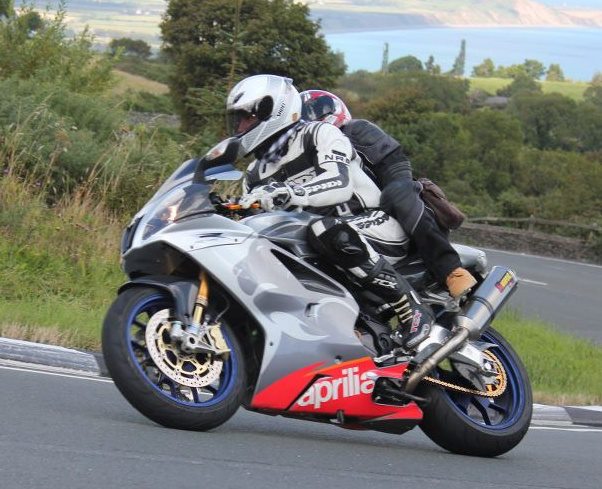
Stuart Jewkes interviews club racer and sports bike connoisseur, Mark Beese, and asks him about life with an Aprilia RSV1000R Factory
The bike - Aprilia RSV 1000R Factory
The owner - Mark Beese
Prologue
Ask a bunch of bikers to name some cutting-edge sportsbikes
derived from the mid-‘00s World Superbike Championship, and it’s very possible
that no-one will mention the Aprilia RSV1000R Factory. Aprilias have
historically always existed in the shadows cast by their more glamorous
Bolognese cousins (those that can do no wrong and that wear red all the time),
and it’s only recently with the incredible RSV4, that the tables have turned in
Aprilia’s favour, particularly in WSBK.
The V-twin RSV1000R was introduced in 2004 as the updated
evolution of the respected RSV Mille, and the “Factory” was the carbon-bodied,
Ohlins-everywhere special edition that was easily the equal of any of its
1000-cc V-twin contemporaries at the time. Yet, bizarrely, everyone overlooked
it. Back then, people were more easily seduced by those red supermodels from
Bologna with their racing success and their superstar-associations, and the
finance was still affordable - even though the Factory was several thousand
pounds cheaper and every bit as good. As a result, few went for the RSV.
Fast-forward to the present, and the RSV1000R sits on the
wrong side of the supply/demand curve by being both rare and cheap for what it
is. Suspiciously so. You can get a good, low-mileage example for about four
grand. That’s about twenty quid per mile-per-hour.
A couple of years ago my mate Mark Beese - club racer and
sportsbike connoisseur, selected an ‘05 RSV Factory over a whole bunch of other
exotic possibilities. Why would he do that, when he could have had any one of
the Japanese products like a R1 or a K5 Gixxer, or even one of those Bolognese
supermodels?
I asked him:
Why?
“I seriously looked at a MV Agusta, a Ducati 999R and the
Factory. The Factory was the best-looking, fitted me the best, and was by far
the best value for money.”
A bit of a no-brainer
in that respect then?
“In that case, yeah. It just made sense. Look at the spec -
unbelievable value for what it is.”
Let’s Start With That Engine
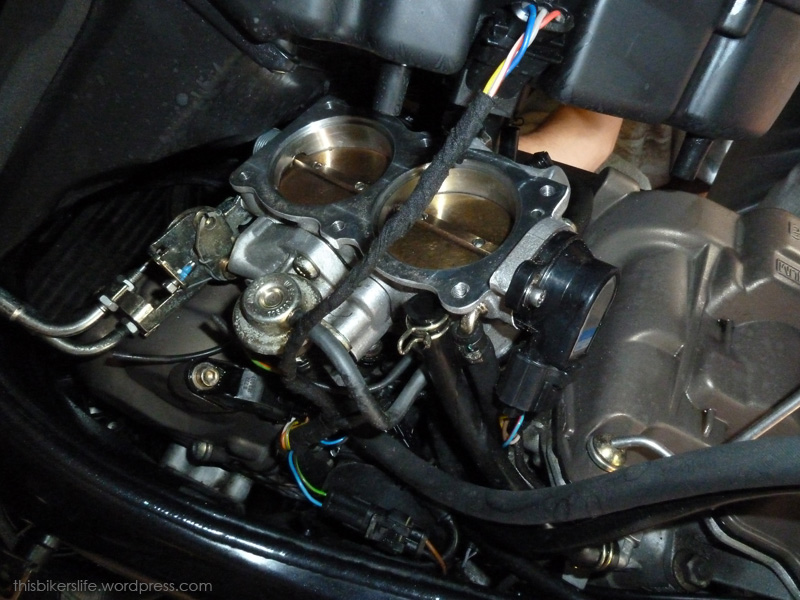
“It’s a 60-degree, 993cc V-twin made by Rotax. This engine
has about 145 bhp - the titanium Akrapovic exhaust system is standard on the
Factory, but this has also got a K&N filter, and the EPROM/ECU has been
reprogrammed to the factory race setting. I always compare it to my mate Ady’s
Ducati 996. This is a 996 on steroids.
“V-twins just make sense. Going from a V-twin back to a 600
like yours [Hornet] is like going
back to a scooter where everything’s at the top end and you have to thrash it -
pin it everywhere - to get anything out of it. A V-twin is just a wall of
torque, from nothing.
“Many V-twins run out of steam at about 8k or 9k. With this,
you have to be brave and know how to ride it to take it past there because it
goes ballistic. Totally changes character with the induction and everything.
The engine note even changes to something more like an IL4 - a totally
different dynamic. From 8.5k to 11.5k it’s absolutely mental. It’s so unbelievably quick.
“I’ve owned all sorts of Japanese sportsbikes - all the “Big
Four” - and only a Suzuki comes close to the Aprilia for pure bulletproof
thrashability. The engine just hasn’t given me any problems at all. Not one. I
gave it a big 18k service recently where the shims in the top end needed checking
and they didn’t need touching. None of them. The engine has noticeably freed-up
while I’ve had it too. It’s loads better.
“You’ve finished
running it in.”
“Yeah.”
“You have to assume
then, that it’s previous owner was a bit of a wimp.”
“Definitely. Another thing is it has a dry sump; so all the
oil is stored in a catch tank on the L/H side of the bike. It’s designed to
prevent oil starvation at any angle of lean [and 2nd-gear mingers!], but checking the oil level is a
bastard. You have to do it when the engine’s hot. Another thing is people
reckon the engine casing corrodes and firs up - they don’t at all. Just keep on
top of it.”
What’s It Like To Ride?
“It’s everything you’d expect from something so
well-equipped. Ohlins forks, Ohlins rear shock and steering damper. Of course
it’s made for the track really, but on a smooth road it’s a revelation ‘cos it
just sits there totally stable even when it’s on its ears. The steering
geometry on it makes it feel like an RS250 but 30% heavier and bigger. I’ve changed
the ride height to improve the handling further too - up 18mm at the rear, and
dropped the forks through the yokes to steepen the head angle. Jacking it up at
the back makes what is already a tall bike even taller; anyone under about 5’9”
would be on tip-toes all the time with it.
“As far as riding it on the road goes, you have to ride
using the torque. Don’t treat the huge engine-braking as an obstacle: let it
work with you instead of against you. First gear tops out at 70 mph and second
at 90 mph. All the other gears are close-ratio up to 169 mph. If you’re
trundling along in 2nd and it feels like it’s about to stall, that’s
40 mph. The gearing’s so tall you can ride round in 1st and 2nd
gear all day. To get the best out of it though, you’ve got to be fully
committed.
“Like a lot of sportsbikes the mirrors look good, but they
don’t work! Know that you will see nothing behind you due to crap visibility
through the mirrors, but you end up going that damn fast anyway that you leave
everything behind you without realising…
“With tyres, after about 3000 miles it just stops handling.
It’s a 190-section as standard, but if you fit a 180 section with a taller
profile it makes it turn quicker. For fast road work, a 180 is the one to have.
Stick to the 190-section for the track where you need the stability of the
wider tyre ‘cos you’re going so much faster. It’s really sensitive with tyres.
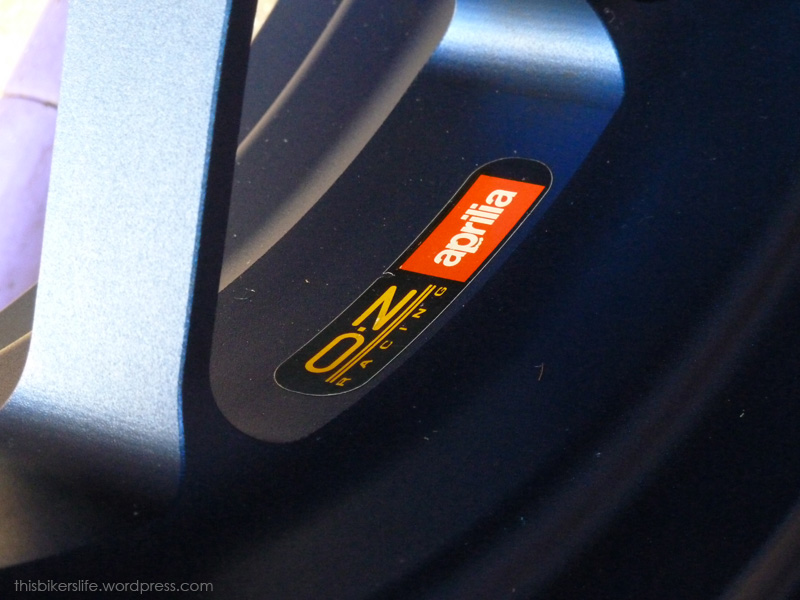
You get the OZ wheels too. They’re only on the Factory, not the standard
RSV1000R.
“The brakes are Brembo monobloc radial calipers and I’ve
fitted Titax adjustable levers. True one-finger operation. Doesn’t need anymore
than that. Brilliant brakes. There’s a common misconception about the rear
brake with a lot of owners: they think the rear brake doesn’t work and is useless
- that’s a load of bollocks. I put fresh DOT4 fluid in there every 6 months,
and you know what else? I USE IT! You’ve just got to keep on top of it and use
it! It is a Brembo after all. I’ve turned the disc blue before…”
What else?
“Some owners have changed the front sprocket to get even
more acceleration but it renders it unrideable. Too many wheelies. All I’ve
done is put Talon sprockets on it at the standard gearing. They’re lighter than
standard so it reduces the inertial mass and improves acceleration slightly
that way. A side benefit there is that it improves fuel consumption. It has a
form of slipper clutch - a back torque limiter - as standard too. I didn’t even
know it had one until I was into a corner a bit too hot up near Settle and the
limiter helped it get back on line.
“A clutch slave cylinder does wonders for clutch lever
pressure too, otherwise you’ll get RSI in your hand from the riding position.”
The noise from those
Akrapovic pipes is unbelievable.
“You can ride through a village and you don’t get people
waving sticks at you. It’s like speed by stealth.”
What, even though
I’ve heard you from half-a-mile away?
“Yeah. If you were on a screaming 600 people would think bloody ‘ell listen to that lunatic.
People can’t tell how fast you’re going ‘cos the noise is a different pitch.
What’s really addictive though is riding through tunnels!”
What’s the fuel
consumption like?
“You can empty a tank in 40 minutes. It likes super unleaded
- really makes a difference. You’ll get 35 mpg under “normal use” - whatever
that is - and about 18-ish in town.”
But anyone who buys
one of these with fuel consumption in mind is a muppet anyway.
“Exactly. Just expect to put 50% more fuel in than everyone
else as a rule of thumb and you’ll be alright…
“It’s also good in winter too. It’s like sitting on a big
radiator. Warm air comes out of the fairing on to your legs; the rear cylinder
is nearly underneath your arse, and if the fans come on they direct warm air
over your hands. In fact it’s a testament to how good the Ohlins rear shock is
that the shock doesn’t overheat. That shock, by the way, cost £450 to service.
You’ve got to keep on top of it. You’ve got to swallow the costs/depreciation
and not worry about it -“
Because that’s not
why you’re supposed to be owning it.
“Right. Don’t treat it like some sort of investment. Ride
it.”
Lets Get The Bad News Out Of The Way Next
“The thing that does give problems on these is the
electrics.
“The dash is brilliant. Best clocks ever. Same as the RSV4.
Big tacho with a flashing red LED as a shift light - but it would be good if
the speedo worked…
“I was on the motorway against a Porsche - then there’s all
this smoke billowing out everywhere and it just died. Turns out the rear brake
caliper has a speed sensor on it that had malfunctioned. The wire from the
sensor to the ECU melted and caught fire. Trouble is it’s all connected to the
fuel pump and ignition and everything - the whole bike could have caught fire.
I’ve disconnected it. That’s actually a potentially dangerous flaw there.”
What else?
“I’ve ripped out the sidestand switch - literally ripped it
out - ‘cos it would cause the engine to cut out in corners! Starting any V-twin
is always risky too as the high compression means you need a big battery, which
gets killed after 7 full cranks. You can’t bump-start them ‘cos of the
compression either. You have to jump it. In an ideal world you’d carry a spare
battery everywhere.
“The ignition key is another weak spot as it’s extremely
fragile. It breaks easily and is as fickle as a virgin’s drawers.
“It has a suicidal sidestand. It’s not long enough. They
made it short to stop it fouling the swingarm, so it leans over too far.
Apparently the stand off a Fireblade will fit it. Always find a camber or
incline to park it against otherwise it will fall over without fail.
“You could say the biggest issue with these is that spares
are very difficult to get hold of. Anything more substantial than consumables
and you have to wait ages and pay through the nose.”
Let’s Talk About The Good Bits
“The Factory’s USP is its character. Japanese bikes are too
clinical. No personality - no charisma - they’re like buying white goods. The
Factory isn’t clinical at all. It has its own personality. This is what Italian
exotica are like. All the problems are part of the adventure. Part of the
relationship. My mate Ady’s 996: he has to go though some sort of ritual before
he starts it. Mine has a gearbox ritual: you have to jab the lever with your
foot a certain way to get neutral.”
So is it worth all
these problems, and the threat of them, just for that riding experience?
“Definitely. It’s got no ABS, no TC, no AW, no yaw control,
no launch control. Just 100% pure torque. A true purist’s bike.
So in the words of
Guy Martin, it’s a real man’s bike.
“Yeah. It’s a man’s bike. You can’t ride it like a muppet.
It’s fun, but it’ll snap. A V-twin has a longer duration of power stroke so it
has more edge grip under power in corners - it’s what “big bang” means - and
because of that you can take liberties with it in the dry. If it’s wet though,
it’s totally the opposite. The torque becomes a disadvantage - highsides
everywhere. It’s fun, but it’ll snap.
Is it a bike that
intrinsically rewards skill?
“Yes. It’s not for novices at all. To get the most out of
it, you’ve got to be right on your game, and that’s what makes it so satisfying
to ride - that it makes those demands on you.”
Would you have
another one?
“No. But not because of the unreliable electrics. The only
thing I’d change it for would be a Panigale or an RSV4 Factory. Japanese bikes
just don’t cut it for me anymore - they’d be a retrograde step. Even the BMW
HP4 is just too clinical.”
All this for four
grand. The Factory really is the performance bargain of the decade then?
“Yeah. It can run with any one of the above in the hands of
a skilled rider and hold its own. Its contemporaries are bikes like the 996.
It’s faster than a 996 and has better brakes. It has the same power as a 999,
handles better than a 999 and is three grand cheaper than a 999R.
The insurance was £700 cheaper too…”
So even the scumbag insurance cartels
don’t realise what they are?
“No.”
Ex-F1 driver Martin
Brundle did a DVD a few years back called “Supercars”, in which, on exotica, he
said “it’s not just the thrill of driving it, it’s the pleasure that it gives
to others.”
“Exactly. That’s what exotica is all about. I went into
Stockport town centre on an errand. I came back out of the shop and there was
about 10 people stood around it - this old boy is on his hands and knees
examining it in detail. He asked me how much it was worth - must have cost thousands he said. I told
him you could pick one up for £4k - nobody would believe me.
“Every ride becomes memorable. I went to the Manx Grand Prix
in 2011 as part of a mate’s team, and I took the Factory over the Mountain. I
did two epic wheelies on the bit from Kate’s Cottage to Creg-ny-Baa and then
down to Signpost Corner. The next day somebody came up to me in the pub and
wanted to congratulate me. I thought he was going to bollock me! Another good
bit was passing a police Range Rover on the Mountain at Joey’s doing 130. It’s
the only place in the world where you could do that.
“It’s a proper future classic. It’s got good looks - it’s
one of the best-looking bikes out there. It’s got character, character,
character. It’s got more power than anyone can reasonably deal with, and it’s
got incredible handling - a good rider can be the fastest thing on the road.
“It really is one of the most under-rated motorcycles ever
made. For the next couple of years, values are going to stay low. When people
start buying bikes again, they’ll go to the showroom and see the price of a
Panigale, a Fireblade, an R1 etc. then they’ll see a 6/7-year-old Aprilia and
look at the spec and they’ll be ripping people’s arms off. “
In newer company like
that, doesn’t that make the Factory an analogue player in a digital world?
“Yeah, but you know how vinyl records sound better than
CDs…?”
* * *
The Timeline
1998 - RSV Mille marks Aprilia’s first foray into big
superbikes. Heavily-influenced by their small-capacity prototypes that owned in
GPs. 128 bhp V-twin, 189 kg, £9,450 RRP. 2k less than the Ducati 916.
1999 - RSV Mille R and RSV Mille SP: the “R” gets Ohlins all
round, OZ rims and a host of other upgrades. The “SP” is the WSBK homologation,
with a new 996cc engine using a different bore/stroke and producing 145 bhp.
Adjustable swingarm pivots, aluminium fuel tank. Only 150 produced. The
“shotgun” tailpipes are the only way you can identify one externally.
2002 - Noriyuki Haga replica. Factory-fitted Akrapovic
exhaust with different ECU chip. 300 were made.
2003 - Colin Edwards replica. Same as the Haga rep but with
the RS3 Cube paintjob from MotoGP. Radial front brakes.
2004 - RSV1000R and Factory introduced to take on Ducati’s
998/999. New RSV is lighter, more powerful and with sharper bodywork carrying a
central ram air intake. Big huge dual sidepipes and radial brakes as standard.
2004 - RSV1000R “Nera” special edition. Liberal use of
weight-saving titanium and magnesium alloys, new lighter pistons, carbon fibre
bodywork. Ohlins everywhere and Brembo racing brakes. RRP £25,000. Came with
freebies like Dainese leathers and MotoGP tickets.
2006 - Final update for the RSV1000R including the gold
frame finish. Aprilia starts developing the fearsome RSV4, which today is
dominating WSBK.
2008 - the RSV1000R is finally discontinued after Aprilia’s
contract with engine supplier Rotax comes to an end.
© Stuart Jewkes 2013