Showing posts with label Safety. Show all posts

4 Dec 2015

I've Never Crashed A Car But I've Nearly Crashed Many Times


Think about the times you've lost control of your car. Did you crash into something or did you momentarily think you were going to crash into something then thank your lucky stars when you didn't?

I've either been extraordinarily lucky behind the wheel or I've got amazing reflexes. Or maybe both. I passed my test 27 years ago and not once in that time have I hit another car or any inanimate object with my car in such a way that you could call it a crash.

But I have had lots of nearly crashes.

Mind you I haven't been quite so lucky on my motorcycle. I've had lots of nearly crashes on bikes too but I did have one actual real life crash. It was terribly embarrassing. I only passed my bike test when I was 33. I'd been riding for five years and had owned an old Yamaha Fazer 600 and a new Yamaha FZ6 - both what non-bikers would call sit up and beg bikes. So I bought a Yamaha R1. 150bhp, 150kg, handlebars so low I had to pull my stomach in to ride the thing.

It was beautiful in red and white - mint condition. One soggy day when my Saab 9-3T was in the garage having a new clutch fitted I took the R1 to my son's school's autumn fayre. My dad was visiting and took son in his Jag S-Type.

After the fayre had finished I headed home. Lots of little boys and girls as well as my son and dad watched as I pulled my leather jacket on, strapped my helmet on and fired up the R1. They oohed and aahed as I turned right out of the school gate and eeeeeehed as the rear tyre found no traction and tried to overtake the front swinging the bike right, left, right, left, right. Then it did find grip, abruptly stopped it's fishtail and spewed me off and into the air whereupon I slid down the road for twenty yards with the bike's front wheel on my right leg.

I was fine, the bike was trashed. I've never crashed a bike again, thankfully.

I'd had plenty of 'nearly crashed' moments before that crash on the bike but none since, funnily enough.

In the car, though, I had one earlier today. I took my Elise out for a winter blat. The weather was fine if a little cold and I wanted to let rip for an hour or so. The roads were quiet and the top was off. I had a vague route sketched out in my mind and headed north out of the village and towards a fantastic road nearby.

Hose Hill is a half mile section of steep road that contains three hairpin bends and that is controlled by traffic lights over its entirety which means it is a one way road. I was headed downhill and as I approached saw a white, diesel Audi TT at the lights ahead of me. Knowing the TT would be driven very slowly down the hill I held back and waited a few minutes whilst the lights changed to red and then back to green.

I lit up the rear tyres away from the lights and held a perfect line through the first of the bends, which is a long, constant radius right handler. This is followed by 120 metres of straight road which leads into a first corner left hand hairpin bend - tighter than both the Gooseneck on the Isle of Man TT course or Loews hairpin at the Monaco GP circuit (I've driven both).

I pelted along the 120 metres in second gear and approached the corner. I braked in the right place - not too early or too late - but I pushed the brake pedal too hard, too quickly.

At this point it should be noted the Elise has many qualities. It has a brilliant braking system with huge amounts of feel, and it has great tyres, the discs are drilled and the pads are green EBC units. The trouble is I had failed to warm the brakes and tyres sufficiently and I had pressed the brake pedal too fast, too hard and too clumsily. Oh, and the car doesn't have ABS.

So we arrived in the corner with the front wheels locked, heading towards a vast pile of rotten leaves which had built up over the autumn.

I should know better because I know the car well and I have been trained on track by experts from Lotus, Porsche, Jaguar, Mercedes-Benz, Polestar and a very sweary and shouty racing racing driver who's Radical SR3 I was piloting around Silverstone at the time.

Anyway, back to the corner and the locked wheels and the impending doom and the possibly very high insurance bill. As you can probably tell by the title of this article I didn't crash the car but it was a close run thing.

Luckily my reflexes acted before my mind even thought, "Oh shit I'm going to crash the car," which made my right foot momentarily come off the brake pedal and then push it again, once the wheels had unlocked, but this time with more finesse. This enabled me to slow the car sufficiently before I hit the wet leaves and a certain crash.

The day was saved by instantaneous action and and unconscious knowledge of what to do in a given situation. This is a credit to the hours of training I've had, and possibly very good reflexes.

Over the years these reflexes have saved me untold times. I remember driving back from a wedding late at night in the rain with the kids bickering on the back seat and my ex talking at me in the passenger seat. My car at the time, an old Passat 1.9TDi estate, did have ABS but it was pathetic. In slippery conditions it made the car travel further than if it hadn't had ABS.

We were hurtling downhill doing 60mph on an empty dual carriageway. I was being talked to and trying to concentrate on terrible road conditions at the same time. I noticed too late the roundabout ahead and did exactly the same as I did in the Elise. I stabbed at the brake, locked the wheels and felt the horrible grind of the ABS being pathetic. I released the pedal, engaged it again and found more grip and slowed us down just enough to make the roundabout safely.

I've driven many powerful cars on public roads as well as race tracks. One in particular gave me a horrendous moment of, "Oh shit! Oh shit! Oh shit!"

If you're a regular reader then you'll know which car I'm talking about. It cost £95k and had 450bhp and as part of the press loan I'd have to cough up the first £5k if I damaged it.

It was my first EVER press car. I reversed it out of my drive very carefully. I drove it down the road very carefully.  I drove it very fast very carefully. Then, like an idiot, I turned the traction control off and booted the throttle.

The rear tyres instantly kicked left and tried to overtake the front. Oh shit. Amazingly, almost before my mind registered the catastrophe that could quite possibly unfold in the seconds ahead, my right foot jumped straight off the throttle, my hands corrected the slide and my right foot went back on the throttle and brought the car back into line.

Disaster averted. I didn't have to pay 5 grand to anyone. I drove the car for another four days then gave it back, relieved.

I've had plenty more of these moments. They've involved oversteering, understeering, overbearing, a couple more fishtails and driving into the central reservation when the traffic ahead has suddenly stopped. Cars are our every day transport. As such we drive when we're alert and we drive when we're tired and drowsy. I've been lucky. I've saved the car every time.

These things happen less now that I am old and experienced. I like to think I am wise but I am probably just more aware than the younger me was of the potential impact on my licence, body and finances of crashing a car.

I learn from every single moment. I was never reckless but we all drive a bit daft when we're young. Nowadays I rarely drive in such a manner that a policeman would consider the need to give me a talking to.

Fingers crossed and touch wood I have yet to crash a car. Hopefully I never will. I'll try my best to make sure I don't. Hopefully you won't either.

Below the article I've posted pics of my old R1 before I crashed it and a screenshot from Google street view of THAT hairpin.

By Matt Hubbard


The 2000 Yamaha R1 I crashed BEFORE I crashed it

THAT hairpin


21 Oct 2014

This Is Why Kamui Kobayashi Retired From The Russian GP

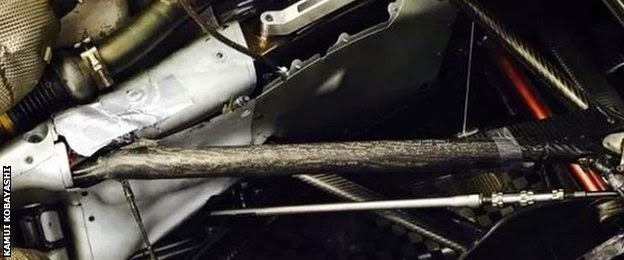
Kamui Kobayashi retired from the Russian GP. At the time he said there was nothing wrong with the car but that the team wanted to save mileage on parts. Now, it seems he was protecting the team and himself - he thought his suspension would collapse following a botched repair.


The BBC has seen Kamui's personal Facebook page, which is only visible to friends of the Japanese driver, where he posted this photo and several updates on the car.

On the Friday of the Russian GP Kamui posted: "Scary! Last night a suspension defect was found. There's no spare so it was repaired by wrapping it in carbon. It's checked all the time but, even so, being asked to race like this is too scary! I want to go home already. From here on there are still practices and the race to go. I'm seriously troubled. As a racing driver, should I drive? Should I safely decline? I drive again in 15 minutes…"

Caterham told the BBC Kobayashi was, "...kept informed at all times and at no time did he have any reason to believe it was not safe," and, "It was extensively evaluated at Sochi and Leafield and ultimately a carbon-fibre wrap was applied to provide additional reinforcement - a normal procedure. The component was signed off as safe and re-checked between each subsequent session, to be absolutely sure there was no issue." 

Scary stuff, especially following Jules Bianchi's accident in Japan the week before.

By Matt Hubbard


22 Jul 2014

The New Volvo XC90 Will Be The Safest Car Ever

Volvo's stated aim is that by 2020 no-one will be killed or injured in a new Volvo car. The new XC90 should set the company on the path to achieving that aim.


We're only seeing the XC90 piece by piece - the full reveal will be in August - and Volvo has just released the latest batch of info - which concerns safety.

Volvo reckons the XC90 will be a safe car by virtue of its construction and its electronic systems.

Run off road protection is a combination of both, and it's a world first.  If the car detects that it's headed off road in an uncontrolled manner the seat belts are tightened all the while it is in motion.  The seats are designed to protect the spine when the car encounters a hard landing.  Finally Lane Keeping Aid steers the car to try and prevent an accident in the first place.

Auto brake at junctions is another world first and prevents the driver from pulling out of a junction into the path of another car.

On top of these the XC90 will come equipped with rollover prevention (in which it tries to prevent a roll over by using the brakes and steering), City Safe (which automatically prevents collisions with cyclists and pedestrians), Extended Road Sign Information (where road signs are read by the car and displayed in the dash), Queue Assist (slow speed adaptive cruise control) and various other systems.

The car itself is constructed using boron steel (the strongest steel used in the car industry) to protect the occupants. 40% of the total body weight is boron steel.

The XC90 will also get parking assist which will be able to park the car in a supermarket car park spot as well as parallel park.

The driver will also get a 360 degree bird's eye view of the car so he or she can judge how close other objects are.

By Matt Hubbard


11 Jul 2014

All Geared Up - How To Choose The Right Motorcycle Gear

In 20 years on and off riding a motorcycle I have probably ridden 20,000 miles, but 10,000 of those were in 2012 when I decided to take the car off the road to hone my riding skills in all weathers.  If it rained or shined I had no option but to get togged up and onto 2 wheels to get to work or wherever I needed to be.

This experience teaches you a lot a lot about vehicle control and very importantly about what gear is required to keep you warm, dry or cool depending on what the weather has thrown at you that day.

When you first take your test or indeed any additional training which I have done (IAM course is well recommended!) they don’t give you any advice about what to wear or how to wear it.  I have found that reading bike magazines can help a little.  Ride magazine regularly carry out long term detailed and scientific tests on all sorts of gear.

Whilst this is helpful you also have to remember that every human is a different size so even when ordering recommended clothing off the internet it might not fit and you end up living with it - either too big or too small, thinking it will ‘give’ a little when used. In addition it's very expensive to kit yourself out in recommended gear and to buy all new, you could easily leave a shop having spent four figures on your credit card.

Motorcycle clothing has two main purposes;

1 - to protect you should the unthinkable happen and you end up sliding down the road at 70 miles per hour, into a kerb, or even under a car, so it is generally made from leather, which has excellent abrasion resistance, and armour, to cushion impacts on vulnerable parts of the body, or parts that will take an impact such as shoulders, elbows and knees.

2 - to protect you from the elements by keeping you warm and dry so your mind is focused on your riding rather than cold/wet parts of your anatomy.

It is regarded that motorcycle clothing should be a snug fit so the armour doesn’t move in the event of a fall.  It is worthless if it is not positioned in the area it is intended to protect.

Let’s start with your helmet, which serves to protect your most important commodity, your brain.  Without your grey cells working propely you fail to operate.  In an impact your brain moves in your skull. The helmet shell protects your skull from impact and the padding stops your head moving within the helmet.  You need to cushion your skull from impact and stop your brain moving too much in your skull which causes brain damage. Scary stuff hey.  Do it right and do it properly.

First off always buy new and always ensure it fits right. Go to the motorcycle clothing shop.  Try many different makes on as they all fit slightly differently.  Take advice from the salesperson to ensure it fits properly as it’s better to be tighter and give a little than slightly loose and loosen up too much. 

At this point you will end up with red ears from trying on lots of helmets but believe me it’s worth getting it right.  If it’s not comfortable move on to the next. Remember, a better fit is vastly more important than an expensive helmet but try to get the most expensive you can afford as generally the more you spend the better quality materials and testing it has had. 

If you like a specific helmet from the larger manufacturers such as Arai and Shoei they can sell different padding to ensure the one you like fits properly. If you still want to save money go find and buy the same helmet you like on the internet, knowing it will fit.

Now you have it look after it.  Don’t drop it as the shell gets damaged easily so if you do have an off it will not do the job it was designed to do. Even if it drops off your bike seat a helmet will lose strength.  Think of an egg shell breaking - once damaged it is visibly damaged and weakened but a motorcycle helmet doesn’t show its shell is weakened - another reason for not buying secondhand as you do not know the history. So don’t leave it on your bike seat or tank when on its side stand and keep a location at home or work where it's flat, dry and safe. I keep mine in my top box when out as it can’t fall from there.

Next up is the jacket and protecting the second most important item on your body - your core. You need to be warm at all times otherwise you could ultimately lose concentration and experience numbness, pain, drowsiness and weakness which will massively affect your ability to ride safely. 

Leather or textiles are your down to personal choice.  I have both and use the textiles for cold wet weather as leather isn’t waterproof. Ensure there's armour in the shoulders and elbows and you can move around freely in it. Your choice of bike can also dictate what you wear, not just in fashion but in design. For example a sportsbike with bars and seat at pretty much the same level is the perfect environment for one piece leathers as if you were to wear separates you might get plumber's crack and rain running down your undies.

For a leather jacket try to keep it a tight fit so the armour stays where it’s designed to and just enough room for a couple of light layers underneath. For textiles I bought mine with a slightly bigger fitment so I can get some more layers underneath as I wear this when it’s colder. The armour's still in the right place but I am warm.

In warm weather leather jackets have vents to open to let some cool air in and you can open the main zip a little, not a lot as you want it to stay on you in the event of a tumble.

Note - outside pockets aren’t waterproof so don’t put phones, wallets, cigarettes in them if you want to keep them dry.  Instead use an inside pocket, which should be waterproof.

For trousers try to buy the same make as your jacket so that they zip into each other at the waist.  This makes a massive difference for keeping in the heat and also safety as they hold together in the event of an off. Again look for armour on the knees and also the shins and look for some padding on the hip. I wear my leather trousers all year round and use overtrousers if it rains.

Motorcycle Boots offer protection not just to your feet but your ankles and calves - areas which could get injured very easily by a car or low wall. Firstly ensure they are not too big for you and could come off in the event of an accident when the socks you are wearing would end up being your only protection. 

As with most items of clothing try these on at the shop.  Whilst motocross boots look mean they are very rigid and make changing gear on a sportsbike very difficult. I bought some Alpinestars size 9 off the internet after trying some size 9’s on in a shop.  When I put them on they were very tight. It turns out I bought the waterproof ones with a gortex liner which made the boot a tighter fit. A good tip to break boots in is to go for a walk in them.  I walked the dog out in mine every night for a week and they soon gave a little. It took 6 months to get them to a comfortable fit though.

You can buy the best boots in the world that have been proven to be 100% waterproof but you must remember that there is always a large hole in the top where you put your feet in. I have been caught out many times in heavy rain when the water runs down your leg and into your boot and they act like a tank to collect water. Not fun. Now I carry some simple overtrousers and when I suspect it may rain I pull over and put these on, their main purpose being to divert water over the top of the boots so my feet remain 100% dry.

For any bikers out there who have struggled to put on waterproofs quickly and with your boots on at a bus stop ensure you keep a plastic shopping bag with you. Simply step into the bag with one boot and hey presto the waterproofs slide over your boot like a warm knife through butter, transfer the bag to your other boot and in 60 seconds you have your waterproofs on. The bag ensures theres no abrasion on the rubbery boot surface for the grippy inside of the overtrousers to catch on and you stay upright rather than tripping up and ending up sat on the floor. Been there done that!

Gloves, you can’t have enough pairs of gloves as they get dirty, wet and you often try different ones depending on summer or winter in a bid to keep your fingers from freezing or overheating. I try to look out for ones with some carbon or Kevlar protection on the knuckle, not just do they look purposeful but they also offer good protection to your knuckles which is the most likely place you will get any injury as you cling to your still beating bike flying sideways down the road. As I ride through most months in varied weathers I look for gloves that are longer in the wrist area which offer more weather protection as you don’t want to get your fingers wet as the padding starts to go out of shape and the seams move so they are uncomfortable.

My top tip for gloves is to ensure they are positioned inside your jacket whenever it’s looking like rain, when it rains the water pours down your arm and into you gloves and they fill up like a balloon under a tap and you lose what feel you had over your minor controls. Unless you ride a chopper with huge cowhorn handlebars you are always better off tucking your gloves inside your coat and zipping it up to ensure a snug fit, I have never experienced wet arms from water going between gloves and coat this way. On a personal note my right coat sleeve is harder to fasten so I do zip the right one up first and then the left using my right gloved hand. It’s trial and error to whatever suits you.

For anyone out there who doesn’t have a snood I would recommend the next thing you do is get on line or to your nearest shop and try one. They bridge the gap between your coat collar and helmet and act as a plug to stop wind getting down your jacket and making you cold. In addition they stop the rubbing you get from abrasive coat collars. When it’s really cold I use 2 to really keep the drafts out. I have an Oxford one which is better made than the other non-branded one and keeps its shape better. As mentioned I have 2 and rotate them weekly, washing when not in use to regain their elasticity, oh and also smell nicer.

With regards to waterproofs it’s best to wear proper textile tested to destruction and monsoon type weather clothing but not everyone has the funds to have both leathers and textiles. My experience has shown me that normal waterproof overtrousers and waterproof overjacket over your leathers can work well to keep the wet away and keep you dry until you get home. The main places where you get wet are in the boots from the rain running down your leg, in the crutch from water running off the tank and collecting just in front of you and your neck where the top of your jacket meets your helmet. I tried a 1 piece rainsuit on numerous occasions which was a nightmare to put on over leathers and in the end bought a simple 2 piece oversuit which is perfect as a temporary measure.

The last item of clothing on the list and is easy to forget is undergarments - thermals, mid layers and base layers. The base layers are designed to draw sweat from your skin, known as wicking and also act as an insulating layer. These are generally a thin elasticated long sleeve top and separate ‘long johns’ and cost circa £25-30 each. Mid-layers are a thin compacted fleece material which offers wind proofing and heaver insulating properties and are long sleeve tops with a slighty higher collar. You can also get ‘Long-Johns’ as midlayers but these are for more severe conditions than we have in England. The final layer top is a fleece to add extra insulation to your core and help keep the wind off the base layers. The beauty of the laying system is that its not too bulky to wear under you existing coat and trousers so you can be comfortable and not too hot.

So now you have bought all the gear you now have to decide what to use on the day. Depending on your journey you should always think about how long you are out for, what the weather will do, where am I going and where can I stop. If its dry then it's leathers, and your choice of under layers.  If its dry but you expect rain, why not put on your leather trousers and textile jacket and take some over-trousers in a tank bag. If its rain then it’s the full monty of waterproofing and I even put on my tankbag as it keeps the rain from running off the tank and pooling in the crutch region.

Now think about how you wear the items.  Do I need to open the vents, close the vents, do the main zip all the way up or leave open a little for fresh air?  Do I need to open my helmet vents to let in fresh air or is rain due and the rain will get into the helmet, it then stays wet and can get mouldy.

If you have a black visor for really sunny days (when it’s quite frankly dangerous to ride with a clear visor) then always carry a clear visor in case the weather turns or the police pull you over. Black visors are illegal for road use even though you have better and safer vision that wearing sunglasses so be on your guard and keep the excuses at the back of your mind ‘well officer it is a perfectly clear sunny day and I thought it safer to wear this visor than my clear one to protect my eyes from the sun.  If the weather turns I can quickly swap to my clear visor which is here in my top box!’

Note I experience misting up issues last year and found the pinlock system on my Shoei (or a fog insert product) to be a fantastic solution, it works by keeping a screen of plastic about 1mm away from the visor inside and it acts like double glazing, it simply doesn’t mist up. My black visor steamed up in cold weather, mornings, and in the rain as it didn’t have a pinlock or fog-guard. No matter what products I used on the inside it steams up in certain conditions if you do not have a fog insert. Seriously consider getting a fog insert or pinlock system if you ride a lot, it really could save your life.

Riding in the rain can be tricky and on the subject of visors I would heavily promote a rain repellent so that the rain beads off your visor. Light mist can be difficult to see in but with the rain repellants sprayed and wiped clean regularly on your visor you simply turn your head and the water runs off.

Often when I go on a journey there’s something which annoys me.  Maybe my jacket isn’t done up enough, I have left a pocket open or I didn’t put on overtrousers when it was looking like rain. At this point I think WHY DIDN’T I just do this or do that?  Now at the start of a journey I think WDI before it happens, then think about the weather, where I’m going and then look at buttons, vents pockets, zips, visors and then set off happy that I’m going to be happy. Why don’t you try that next time you go out!

With all of the above put into practice I hope you can stay warm and dry but I have listed below a few additional tips:

1 - When you buy new gear, always keep the old gear in case of emergency. If for example the heavens open and you get soaked to the skin, if you have kept your old gloves, boots, leathers you can wear them the next day whilst your wet gear dries out. Wet gear can take days to dry out.

2 - Don’t dry out motorcycle clothing on radiators.  Leave to naturally dry in the house over the back of a chair or window sill. Heat dries out and causes cracking which in the  long term damages leather.

3 - If you really can’t keep your hands warm with just gloves then try heated grips.  They can be bought from just £40 and are fairly easy to fit and make the world of difference when the weather is freezing or just when wet.

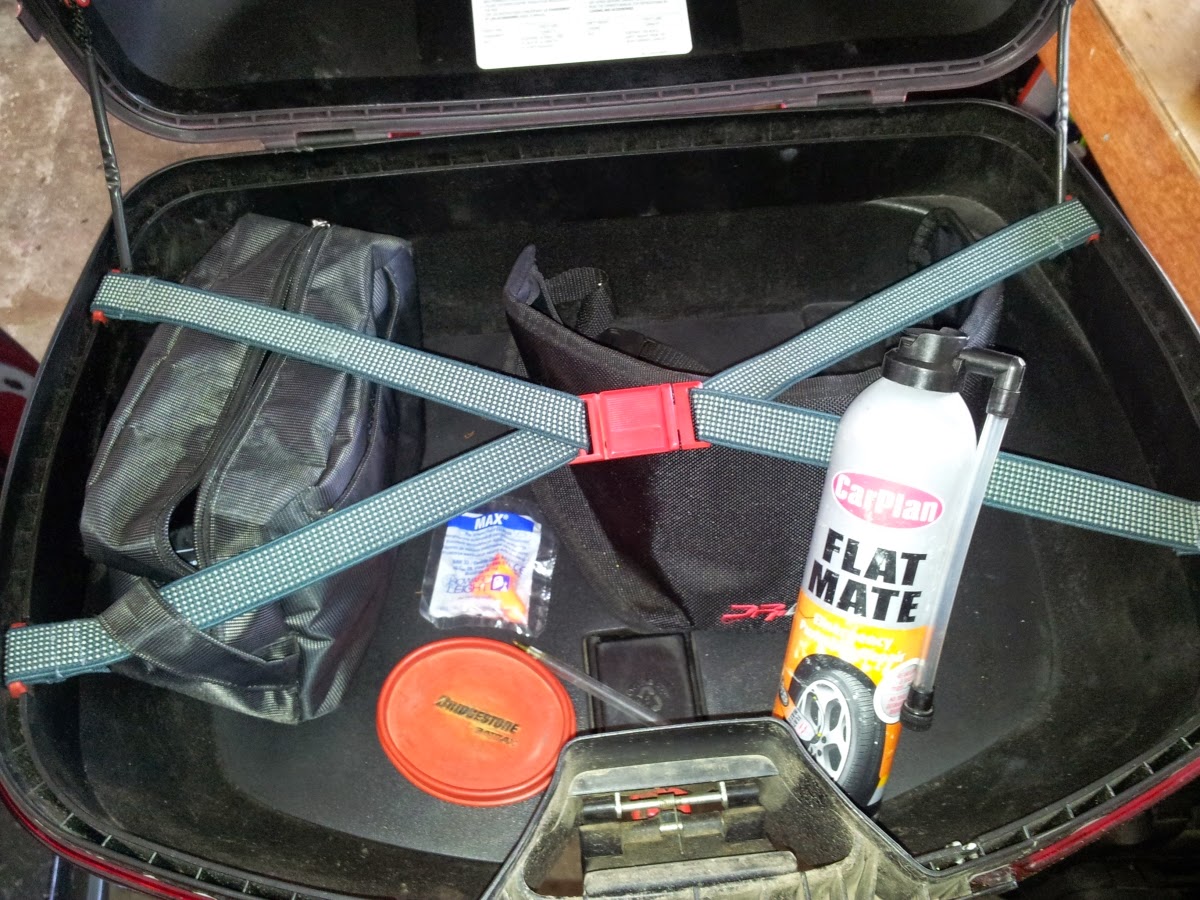
4 - If you ride on a daily basis seriously consider a top box, they allow you to safely and securely take items/shopping with you and at the other end store your helmet, gloves etc so you don’t have to walk around with them. In addition put a toiletry pack inside and keep essentials such as a tin of tyre weld, a pen, baby wipes and a side stand plate to stop you sinking in the mud when you haven’t got an old beer can.

Thanks for reading and if you have any tips please add as a comment.

Article by Colin Hubbard

29 Apr 2014

The Speed Kills Campaign Is Just Stupid

I am not usually one to rant, at least in writing, but today something pushed me over the edge. Something needed to be done, something stronger than an email to the BBC or a letter to The Daily Telegraph.


I turned to SpeedMonkey.

The question of how high or low speed limits should or should not be is one that has been pondered over for as long as we have had cars on the road, and it will continue to be debated until such time as we can be transported in an exciting Star Trek like fashion.

I will make it clear now that I am open to both angles of the faster-slower argument, provided there is enough evidence to back up a point, but that I personally sit squarely on the “We-Can-Probably-Go-Faster-Without-Killing-Ourselves” side of the fence.

Having driven a fair bit as part of my job, in both the UK and elsewhere in the world, I’ve been lucky enough to experience all sorts of different road cultures, from the mad and altogether slightly alarming bicycle-crazy Amsterdam, to the faster and still just as alarming Autobahns of Germany.

As a result, what I believe absolutely is that speed does not kill. Before you reach for your shotguns, please allow me to elaborate.

I am not for one moment trying to belittle how serious deaths on the roads are - it is something I try not to think about too much when driving, but it does terrify me, the idea that it can happen to anyone at any time, and I am aware of that every time I step into a car.

I am also not trying to deny that the speed at which an impact occurs, whether it be between a car and another car, or someone’s head and steering wheel, makes a difference to the injuries that people experience; It’s basic physics, and the faster you go the more energy and momentum there is.

But my problem with the tagline ‘Speed Kills’ is that, yes, higher speeds mean you have more energy and the forces involved are greater, but that very line puts speed as the cause, which it isn’t - speed merely contributes to the severity of the accident.

If I drive on a straight road with nothing to hit at 50mph or 70mph, I am not in any more danger than if I were driving at 250mph. Of course, if something does go wrong then you have more energy in the car and you might not be able to respond to a situation as well as if you were going slowly, but the key there is “if something does go wrong”, something outside of the domain of ‘speed’ - speed is just a number and doesn’t ‘try’ to kill you.

Besides, the idea of living a life of fear, not driving anywhere with any pace for fear of being killed isn’t one that many of us would choose to live. It would be like not going outside for fear of being hit by lightening.

For speed to kill, it needs to be combined with something else, in the same way a gun is not a killing machine left to its own devices, locked away in a box.

Driving at an excessive speed in proportion to the conditions, taking unnecessary risks, exceeding your abilities and the abilities of the car, driving too quickly on an unfamiliar road, driving after a few too many sherries etc. causes the accident, speed just means there’s going to be more damage done if something goes wrong.

This rather long argument of mine (I apologise) is why I felt somewhat irritated at a leaflet that was put through my door this morning.

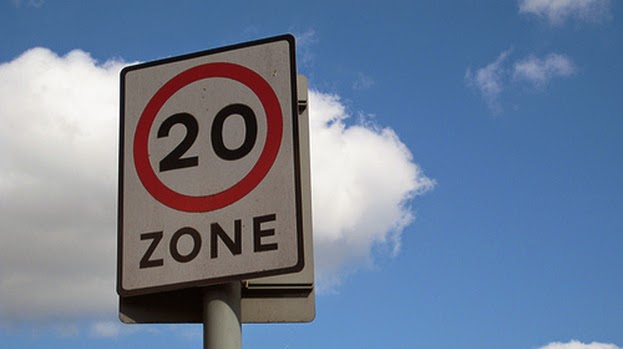
The slogan read “20’s Plenty”, and the headline asked “Would you like your town to be a better place to live? Do you want safer, quieter streets?

If you haven’t made a cup of tea recently, I suggest you do it now before you continue reading.

Essentially, the leaflet is part of a campaign to let people know that there is a consultation in my town of Worthing to decide whether imposing 20mph limits in residential streets is a good idea. The catchment area for the lower limits include almost every road in the town, with the exception of the slightly larger roads that act as the town’s arteries.

So, the following paragraphs detail what the leaflet says, and I have responded as best I can with my opinion. You might agree, you might disagree - regardless, this is what I have to say.

Would you like your town to be a better place to live? Do you want safer, quieter streets?

Yes, of course I would like my town to be a better place to live - I am not a child of the devil who wishes pain and suffering on all. But does lowering the speed limits clean the streets, or make homes more picturesque, or reduce poverty and malnutrition? As far as I know, it does not.

Of course I want safer, quieter streets, but safety is, as I have explained, not defined by speed, but by a number of other factors like how you behave or decisions you make. Jumping in front of a car, regardless of the speed, is not a good idea.

And as for making the streets quieter? Volume relies on so many factors, none of which is specified in this flyer. Tyre profiles make a difference, engine type and size make a difference, gearing makes a difference, road surface makes a difference, music makes a difference, a faulty car makes a difference. If you’re driving a Toyota Prius at 20mph on 24 inch wheels with studded tyres, on a broken surface, with a stereo playing Queen at such a volume that you’d be forgiven for thinking Brian May was actually in the car, I can guarantee it would make a lot more noise than a Ferrari Enzo driven respectfully at 30mph on a good surface and in the right gear. Speed has nothing to with it, and the idea that the turbulence created by a car at 20mph would be dramatically less than a car doing 30mph is laughable. Ramp it up to 180mph and you might have a point.

The next few lines raise some more issues: “No cameras, no speed humps, just the people agreeing to make our town a safer, more pleasant place for everyone.

No cameras or speed bumps means no enforcement, and the majority of people will not pay attention to a sign if the conditions will allow them to drive at 30 rather than 20. If there are people around then, of course, they might drive at 20, but that’s using common sense, something that this leaflet assumes drivers do not have. If there’s no extra enforcement, what’s the worst that will happen? A disapproving shake of the head from a pedestrian? Oh, the shame.

And lowering the speed limit does not make it a “more pleasant place for everyone” - driving to the conditions and not behaving like a tit will make it a more pleasant place for everyone.

This is your ONE chance to make your voice heard. If you would like safer, quieter streets for children, for pedestrians of all ages, for cyclist and for drivers, then … Please vote YES!

This is not our “ONE” chance to make our voice heard, as we live in something of a democracy and we’re quite happy voicing our opinions. (Also, note the desperation in their use of capitalisation.)

Safer, quieter streets…” - are you noticing a slight repetition of something that's fundamentally flawed and quite idealistic? “For children, for pedestrians of all ages” is another hilarious cry for help, because as I understand it the pavement is designed for pedestrians and the road is designed for cars. Crossing the road is a choice the pedestrian makes, and reducing the speed won’t make the pedestrian’s choice to cross any more dangerous. If a car is doing 20 or 30 and you step in front of it when it’s five yards away then you are going to be killed, regardless.

One final word on that paragraph is that they should have said ‘cyclists’ not ‘cyclist’ - proofreading usually helps with campaigns.

Better for the community… All of us will feel safer and happier to walk, cycle or chat with neighbours.

It is not better for the community. We won’t feel safer and happier to walk as, I say again, we shouldn’t walk in the road, nor do we chat with our neighbours in the road, and happiness with walking is not dependant upon car speed. Having a broken leg would make you less happy to walk, not passing vehicle speed.

Better for health… Walking and cycling for short journeys is great for getting more exercise. Parents can be more confident about letting their children walk, scoot or cycle. Avoiding short car journeys reduces air pollution, and saves money. Traffic noise problems will be reduced.

In this one statement, the writers are making so many assumptions and ideological statements that they might as well have a say in every aspect of governmental and legislative life.

Let’s work backwards. Traffic noise problems will not be reduced, as I’ve said. Avoiding short car journeys, of course, reduces air pollution and saves money, but so does not breathing or moving? If I want so spend money driving a car then that’s my decision.

Parents can be more confident about letting their children walk, scoot or cycle” is a statement that provides a number of issues. Parent confidence is not necessarily proportional to local traffic speed. Your child’s ability to ride a bicycle would make you more confident, as would them wearing a helmet, and remember that if they’re cycling on a road then they are a vehicle of the road, and surely it is as much their responsibility to behave appropriately for the road and the conditions as it is a car’s.

Better for health… Walking and cycling for short journeys is great for getting more exercise” is a line that I read in disbelief. This has nothing to do with reducing the speed limit, unless you are insinuating that I will become so unspeakably angered by the lowered limit that I will quit driving. I spend most of my time on a bicycle, and so if I’m in a car I’m either driving a car to review it (something that I need to do if I want to eat and, in general, live on anything other than bread and water) or driving a journey that would be impractical or impossible by foot or bike. Worst of all, though, is that this is an idealistic, lifestyle statement. As I spend so much time driving, I’m fully aware that if I don’t exercise I will end up looking like Jabba the Hutt after a heavy night in McDonalds, and as such I spend my free time cycling, running, boxing, walking… This reads more like an election line for the Green Party than a legitimate argument as to the benefits of lowering the speed limits. I’ll exercise if I want to, so leave me alone and let me drive my car.

Better for safety… If a child steps out three car lengths in front of you, at 20mph you could stop in time. At 30mph you would hit them still doing 27mph and potentially seriously injure or even kill them. Hit at 20mph and there is a 99% chance of survival.

Firstly, I could point out that a child should have looked to see if there was a car coming, but I’m aware that these things do happen, so that hardly seems a valid point for me to argue. But, as usual, this statement does not take into consideration the car that’s being driven. Good maintenance, decent brakes, and paying attention to the road could mean you brake in time - it is not a certainty that you’ll hit them.

Will journeys take longer and use more fuel?... No, there will be little or no change to journey times: most people live within 500 meters of a 30mph through road. Driving more slowly at a steady pace will save fuel and reduce pollution, unless and unnecessarily low gear is used.

This is getting tiring. Speed is distance over time, so if you needed to travel 30 miles one afternoon, at 30mph it would take one hour, and at 20mph it would take one and a half hours, 50% longer. So what if you live within 500 meters of a 30mph zone? That doesn’t make up for lost time. And really, the pollution argument again?

Finally, the leaflet asks “Who supports the 20mph limits?... The majority of the public; Road safety groups; Health organisations; Cycling organisations; The government; People like their street to be a quieter, more pleasant place to live.

To make statements as bold as this, with no evidence or reference to names, is, to put it kindly, flawed. The majority of the public are not in favour, and for the last time: lowering the speed limit will not clean up our roads, make them more picturesque, improve out health, happiness or wellbeing, or make our streets quieter and more pleasant places to live!

I am not against better road safety, but reducing the speed won’t change the way people drive, make them check their brakes, force them to focus more on their surroundings when there are lots of pedestrians nearby…

We need to change the way we approach driving before we change the limit.

By Sean Ward


24 Feb 2014

What Is The Point Of Speed Cameras?

Asking what is the point of speed cameras might seem like a dumb question.  To stop people speeding is the obvious answer.  But think about the wholly inappropriate locations of most cameras and the answer could just as well be, to generate revenue.  Or to control us.


Speed limits are often sensible but often they are not sensible.  A 30mph limit in a village is sensible but that last 100 yards of 30mph limit outside of a village, before it turns into a 60mph limit, is not sensible.

For a speed limit to be appropriate, and to be respected by drivers, it must be located in a place where it makes sense for it to be located.  Why is that 100 yard stretch of open road, with no driveways off it, protected by a 30mph limit whilst an identical stretch of road just after it has a 60mph limit?

Usually because 30mph zones reflect parish boundaries.  So if the parish extends half a mile into rolling countryside where the road is open and wide and contains no major hazards the limit would still be 30mph until such point as the parish boundary ends.

Yet this is often where fixed and mobile speed cameras are located.  I have previously pointed out two examples, one in Oxfordshire and one in Berkshire.

I was also stopped and fined on the Isle of Man on a section of the TT route.  I had filled my bike with fuel and turned left out of a petrol station.  The road was clear (and had no buildings either side) and I accelerated through the last few yards of the 30mph section into the 60mph zone.  A policeman was hiding behind a stone wall and zapped me doing 38mph.

Yes I was wrong and yes it cost me £200 but what was the policeman doing, hiding with a speed camera, on a section of road where I would cause no harm to anyone, instead of in a busy town or village where I could genuinely be a menace at that speed?

The answer to this and the vast majority of speed camera locations is twofold.  One is to generate revenue and the other is control.

Police forces, councils and government love extra money. Tele-Traffic, who make speed cameras told undercover newspaper reporters who were posing as Eastern Europeans looking to buy Tele-Traffic cameras for their country that they could catch, "businessmen in the morning and school-run mums in the afternoon," and that, "Setting up cameras in new areas was the equivalent of having 'a blank cheque book', guaranteeing 'when you first set up you will have lots of offences, you will have bucketfuls'."


Speed cameras, and speed limits, on motorways are just as bad.  The limit is 70mph but 70mph is often stupidly slow, and sometimes too fast.  It depends on the road conditions, traffic, availability of a hard shoulder.

Modern cars with competent drivers at the wheel could quite easily and safely travel at 100mph for mile after mile.  Yet we are all treated equally and made to travel at 70mph, and targeted by hidden mobile cameras operated from motorway bridges.

Ideally a higher level driving test could be taken by those wanting to drive at higher speeds on roads were it is safe to do so.  Those who pass the test would have a magnetic disc to attach to whatever car they are in at the time.

At least that would be fair, because right now a lot of speed limits are ridiculous and speed cameras exist not to slow drivers but to punish those who transgress by a couple of mph.  But it would never be implemented because the state is too stupid to realise that humans are capable of intelligent thought.

The M62 around Birmingham is, for me, the most stressful road in the entire UK road network.  The sheer randomness of the variable speed limits - 40, 60, 40, 50 within a few miles - means having to constantly watch the speedo instead of the road.  If the limit on the overhead gantry is set to 40 (even if the road is clear) and you do 42mph you will be caught, processed, fined and points added to your licence.

More money and control for the state.  Less respect for the state from motorists.

Variable speed limits and cameras can now be found on the western section of the M25 and around Bristol on the M4.

It makes journeys much less pleasant.

If I need to travel to the south west I now use the A303 but even that has its share of mobile speed traps.  A local recently told me about a mobile camera which was held by a police officer in a lay-by.  The officer was hiding behind an HGV.

How is that meant to benefit anybody other than Somerset and Avon Police? 

I was recently travelling on the A34 just south of Oxford.  The road was quite busy but the traffic was flowing.  We were doing 70mph when all of a sudden the traffic slowed sharply, which is a dangerous occurrence on any road.  

The cause was a mobile speed camera in a lay-by.  Drivers saw it and immediately braked for no reason other than the instinct not to be punished by the state if they were briefly travelling at 73mph. 

The mass of traffic meant that nobody would have physically been able to travel at more than 70mph yet Thames Valley police had decided to place a man in that lay-by for the morning, causing more danger than if he had not been there.

Speed cameras, unless they are protecting road workers, schools or other sensitive locations are disingenuous and do nothing to protect anything other than income for and control by the state.

By the way, I live on a 60mph road.  My driveway directly abuts the road.  Half a mile away there is a 30mph section of road with no houses abutting it.  Where do you think the mobile camera is often parked?

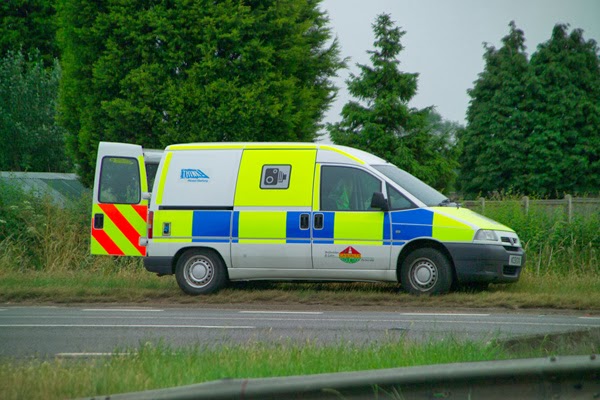
The speed camera van in the photo say THINK on the side.  I have thought and I think speed cameras should be abolished and should be replaced by real police men and women who are able to use rational judgement.

By Matt Hubbard


10 Jan 2014

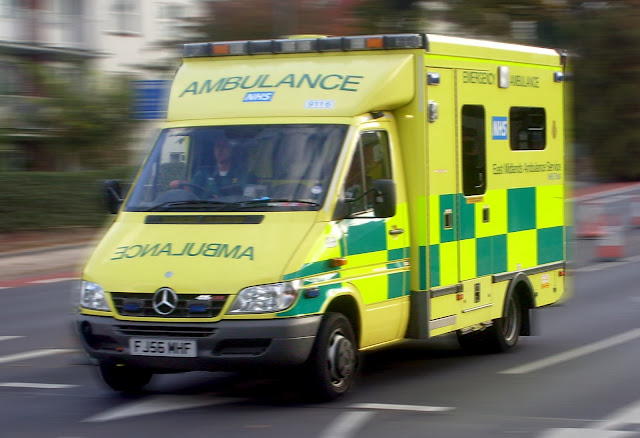
What To Do If You See An Ambulance Approaching

The question of what to do if you see a blue light ambulance approaching in your mirrors was posted on the Speedmonkey Facebook page recently, and we got a response from an ambulance driver with some sage advice.  


Facebook page admin Bill Whitehouse asked:

"Interesting dilemma; do you drive up the kerb to allow the increasing number of para-ambulances to pass or do you expect them to do similar and trash their wheels? BW"

The response came from "blue light response ambulance driver" Dave Tillyer:

"I believe drivers should be educated on the best way to handle emergency vehicles. We would never expect a member of the public to mount a curb or to move their vehicle in such a way as to potentially cause damage.

There are a few things you can do we would appreciate:

1. Slow down significantly or stop. It is very frustrating trying to pass a vehicle doing just below the speed limit. Our ambulances aren't very powerful.
2. Don't stop near central bollards or vehicles that have stopped on the opposite carriage way.
3. If a car stops in front of you, use your mirrors before swerving around them (although this should be common sense).
4. We often use the opposite side of the road. If you see this try to slow and allow a larger gap for us to slot back in. Other than that most road users are courteous and helpful. Ultimately we are trying maintain progress and get to sick or dying people as quickly as is safely possible."

So there you have it.  Follow Dave's advice and you'll make the roads a safer place.

By Matt Hubbard


24 Dec 2013

How To Drive Through Flood Water - Buy A Land Rover


Speedmonkey HQ is situated in West Berkshire, where we've had some fierce storms, leading to various tributaries of the River Thames bursting their banks.

That's problematic for most drivers, who can't get through.

But it's no problem if you own a Land Rover.  Here's me in my wife's Discovery 2 sailing through one of the flooded roads whilst all around lose their heads (engine heads due to ingress of water into the engine).  Being a Land Rover the air intake is high up in the engine bay.

If you need to drive through flood water, buy a Landie.  I witnessed a woman in a BMW X5 drive through that same stretch of road the last time it was flooded.  The car stopped as water (which doesn't suck, squeeze, bang or blow) killed her engine.

Stay safe folks!

Matt Hubbard


10 tips to avoid crashing your car

Speed doesn't kill you.  It's the sudden stop that kills you.  An age old phrase but true enough.  Add in the fact that when in a car you are surrounded by 1,500kg of metal and plastic that can easily deform and crush you, or at least parts of you, in a collision and it's pretty obvious that the best course of action is to avoid having a crash.

Think

How often do you drive like a zombie?  How often do you realise, whilst on the motorway or in slow traffic, that your mind wandered and you can't remember what happened over the past few minutes?  You do it, I do it, we all do it.  It's part of human nature and the sooner you realise you are in the 'zombie zone' the sooner you snap out of it and get back to driving with your mind rather than just holding the wheel.  But thinking is more than just being aware that you are driving the car.  Think about everything.  Think about mistakes you made and think about how not to repeat them.  Thinking about how you drive has everything to do with the rest of the rules.

Observation

Do you observe everything around you?  Really?  When police drivers are going through their training they have to narrate everything they see and do with no hesitation and no mistakes.  This is played back to them after the drive and the audio and video compared side by side.  They can be failed if the two don't match.  Do this yourself and see if you would normally spot everything around you.  'Car in side road waiting to turn across me, travelling at 38mph, speed limit 40, low sun obscuring vision, white Mondeo 20 yards behind, red BMW 3-Series 30 yards ahead, bend ahead, third gear, slow for bend, mud on road etc'.  The simple task of forcing yourself to say out loud what you observe makes you both more aware of what is going on and what potential hazards lie ahead - and can amaze you at how little you would normally observe when driving.

360° Zone

This is something motorcyclists learn very quickly either formally or through experience, and is equally valid in a car.  Know what is around you at all times.  Have an understanding of the 360° zone around your car.  You should always know what vehicle is behind you, to the side and in front.  Always.  This cannot be stated enough.  Use your mirrors, look over your shoulder and listen.  Not only should you know what is currently around you, you need to know what is going to be within your 360° zone shortly.  That car waiting in a side road may be in your 360° zone soon enough.  The driver might be on autopilot and pull out right in front of you.  Understand this, know that he might do it and prepare.  Slow down, allow space around you, be on high alert.  If another driver does something stupid or unexpected and you anticipated this then you have time to react and avoid a collision.  The 360° zone  matters even when stationary.  You stop at a set of traffic lights.  The car you can see in your rear view mirror is 100 yards behind you and approaching.  He might not stop.  He might hit you.  You could have avoided this by leaving space in front of you, keeping an eye on your rear view mirror and pulling forwards at the point when you realised he'd not left enough distance to stop.  This neatly leads us on to the next rule.

Plan your escape route

Accidents happen to other people if you drive properly.  But sometimes other people have their accident in the bit of road you were just about to occupy, or were occupying had you not done something about it and got out of the way.  This is why you should always plan your escape route - and it ties in with the above two rules.  An example - on the motorway you are in the fast lane (OK, lane 1) and the traffic is heavy but moving at 70mph.  Every now and again it slows to 40 for a few moments and then back up to 70 (this is because someone ahead isn't anticipating, which we'll come to).  Accidents often happen in these circumstances - usually someone driving up the back of someone else.  Both of those drivers could have avoided the accident, even the driver in front.  So you already know your 360° zone.  The traffic suddenly slows to 40 and the car behind is approaching fast. Before he hits you you should have already worked out where you are going to be INSTEAD of in the place where he will hit you.  This might be between the traffic in the fast lane and the central reservation, it might be in the middle lane or it might even be that you have allowed space ahead of you (by using anticipation).  If you constantly think of where you can escape to in case you have to escape you have a better chance of avoiding an accident.  It is for this reason I will not travel side by side with another vehicle on a dual carriageway or motorway.  You should always have space to the side of you in case you have to swerve to avoid some idiot who swerved in order to change CD, or whatever.

Anticipate, don't hesitate

You're travelling in your car.  You've observed that the brake lights of a vehicle four cars ahead of you have come on.  What do you do?  If you do nothing you might crash or be crashed into.  What you should do is anticipate that the traffic ahead will pretty soon be slowing as each driver realises that the car ahead is slowing and act accordingly by allowing space in front of you.  Don't let this happen.  Observe the road ahead and anticipate.  If you are at a side junction waiting to turn into moving traffic, observe the traffic and spot the space you can pull into well ahead of it actually being in front of you.  If the space disappears don't do a half-move.  Just wait for another space.  If you do this you won't hesitate, fluff it up and risk someone T-boning you.  Another example - you've observed the entrance to a construction site ahead. Anticipate that the road will be slippy, or that a dumper truck might suddenly appear, and act accordingly.  Don't hesitate and let an accident happen.  Don't let others' lack of observation and anticipation mean they have a crash in which you become involved.

Read the signs

This isn't a simile.  Read the road signs.  They're there for a reason.  OK, you often get stupid ones on the motorway like FOG when it isn't foggy, or a sudden 30mph limit when there is absolutely no reason for it.  But generally signs are there for a reason.  And the more signs there are means the more dangerous the road is.  Most warning signs are only put there because people have died on that stretch of road in the past.  A bend will have no chevrons warning of it's presence until at least two people have been killed at that spot in the past.  Signs cost money and councils will only spend money if they absolutely have to.  They absolutely have to if people are dying on a stretch of road because there are no signs.  Observe signs, think about what they mean, act accordingly.

Positioning

Road positioning is hugely important.  Any motorcyclist knows this.  Most drivers don't.  When you approach a corner position yourself in the road so you can see as far round the corner as possible.  Extend your line of vision as best you can by approaching left hand bends on the right hand side of your lane and vice versa.  Use your road position to be able to see further round the corner.  This way you can observe and anticipate what is going to happen.  When on a busy road position yourself so you can see the brake lights of vehicles ahead.  This will give you time to observe, anticipate and react.

Only drive as fast as you can see

Pretty obvious but do you do it?  I like driving fast but I only go round a corner as fast as I can see.  What this means is I can always stop in the space that I can actually see ahead of me.  If I can only see for 50 yards I only drive as fast as I can come to a complete halt in 50 yards.  This is an advanced police technique and prevents you, for example, hitting a car up the rear who may be stationary - but out of sight round the corner, or an animal in the road, or a pedestrian crossing the road, or even idiot cyclists two abreast in the road ahead of you.

Know your limits

Know the limits of you and your car.  It takes 1 second for the human mind to physically react to something the eyes see.  If you've observed and anticipated then you've got a head start but do you know how long it takes your car to stop at 60mph?  If not, find an empty stretch of road and practice.  If you don't do this then you'll never know until it's too late.

And finally...

This one piece of advice was taught to me on a naughty boys course (A Speed Awareness course, which is an afternoon's training in lieu of points on my licence).  It is something you would never think of but is absolutely invaluable.  When waiting, in the road, to turn right (UK roads) always keep your wheels pointing forwards.  If, in anticipation of the right hand turn you're about to make (and despite everything you've read above), you sit in the road with your front wheels pointing to the right - what do you think will happen if someone shunts you up the rear end?  You'll be pushed into the traffic coming the other way and if a vehicle is approaching you will hit it head on.  If, on the other hand, you had your wheels pointing forwards you would be pushed further along the lane you were in - thereby avoiding a head on collision with the oncoming traffic.

Article by Matt Hubbard

20 Dec 2013

How To Aquaplane And Not Crash

It's mid-winter.  It's been raining a lot.  It goes dark at 4pm.  The puddles are big and the dazzle from other driver's headlights make visibility poor.  It's easy to aquaplane.


In short the driving conditions are grim.  And it's dead easy to aquaplane right off the road.  I've thought about this over the years and adapted my own techniques for dealing with aquaplaning.

Don't be like this idiot and blame the rain.  As a driver you know deep puddles are there and you could aquaplane on them, so take control of how you approach driving in these conditions in order to prevent losing control.

First off, we need to analyse exactly what aquaplaning is.

A car has four contact patches - the tyres.  A tyre must be in contact with the road surface to generate friction - hence it grips the road.  The treads in tyres channel water from the road surface and out behind the tyre, allowing the surface of the tyre to remain in contact with the road.

A given tyre will be able to displace a certain amount of water.  If the volume of water on the road is too much for the channels in the tyres to displace then the tyre will temporarily lift above the road surface.

When this occurs that tyre will be aquaplaning and you will not be in control of it.  If it happens to more than one tyre you will have lost 50% of grip.  If those wheels are the front wheels then the momentum of the car will cause you to continue travelling in the direction you were headed in before you started to aquaplane.

This may well be towards a hedge, barrier, or 44 ton HGV on the other side of the road.

Now we know what aquaplaning is and how it is caused let's look at what you can do about not allowing it to cause you crash.

The car


You may think the car itself has nothing to do with the outcome of aquaplaning.  It does.  The most important aspect is the condition of the tyres.  The legal minimum tread depth of tyres is 1.6mm.  This is too shallow in heavy rain.  Your tyres should have plenty of tread in order to displace the maximum amount of water. The deeper the tread the more water it will displace.

Also make sure your windscreen wipers are in good order so you can actually see the road, and that your tyre pressures are correct.  Too much or too little pressure can affect how the tyres perform both in wet and dry conditions.

Speed


It goes without saying that you have less grip in wet conditions so should drive slower.  Specifically when dealing with conditions where aquaplaning may occur - i.e. you have seen a large puddle - you should lower your speed.  Remember, the tyre treads can only displace a given amount of water.  If you drive faster the tyres have to displace more water so aquaplaning is more likely to occur.

Observation


It goes without saying that large puddles may also be quite deep.  The deeper they are the more likely you will aquaplane in them.  Also, be careful of puddles at the edge of the road.  If wheels on only one side of the car aquaplane you can be pulled into that HGV, so try and avoid them if possible - without swerving about all over the place.

Another crucial aspect is to observe where puddles are in relation to the road.  If you aquaplane in a straight line then you should be OK if you act accordingly.  If a puddle is anywhere near a corner then different action is needed.

Placement


An aquaplaning car will continue in the direction it was travelling before the loss of control.  If you aquaplane on or before a corner your car will continue straight on.  Avoid driving through puddles on corners and reduce speed accordingly.  If at all possible position your car so that if you do plough straight on you are doing so in such a way as to not leave your lane.

If I see a large puddle on or before a corner I will, if I can and have no other choice, turn ahead of the puddle so the car is facing the direction the road is going in after the puddle.  If I aquaplane then it is not  off the road but down the road.

Most roads are wide enough to allow a degree of flexibility in positioning without being discourteous to other road users, and without causing a danger to you or anyone else.  Use your road position wisely.  Imagine that you might travel in the direction you were travelling in for a period after the puddle, and place your car accordingly.

Driving through the aquaplane


You have lost control.  Your wheels are travelling above the surface of the road with zero grip.  You are moving in a straight line and for a moment have no control over where you are headed.

But in a brief moment your tyres will be in contact with the road.  How you drive through the aquaplane dictates what the car does immediately after regaining grip.

It is vitally important to make sure you do nothing suddenly.  Do not turn the wheel suddenly, do not accelerate, do not brake.  Instead, keep the front wheels in the direction they were in before the aquaplane and stay on the throttle setting you were in beforehand.

In a straight line aquaplane the aim is to come out of the aquaplane with all four wheels pointing forwards and the driven wheels travelling at the same direction as the speed of the car.  If you are in a manual car it's worth depressing the clutch in order to allow the wheels to freewheel.

If you brake the wheels will skid when they hit the road surface.  This may lead to a loss of control, or someone shunting you up the rear.  If you accelerate too much you may spin the wheels more and either aquaplane further or enter wheelspin when you make contact with the road, and crash.

If you over steer you may actually induce a skid when you come out of the aquaplane.

Imagine a rally car jumping over a yump.  If his wheels are turned when he hits the road the car will veer out of control, and maybe into a tank slapper.  It's the same theory here, and the same goes for braking or accelerating.  A rally driver will keep his foot off the brake, and will try and maintain wheel speed with road speed until the point he touches down.

If you have not positioned the car correctly and have aquaplaned on a corner the car will continue to travel in the direction it was already going in - at the angle the car was in before it aquaplaned.  In this case you should maintain a steady throttle and do not apply the brakes.  Steer gently in the direction you wish to go in after the aquaplane.  Do not overcorrect the steering or you will either skid or go into a tank slapper when the wheels regain grip.

After the aquaplane


Presuming you have followed the above advice you will be in a good position to regain control.  Everything you do should be smooth and controlled.  Don't steer suddenly, or you might skid, don't brake suddenly, or you might skid or be crashed into, don't accelerate suddenly.

Be smooth.  Match your wheel's speed with the road speed and your wheel's direction with the road's direction.  Once it has happened analyse what you went through and what you did and store it in your memory bank so you know how to react next the time you aquaplane.

By Matt Hubbard


9 Dec 2013

How To Ride A Motorcycle In London Like A Pro

Nelson Piquet once said that competing in the Monaco Grand Prix was like riding a bicycle round your bathroom.  Riding a motorcycle in central London is like riding a bicycle in your bathroom but there are ten other cyclists, marksmen standing in the bath, the floor is full of potholes and every now and again a bus drives through the middle of it.


London traffic is absolutely, dreadfully awful.  London roads weren't designed, they evolved from an ancient pattern of cart tracks into the world's most stupid road layout.

Riding a motorcycle in London is not for the faint-hearted.  To even consider venturing into the smoke on a bike you need:

  • To be a vastly competent rider.
  • To know how to use your bike's controls without even thinking about it - all your brain power will be used to read the conditions ahead, to the side and behind.
  • To be a fast and good decision maker.  You make decisions in a split second and if you get it wrong you could get squashed between a bus and an HGV.
  • To be a confident rider.  You decide, you act.  If you hesitate someone will block you or you will get knocked off your motorcycle.
  • To be fearless.  Timidity is not a great attribute when the gap you thought you could squeeze through is closed 0.5 seconds before you arrive at it.  You simply react accordingly without fear and move on to the next thing without thought.
  • To be a good all round observer.  To be able to know what is in the 360° zone around you.
  • To throw away everything you thought you knew about the rules of the road and be prepared to learn new ones.
And if you possess all the above attributes you will still be a useless newbie in London traffic the first time you ride through it.

There are two sets of road rules in England - those inside and those outside the M25.  You will not find courtesy, politeness or calmness in London.  You will find aggression and drivers who care nothing about you.

After all that why would you even bother riding a motorcycle in London?  

For me there are three reasons.  1) Because driving takes an absolute age and there is nowhere to park, 2) Because biking is infinitely faster, cheaper, more pleasant and satisfying than using public transport, 3) Because it's massively exhilarating.

I absolutely love the nip, tuck, rush and constant barrage of dangers thrown at me whilst I thread my way through London traffic.  It constantly tests my skills and exercises my brain.  You get to your destination with a feeling of elation that you are alive, and didn't have to sit next to the smelly person on the tube.

Now down to the nitty gritty.

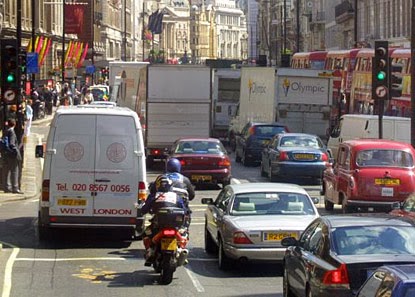
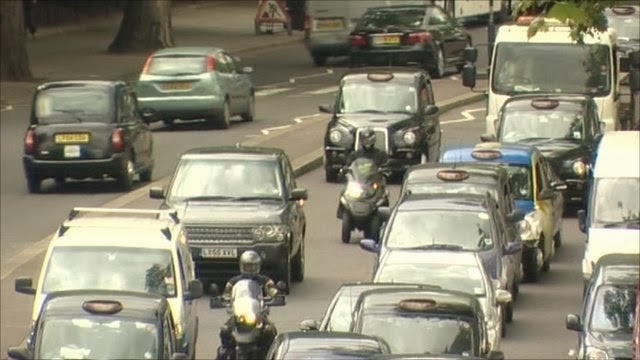
You enter London and see the traffic is quite different to that in most places.  It is a mix of normal cars, scooters, taxis, vans, private hire people carriers, HGVs, buses and coaches.  You have to consider that all of these are deranged psychopaths, but that anything with Addison Lee written on the side is a deranged psychopath who's next intended victim is you, and they are texting their friend to tell them this.

The safest way to start is by entering London on the M4.  It is a real motorway with three lanes.  At some point it becomes two lanes.

It is at this point the London experience starts.  Drivers will move over suddenly (and without indicating) with no regard for you or anyone else.  They will jostle with each other and they will shuffle forwards in jerky movements until three lanes becomes a grumpy, grumbling two.

Your job is to weave in and out of this morass of metal in a such a way that you touch nothing but lose as little speed as possible.  

You need to be able to judge distances between vehicles, both stationary and on the move.  You need to know how wide the gap will be when you arrive at it.  You need to know how wide the widest part of your bike is, typically the mirrors, to the millimetre and in a millisecond calculate if it will fit through a gap, that will possibly be smaller when you arrive than it is when you first see it.

After the M4 has turned into the A4 it then becomes three lanes again - but three really narrow lanes.  As the cars slow down you need to filter - overtake, undertake, and use whatever tactics you can to find space, be it between lanes 1 and 2, between 2 and 3 or on the inside or outside.

Like I said before, normal rules do not apply.

You will weave in and out, moving and observing.  You need to look as far ahead as possible.  You need to know when the traffic lights half a mile ahead are going to change.  You need to know what that car two cars ahead is going to do and when.  You need to know if that vast coach to your left will stay where it is or move towards you.  

Coaches are the ocean liners of London - huge, slow, dim-witted and unstoppable.

You need to not be in a position where you could get crushed.  Never sit between a car and a bus, coach or lorry.  Always see an escape route and use it.

As the traffic moves sometimes you sit in the middle lane and hang back a little so you can judge if it is best to go between lanes 1 and 2 or 2 and 3.  Whatever has the least amount of large vehicles with sharp, pointy bits is best.

But then be prepared to move across and through the other traffic into another space if that will let you move forwards faster.

At this point you will notice other motorcycles.  They will not behave as they would outside the M25.  They will not wave or nod. They will either block you by refusing to move through that gap you know they can fit through, or they will be in your mirrors getting annoyed that you have not moved fast enough.

As you move across the lanes you must always check over your shoulder for a biker coming from between the lanes of traffic.  Some of them (us) move faster than you think.

The further into London you go the more the road splits from two to three lanes and back again, the more junctions, traffic lights and bizarre roundabouts you will encounter.

You will also find pedestrians in strange and unusual places.  They dawdle in a daze with their iPods on and will suddenly appear from behind vans.  They are soft and squishy and you are hard metal.  If you hit them the law will say it is your fault and you will probably go to prison.

Your observation and anticipation must be heightened and your reactions must be lighting fast.  You must be able to stop your motorcycle in an instant without locking a wheel and falling off (if you do someone will run over you).

In order to use as much brain power as possible on riding you should use a bike mounted satnav so you don't get in a fluster about directions.  London's road layout is so insanely disorganised and downright weird that someone new to the capital's streets can get very easily confused.

A good way to improve your skills is to try and follow the couriers.  That's how I learned.  Weave in and out.  Try to never stop but rather find that gap, keep moving, turn in and out, judge gaps at speed, use whatever space is available.  Feather the throttle, use the clutch, apply the brakes confidently.

Be quick, be smooth and never stay in one place too long.  Don't let trouble and danger find you.  Identify where it might be and get out of that place as soon as possible.

You can use almost all bus lanes in London.  But so can taxis, buses and diplomatic vehicles.  All of these will move in and out of the bus lane at speed, will often stop with no warning and will open doors in your path.

When in a long line of traffic weave in and out of the other vehicles to make sure you get to the front, moving from  lane to lane if necessary.  Understand how tightly your bike can turn.  Do everything possible to get to the front.

If someone is needlessly blocking your way either beep your horn at them or rev your engine.  If they do not move they must be considered dangerous either because they are angry that you are going faster than them or because they have not noticed you.  You should get as far away from this sort as possible.

I enjoy riding in London but wouldn't do it purely for fun.  There are so many ways for you to die or be injured.  You have to be on constant high alert and be prepared to act accordingly.

Very, very occasionally someone will see you coming and move over slightly to allow you to pass.  Be a good rider and acknowledge their deed with a nod or wave.

Finally - once you have left the Metropolis you must remember where you are.  The police and other road users are tolerant of you riding in a fashion that would be considered idiotic and illegal elsewhere, because everybody does it.

If you try the same moves in your local town centre the police will spot you or a driver may take umbrage and try to enact revenge in frustration that you represent everything he wants but doesn't have - freedom, fun and enjoyment.

Article by Matt Hubbard


6 Dec 2013

Will Using Winter Tyres Increase Your Insurance?

We've published several articles about winter tyres and the general consensus seems to be they are a good thing as they increase grip and reduce stopping distance.


But would you imagine winter tyres could ever increase your insurance premium?  The thought hadn't even occurred until Paul Eldred got in touch.  Paul had noticed a letter written to the Sunday Times, and helpfully transcribed it.

Here's the letter:

"I have just fitted a set of Audi approved winter tyres and wheels to my 2012 A6 Avant. My car is insured through the RAC, an organisation committed to motorists’ safety and whose own website advises us to consider buying winter tyres.
I was astonished and disappointed, therefore, to find that the RAC will not continue my existing insurance cover and requires me to change insurer, take out a new 12-month policy at a higher premium and will charge me an additional administration fee now and when I put the car’s original wheels back on in April.

The reason it gives is that because the wheels are slightly narrower they are classified as an aftermarket modification. What can be done to get insurers to see sense and recognise the efforts of their customers to reduce risk on the road?"

Really?  Winter tyres as a modification like some chavvy spoiler and 4" exhaust tip?  Surely not.  

Has anyone else come across this before?

UPDATE:  The Association of British Insurers surveyed its members and produced this guide.  It shows that the vast majority of insurers do not charge extra for fitting winter tyres, but some do.


By Matt Hubbard


4 Dec 2013

Volvo Prove Winter Tyre's Effectiveness

Being from Sweden, Volvo might have a head start on other companies when it comes to preparing for winter conditions.   But a standard front wheel Volvo on summer tyres is quite useless on an incline in the snow.

Volvo took a pair of V40 D2s to a Snowdome and drove them up the slope.  One car had winter tyres and one car had winter tires.

The result - the car on winter tyres went all the way to the top of the slope whilst the car on normal tyres couldn't make it past the 5 metre marker.

If you've sat on the fence about winter tyres this video is a pretty comprehensive testament to the fact they work.

Of course being Volvo this is all about safety.  The Department for Transport reckons there were 5,000 crashes in the UK last winter due to treacherous conditions.

By the way, the chap in the video is Martin Bayntum - Volvo UK's Media Relations Manager and an all round good egg.


You may also like:

Winter Tyres - A View from Sweden

By Matt Hubbard


2 Nov 2013

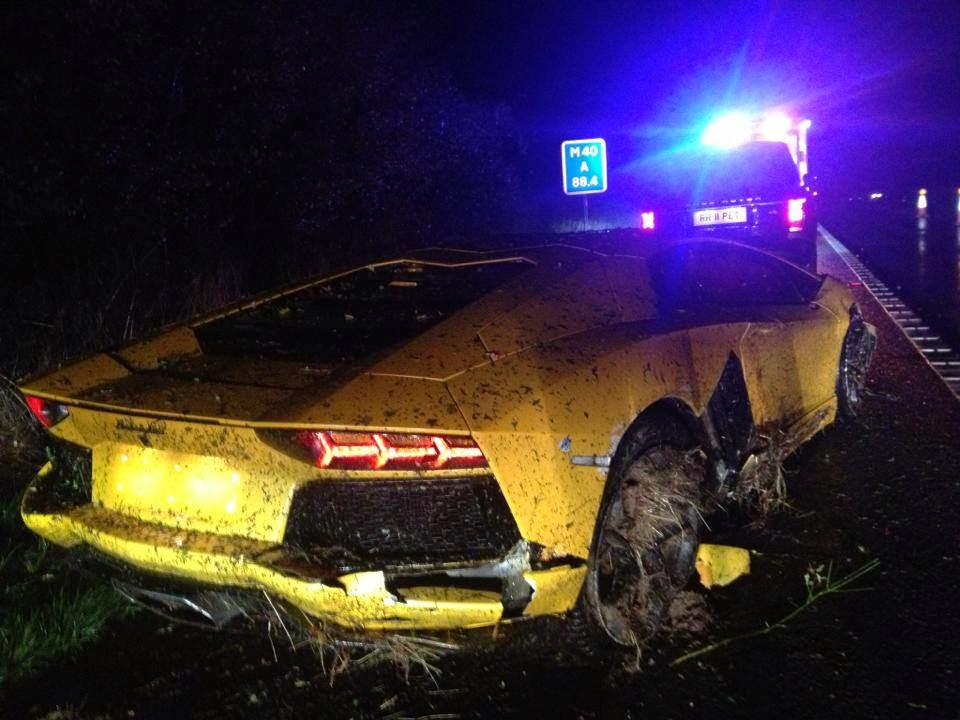
Lord Aleem Crashes Lamborghini - Incorrectly Blames Rain


There is a man on Facebook who calls himself Lord Aleem.  He recently crashed his Lamborghini Aventador and posted this photo and an explanation.

The text started with:
"Since the word has managed to somehow get around I will confirm the Yellow Lamborghini Aventador has been involved in an accident. It was caused by the torrential rain we experienced a few days ago which caused the car to Aquaplane and lose control. The damage looks worse than it actually is thanks to all the mud and grass!"
Think again about the words, "It was caused by the torrential rain we experienced a few days ago which caused the car to Aquaplane and lose control."

Aleem is blaming the rain and the car on his crash.  That is an unfortunate and common mistake.  The rain and the car did not cause him to aquaplane.  Inappropriate speed for a given situation causes you to aquaplane and lose control.  You cannot, for example, aquaplane at 10mph unless your car weighs just a few kg and your tyres are massively wide slicks.  At 10mph an Aventador's tyres will slice through the water and remain in contact with the road below.  At, say, 70mph they may not.

Only at great speed will the tyres hit water and momentarily skid above the road surface due to the grooves in the tyres not being able to displace the water at a fast enough rate.

I've no qualm with Aleem but blaming the car and rain on his crash is wrong.  He misjudged his speed and crashed so, ceteris paribus, it was his fault he crashed.

Update:  There's been quite an odd response to this.  First of all Lord Aleem posted this tweet:
To which I responded:
Then at roughly 5.20pm Lord Aleem tweeted this:

Then I started to receive lots of texts and anonymous calls, none of which I answered as I was driving:


By Matt Hubbard