Showing posts with label Dacia. Show all posts

22 May 2014

2014 Dacia Sandero Stepway Review

Mike Armstrong reviews the Dacia Sandero Stepway


Budget cars need not be cheap and uncheerful, as Dacia's new Sandero Stepway has proven. Available to purchase brand new in the UK right now, supermini buyers can mix the compact dimensions with the rugged appeal of a crossover.

What is it?


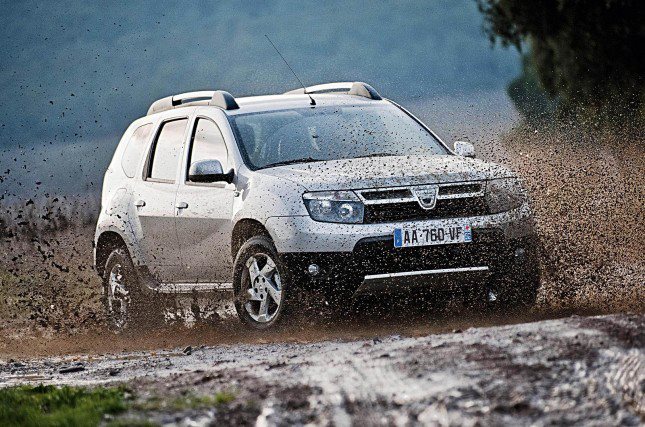
In a nutshell, the Stepway is essentially a regular Sandero with 40mm more ground clearance and off-road style body fittings, including: plastic arch extensions and bumpers with imitation underbody protection plates and roof bars. Although, surely there must be a better reason to purchase one than a false off-road gimmick?

Indeed there is, for the Stepway comes with an increased list of standard options by comparison to the ordinary hatchback model. Body coloured door mirrors, Satin Chrome roof bars and front fog lights are three of the extras on offer for the equivalent Ambience trim models, whilst Lauréate spec also benefits from the inclusion of rear parking sensors. Stepways are only available in Ambience and Lauréate trim, thus eliminating the entry level Access trim offered on the regular Sandero. Furthermore, a cost premium of approximately £1,000 doesn't do wonders for the Stepway's austere favours.

On the road


Road handling certainly is a winner by comparison to the regular model, despite a noticeable amount of extra body roll. Steering is accurate enough, although far from spirited; plus the larger wheels actually cause the ride to appear more plush and pleasant. Grip is nigh on identical, despite the extra ground clearance. Plus, the utility of this vehicle is obviously improved due to the extended ride height, although don't be fooled into believing that the Stepway is an off-roader - it's far from it with a front-wheel drive only layout. Refinement is also poor by comparison to mainstream competition due to intruding road and wind noise and the noticeable diesel clatter protruding from the engine bay.

Two engines are available, including the 898cc TCe 90 three-cylinder petrol unit. Whilst the TCe unit is fairly liveable, most buyers will quite justifiably opt for the diesel engine. The 1.5 dCi offers superior fuel economy (70.6mpg combined vs 52.3mpg) and is far cheaper to tax at £20 because of it's emissions figures of just 105g/km of CO2, a saving of £90 on the petrol. A price difference of £1,000 between the petrol and diesel equivalents will pay for themselves in terms of taxation, fuel costs and residual values in the coming years. Not to mention that the dCi unit is arguably better to drive, although one second slower to 62mph from a standstill at 12.1 seconds. Neither will set the world on fire quite frankly, although the diesel is the best all-rounder.

Obviously those opting for the Stepway should select the diesel unit, although which trim level is the overall winner? As buyers will obviously be seeking a new car on a budget, the entry level Ambience trim represents the best value for money. At £9,395 (£8,395 for the petrol), Ambience models come equipped with electric front windows, front fog lights, and roof bars, Bluetooth, metallic paint, and a radio/CD system, driver and front passenger airbags, front side airbags and electronic stability control. Add another £1,600 and addition niceties will include air-conditioning, a chrome front grille, electric rear windows, electric heated door mirrors, cruise control, speed limiter, rear parking sensors, Sat Nav and entertainment system with a seven-inch touchscreen and AUX and USB inputs.

Interior space is identical to the regular hatchback, and arguably quite impressive. The only real benefit of the Stepway is accessibility to the vehicle, thanks to the raised suspension. In light of the more expensive competition, 320-litres of boot space dwarfs that of the popular Ford Fiesta, with a mere 290-litres on offer. Furthermore, the Sandero and Sandero Stepway punch above their weight considering that a Ford Focus offers only 316-litres with the seats folded up. Space for four adults is quite impressive, and interior fittings are cheerful enough, although noticeable cheaper than the new Renault Clio.

Is it worth buying?


Essentially yes. Providing that your criteria demands a supermini for a sub-£11,000 price bracket, and that the raised suspension and beefier looks float your boat. Whether or not the regular Sandero is the way to go though depends on whether the supermini in crossover's clothing puts the skip in your step. The Stepway is a no-frills product with all the essentials that most motorists will require, and reasonably priced at that.

Follow Mike Armstrong on Twitter.


14 Mar 2014

2014 Dacia Logan MCV Review

Graham King reviews the cheapest estate you can buy in Britain

2014 Dacia Logan MCV

Hopefully I don't need to explain what Dacia is anymore. What you might not realise is quite how successful Dacia has been since it was launched in the UK last year. In its first 12 months, Dacia racked up over 17,000 sales, a UK record for a new brand. Even more impressively, it picked up 1.4% of the retail (i.e. private buyer) market, outselling the likes of Mazda and Volvo.

So it seems the principle of selling a quite a lot of car for not a lot of money has really struck a chord with British car buyers. Now, already selling the cheapest supermini and SUV in the UK, Dacia has added the Logan MCV to the range, giving it the cheapest estate as well, with prices starting at a paltry £6995.

Dacia markets itself on being no-nonsense. The Logan MCV carries on that tradition, MCV standing for Maximum Capacity Vehicle. And that, really, is want the Logan is all about: selling you a gigantic boot for very small amount of money.

But I'll come back to that, as it's worth going over the rest of the Logan MCV. First off, there's the styling which is as no-nonsense as the name. It with slab sides and a bluff rear, it looks like the wardrobe that will fit in the back.

The interior is very grey, very plasticy and frankly rather boring. But it's clearly laid out and solidly screwed together - I actually hurt myself bashing the dashboard. As for equipment, well, you have to lower your expectations to match the price. The base Access model comes with literally nothing, while the top-spec Laureate gets air-conditioning and electric windows and mirrors. A bit stingy perhaps, but Dacia will tell you don't really need any more than that and they may well have a point.

The Logan MCV shares its chassis (a Renault Clio hand-me-down) with the Sandero hatchback. As such, you might expect the driving experience to be more-or-less the same, but the differences are surprising. The Sandero comes to the UK wearing the same suspension it has in its developing world heartland, where the roads are even worse than they are here. That results in slightly top-heavy handling and a decidely bouncy ride.

By contrast, the Logan feels much more composed and tied-down. Presumably the rear suspension has been beefed up to cope with the extra load capacity which could have something to do with it. Or it could just be a function of the Logan's extra 43cm of length and slight increase in base weight. Whatever the reason, I found myself driving the Logan along a twisting country road quite a lot faster than I assumed would be possible.
2014 Dacia Logan MCV

The speed was helped by the surprisingly sweet drivetrain. I drove both the 900cc turbo 'triple' and the 1.5 diesel. The petrol is an interesting engine with plenty of power, but really this kind of car makes most sense with a diesel, which does mid-40s mpg even when it's being driven by motoring journalists all day. On the downside, the diesel is always there in the background and the gearchange is rubbery.

Now, back to the space, and there really is an enormous quantity of it. Some 573 litres with the rear seats up, and 1518 litres with them folded down. That is considerably more than the estate versions of the Focus, Astra, Auris, etc etc. When you consider that the most you can spend on a Logan MCV is less than £14,000, it starts to looks mighty tempting. (Incidentally, all the extra room is behind the rear seats, so space there is still a bit cramped.)

The Logan MCV sets out to be nothing more than a very cheap estate, and it does that very well. In the process it manages to be very likeable, even oddly compelling. Personally, I would buy a second-hand Focus estate with my own money, but like all Dacias I don't think it really competes with used cars. I suspect people buy them because they want them. And if you want a Dacia the Logan MCV is the one to go for.

Stats


Car: Dacia Logan MCV TCe 90 Laureate
Price: £9,795 (£10,775 as tested)
Engine: 898cc, 3-cylinder, turbocharged
Transmission: 5-speed manual, FWD
Power: 90hp
Torque: 135Nm
Weight: 1038kg
0-62mph: 11.1secs
Top speed: 109mph
Fuel consumption: 56.5mpg
Co2 emissions: 116g/km
2014 Dacia Logan MCV

2014 Dacia Logan MCV

2014 Dacia Logan MCV


23 Mar 2013

Dacia have sold so many Dusters they can't make them fast enough

Dacia just posted a message on their Facebook page apologising to customers who have ordered a Duster and haven't received their car yet.

They don't say how many orders have been taken (although Mike Gale of Renault recently told us Dacia had taken 4300 pre-orders in 2012) but have 1400 Dusters en route to dealerships and 660 on the road.

More are being delivered every month but Dacia simply can't make them fast enough and are prioritising based on a first come first served basis.  Their problem is matching certain trim levels with what customers have ordered.  Dacia predicted the Laureate trim would make up 50% of sales - maybe they got that wrong.

If you've got a spare £10,000 and manage to get hold of a Duster in the next few weeks it might make for a wise short term investment.  Residuals are already holding up.  The used market has a handful of Dusters with 1000 or 2000 miles on the clock that are selling for the same price as a new car with a handful of options.

With customer demand mounting, and supply failing to match it, nearly new examples might start to attract a premium over the next few months.  This phenomenon happened in the early days of the BMW Mini and happens every now and again when a popular model hits the market.

Dacia said on their Facebook page:

Hello. We’re very sorry that we've been unable to provide accurate information about the delivery dates for Dacia Duster. Demand from all countries has been extremely high and we've simply not been able to build them quickly enough to keep up.

We have around 1,400 Dusters now with us in the UK that are either at our import centre or en route to Dacia retailers across the country. In addition, 660 Dusters have now been delivered to customers and are on UK roads. Further shipments of Duster are set to arrive in the UK every month and we are working around the clock to ensure we meet the great demand for our cars.

Some of you have expressed concerns about the priority of your order. The priority system works by allocating vehicles on a first come, first served basis according to the exact version and specification ordered. But, demand on certain specifications has been exceptionally high and this has exceeded expectations. Therefore, a customer who ordered a particular specification and colour may take delivery before a customer who has ordered another combination, regardless of when the order was made.

We do have certain versions of Duster available straight away. If you are interested in one of these, please contact your chosen Dacia retailer who will talk you through the options.

We’re providing our Dacia Retailers with regular updates as we receive the latest delivery information, so your local Dacia Retailer is your best point contact for all enquires.

Thanks, Dacia

15 Mar 2013

Dacia Sandero review

Matt Hubbard reviews the new Dacia Sandero, and finds you get a decent car for not a lot of money

It wasn't even on the market at the time but in 2012 Dacia took 4300 pre-orders for their new Sandero and Duster models.  All Dacia had done was make the market aware of it's presence via motoring journalists and bloggers, and the buzz did the rest.

A brand new car.  Dirt cheap.  Made by Renault.  OK, what's the catch?

Aside from the fact it is pov spec there isn't one.  Really pov spec.  The £5995 base model Sandero doesn't even have a radio.  You have to wind the windows up BY HAND.  I should imagine some people have plain forgotten how to do that and just stare at the strange thing on the door with a look of puzzlement on their orange tanned faces.

That's the point of Dacia.  Everything is basic, everything is cheap, every option you might want is cheap too.  They're made in China and Romania in the same factories as Nissans and Renaults.  They're transported to the UK on the same boats and brought from docks to dealers on the same lorries.

The switchgear is from previous model Renaults.  The most anyone in the UK has ever paid for a brand new Dacia is £17,800.  That was a top spec Duster with 4WD, every option ticked and a 7 year warranty bought as an optional extra (standard is 4 years).  The men and women of Dacia thought that was great.  They buzz with enthusiasm when they talk about their range.  They struggle to hide the smiles on their faces as they talk about their cars and how hilariously cheap they are.

If you think that the press get to drive fully specced cars you'd be right.  The base model costs £5995, the one I drove, a Sandero Ambiance dCi 90, costs a mighty £8395 - and with almost all options included, £9290.  The Skoda Fabia range starts at £9880.

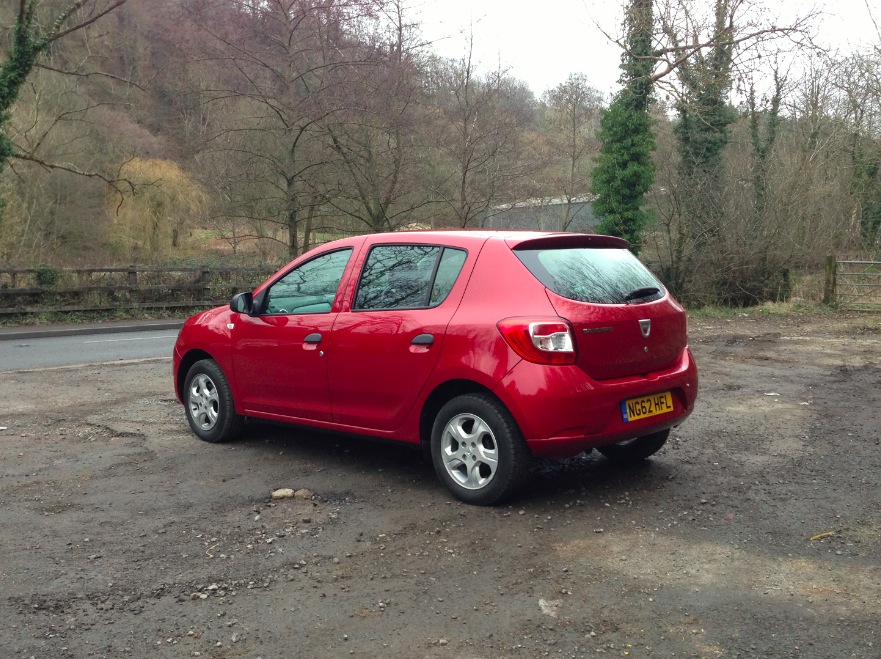
In the metal first impressions are that the Sandero is quite a looker.  The deep red paint works well and isn't just one coat deep.  The body coloured bumpers and spoiler are a step up from the bare plastic items on the base model.  The car itself, the overall shape of the thing, works well.  Indeed the front end is much more handsome than the gawping mouth possessed by the latest Fords.

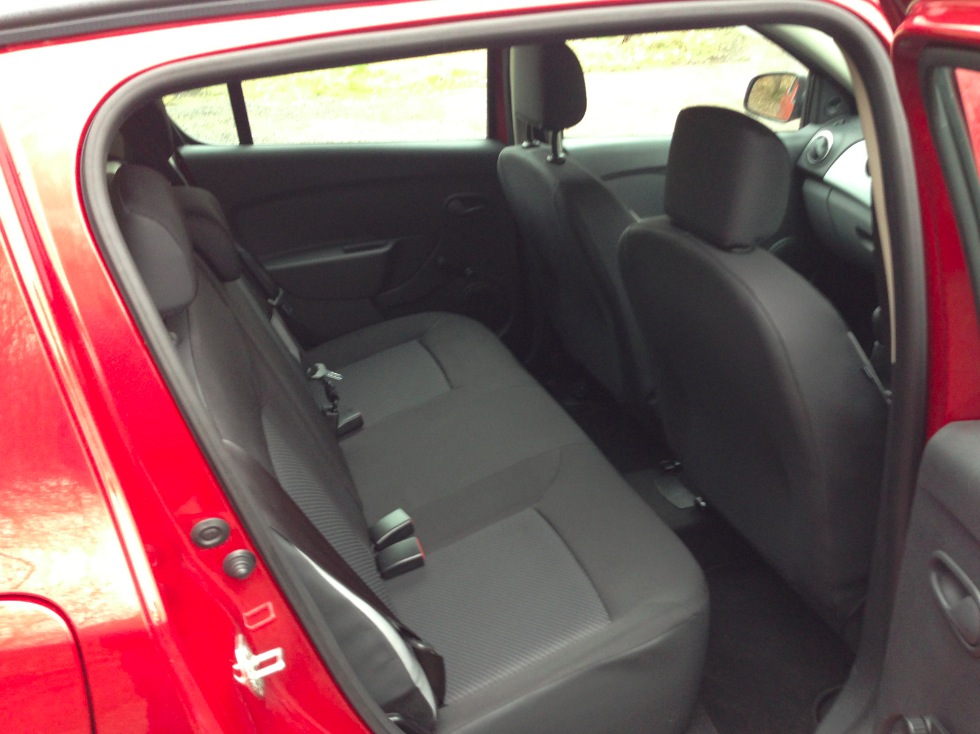
And it's big. It's commodious.  3 adults could sit quite easily in the back seats, although even on this model they'd have to wind the windows down by hand (First World Problems, eh?)  The boot is bigger than a Golf's boot.  It's a spacious car.

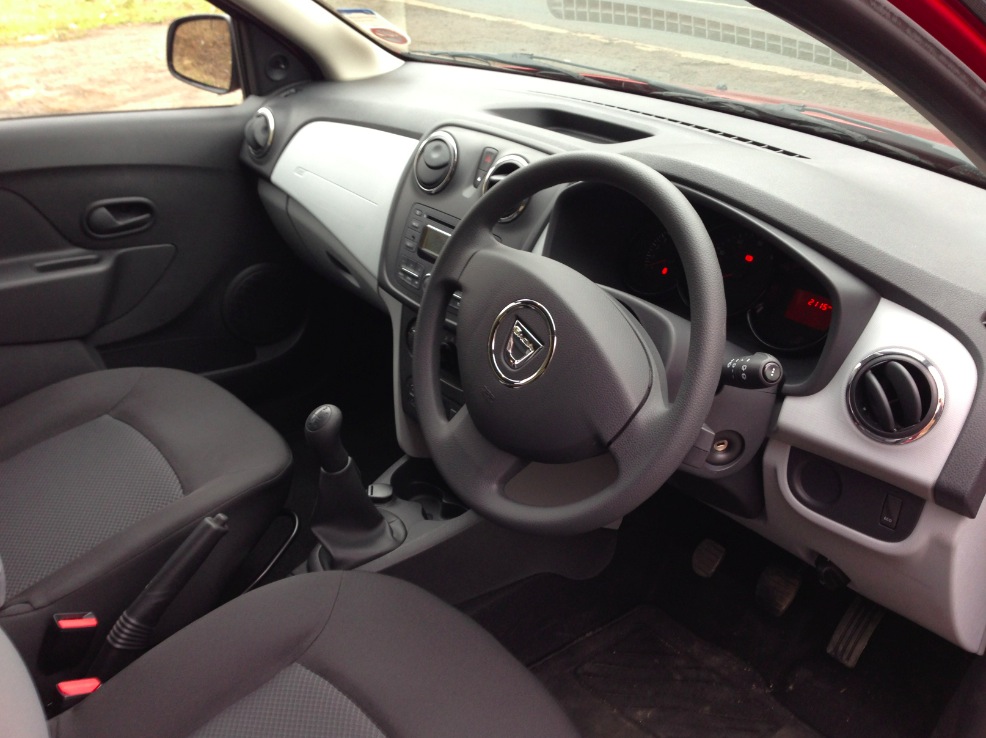
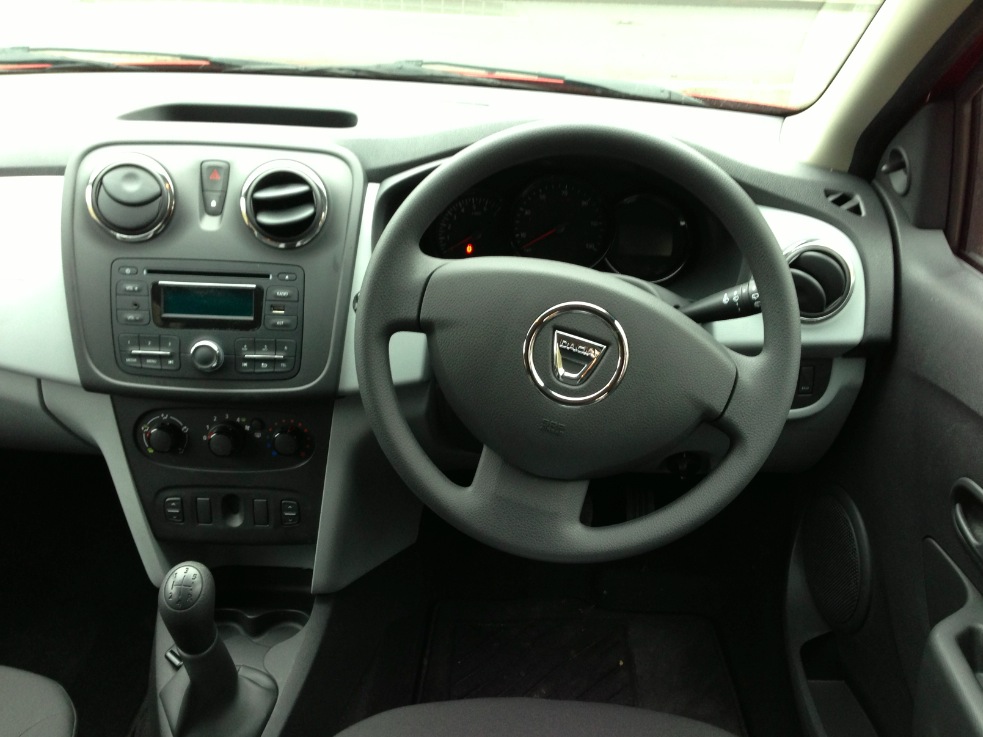
There's no skirting round the fact that the interior is dead basic.  Plastic everything, with the odd chrome highlight to alleviate some of the sheer plasticness.  But it's never a nasty, thin, Airfix model type plastic you see on some Japanese cars.  It's tactile enough.  Doesn't sound hollow.

The switchgear is good.  It should be as it's been filched from the previous generation Clio.  You could imagine spending time in the Sandero and not really giving a damn about it's cheapness.  The budget has been spent well.

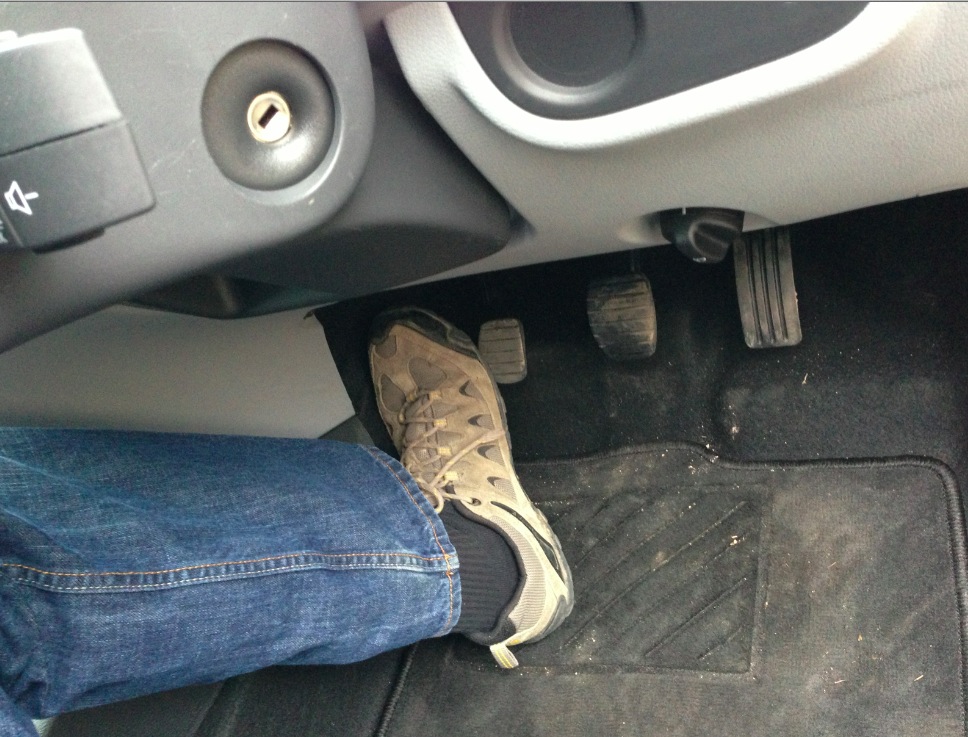
Two things about the interior annoy.  One is that the seats are flat as a pancake.  Hardly any lumbar or thigh support at all.  Surely it wouldn't cost much, if anything, to reshape the frame with a little curve to accommodate the human body.  The other is that the space between the clutch and central bulkhead is less than the size of a human foot (see photo).  Again, it wouldn't have cost much to design the problem out.

The Sandero has a key, which is quite unusual for Renault.  Most have silly remote cards and a button to stop and start.  Turn the key and the engine starts just like cars used to do before Start buttons were invented.  The Sandero I drove had the 1.5 litre diesel, known as the dCi 90.  It has 90bhp as you might have guessed.  Not much, but this model weighs 1033kg.  It does 0-62mph in 12.1 seconds and returns 74mpg.

On the road and the most impressive feature is the drivetrain.  Engine and gearbox are the very latest Renault units and they work well.  The 5 speed manual 'box snicks into gear nicely and the engine is adequate enough to keep things buzzing along nicely.

Get a bit lairy through the corners and the softness of both the suspension and the seat means you'll be getting intimate with your passenger sooner than you might have anticipated.  English roads might be poor but Romanian roads are far worse.  It seems to have been set up for Romanian roads and is much too soft.  The flatness of the seat means that when the body rolls you roll too.

But, to complain any more is to nitpick.  Dacia have hit upon an idea that other manufacturers have previously dismissed as unworkable.  The British like their cars well specced, refined and expensive, right?  Not necessarily.

The Sandero will sell well.  The price is right, the product is good.  Their target market is not the Kias, Hondas and Chevrolets of this world, it is the secondhand market.  They expect the warranty, the residuals (best in class depreciation), the finance packages, the fact you get a brand new car to attract buyers who would normally consider a used car.

They also think it'll be attractive to people in rural areas, and they're right.  Farmers, vets, horsey types whose cars take a battering down narrow, potholed, muddy lanes will love the Sandero and Duster.  It's no featherweight in the construction stakes.  It feels well put together.  The Sandero will take a battering, and when parts fail or fall off they'll be cheap to replace.

The Dacia Sandero is a sound business proposition, for Dacia itself and for the recession hit, cash strapped buyer.

The car I drove was the Dacia Sandero Ambiance dCi 90.  Specifications:

Price - £8395 (£9290 as tested)
Engine - 1.5 litre diesel
Transmission - 5 speed manual, FWD
Power - 90bhp
Torque - 162lb ft
Weight - 1033kg
0-62mph - 12.1 seconds
Top speed - 107mph
Fuel consumption - 74mpg combined
CO2 - 99 g/km