Showing posts with label Hybrid. Show all posts

25 Jan 2018

Are we really ready to make the change from petrol and diesel to hybrid cars?

We are at an automotive crossroads. How we power our cars, and the nature of cars themselves is all set to change. Even the design of our cars is changing. But do we, the consumers, really want what our legislators and manufacturers tell us we will have?
I’m not convinced we do.

When I was very small, back in the 70s, my Dad drove a petrol car - an E21 BMW 320. My mate lived on a farm and his Dad drove a tractor which ran on diesel. Our milkman drove an electric milk float. If you woke up at 5am you might catch a glimpse of him trundling along at 5mph. It was perfect for short journeys at low speed and, crucially, it was quiet.

This situation carried on into the 80s and 90s - except by this point Dad had swapped the BMW for a series of Jaguars (he only broke the chain with a Lexus CT200h which was crap so he sold it and bought a new XE).

And still, in this era, petrol was for cars, diesel was for tractors and trucks and electric was for milk floats.

When I started driving in 1988 the only thought was of a petrol car. Diesel was not even an option. So I bought a Nova Merit 1.0. I started my first job later that same year, for an engineering company in Manchester, and 90% of the staff had a company car. Every single one was petrol, and the size of the engine dictated your position in the company - Orion 1.3LX (minion), Sierra 1.6GL (lower management), Sierra 2.0 Ghia (middle management), Granada 2.8 Ghia X (the boss).

I drove that Granada once and it was much slower than expected, and the leather creaked. Not a patch on Dad’s XJ6.

Fast forward to 2002 and the birth of my son. Thinking I ought to save some money and buy a practical motor I purchased a VW Passat estate 1.9TDi 110 SE. It was the first diesel I had ever driven. 110 meant it had 110 bhp and this was not enough. It was the slowest, most boring car I had ever experienced. I hated it, even though it returned 50mpg no matter how hard I drove it. I sold it and bought a Subaru Outback.

So that was my diesel experience until 2015 when I leased a Volvo XC60 D4 for two years. It was a lovely car and the engine was great but I much prefer the 306bhp petrol engine in my current Golf R.

And there we are - 2018. The car was invented in 1886 and became a transport solution for the masses just twenty years later. For over a hundred years the most popular engine has involved a mix of petrol and air being exploded to push pistons up and down. Nowadays diesel as a fuel is just as popular as diesel engines have almost caught up with petrol in terms of power and refinement.

For the vast majority of motorists the choice is still between petrol or diesel. For a small percent it also includes a hybrid. For a yet smaller group who don’t drive very much or very far the choice also includes electric cars.

Over the past decade or so the popularity of diesels crept ahead of petrol but when Volkswagen were found to have cheated emissions tests the UK press and government massively overreacted. Diesel was bad, taxes went up and people wanted petrol cars again.

But still nobody really wants a hybrid car. Hybrid cars have two power units - one petrol or diesel and one electric - and two energy storage systems - a fuel tank and a bank of batteries. This makes hybrid cars heavy and extra weight is inefficient.

According to SMMT in 2017 2,540,617 cars were registered in the UK. Of these 13,597 were electric and 106,189 were hybrids. So 4% of all cars registered were hybrids and 0.5% were electrically powered.

The most efficient hybrid car is a PHEV - Plug-in Hybrid Electric Vehicle. But to use one of these you need access to an electrical point, which a great many households don’t.

Yet the government continues to steamroller us towards using them.

We have a massive network of fuel stations which deliver a tank of petrol or diesel in around two minutes. That’s between 300 and 800 miles of motoring. We do not have any kind of network of electrical chargers. Those that do exist often do not work.

My car is quite inefficient - if you consider fuel used for distance covered inefficient. It’s actually mighty efficient at converting fuel used to achieve incredible speed in a very short amount of time. Anyway, it does around 33mpg on a long run and last week I drove 380 miles in a single day. I left home at 8am, drove to a meeting 190 miles away, sat in the meeting for four hours and drove home. On the way home I stopped for fuel and carried on until I arrived into the welcoming paws of my dog, Kes, at 7pm.

If I had used an electric car I would have been 3 hours late for the meeting and poor Kes would have had to wait - alone, hungry and sad - until 11pm for me to arrive home.

This is why I (and many, many others) consider electric cars to be totally impractical and the weight penalty and requirement to charge them means hybrid cars are also impractical in 2018.

Oh and then there’s the issue of second hand cars. Hybrid and electric used car values are lower than the equivalent petrol or diesel cars. Servicing of hybrids by non dealers is almost impossible. Batteries reduce in efficiency over time and cannot be serviced. People on low incomes buy old cars and need to be able to service them cheaply.

But the government and manufacturers think we’ll all be buying hybrid and electric cars exclusively by 2040. This is daft.

Current battery technology means they do not store enough electricity, cost too much, weigh too much, take too long to charge and use rare earth metals (of which there is an impending crisis in terms of supply and cost).

Until there is a step change improvement in battery technology then battery cars will be silly and impractical - and so will hybrids.

So, bearing this in mind, how are we to reduce the impact of our cars on the environment?

The answer seems to be in a mix of things. For a start petrol and diesel engined cars need to become more and more and more efficient. Not just the engine but the whole car.

A fast, comfortable car can be built and designed to weigh 800kg yet the market dictates that our cars are becoming bigger and heavier. People now want SUVs and crossovers and they want all sorts of technological gubbins that they don’t need. SUVs require more height and more height means more weight in all areas. More height also means more drag. All of this means more fuel is used.

We should really be driving small, light, aerodynamically efficient hatchbacks and coupes instead of big, fat SUVs.

Electricity isn’t the only future fuel. Hydrogen is a really interesting one. It can be used to fuel an internal combustion engine, is the single most abundant element in the universe (around 75% of all mass that ever has or will exist) and the only emission from the exhaust pipe is water. Hydrogen engines currently cost about 50% more than petrol but with a few years R&D this cost will reduce. The biggest problem is fuel storage. As a gas it needs to be stored at 5,000 psi and as a liquid…well, it boils at -253°C.

Battery technology will eventually become the dominant force. This will come about through solid state technology but this is years away.

For now the only real solution that suits us ordinary people is petrol and diesel. Change will be needed as emissions regulations are tightened up - and these will become impossible to achieve if we all drive fat, heavy SUVs.

The government and manufacturers still reckon they will push us all into hybrids and EVs whilst we, the public are not ready for this.

The public have been pushed around by governments for years but this time I think the legislators will have a real fight on their hands. The public has a recent history of not doing what they are told to do by governments and bureaucrats.

How will this all end up? Who knows…

By Matt Hubbard

20 Feb 2015

2015 Volvo V60 D6 Hybrid Review

Matt Hubbard reviews the Volvo V60 D6 Hybrid, which is actually a plug-in hybrid.

2015 Volvo V60 D6 Hybrid

The future of motoring is slowly taking shape in front of our eyes.  The basics of car design will continue to be refined but will essentially remain as it is - seats, body, wheels, power unit. The fundamental problem in future cars comes down to one of energy storage both at car and distribution level.

Petrol and diesel are relatively easy to extract and refine and extremely easy to transport and store. Once in the car it stays where it's meant to until it is used, at which point it is quick and easy to replace. Enough can be stored in a car to give a range of hundreds of miles without the need to refuel.

Petrol and diesel also have a large amount of energy stored within their mass, and extracting that energy is as easy as setting fire to it.

Emerging technologies and fuels have to match existing fuels in terms of storage, range and price - or else the market will not adopt them.

Electricity is in many ways a better fuel than anything else to power a car. It requires few moving parts in the drive train and will ultimately lead to lower running costs. It also provides a smoother driving experience and produces no pollution when it is used (although it sometimes produces lots when generated).

But mankind has yet to suss out the problem of quickly refuelling a car with electricity, and storing enough on board to match the range of a fossil fuelled car. Until that happens electric vehicles are folly.

And until that point we are stuck with hybrids which utilise electricity until such point it runs out, whereafter a petrol or diesel engine takes over. The two engines can also be combined for more and better power delivery.
2015 Volvo V60 D6 Hybrid

Some companies (Toyota and Honda) have been making hybrids for years whilst others resisted (mainly due to being smaller companies with lower R&D budgets) and waited until the technology was mature enough that it cost less to introduce it.

Nowadays most manufacturers have at least one hybrid in their range. Some hybrids look the same as any other car and some look...different. Some cost a little bit more than a standard car whilst others cost the earth.

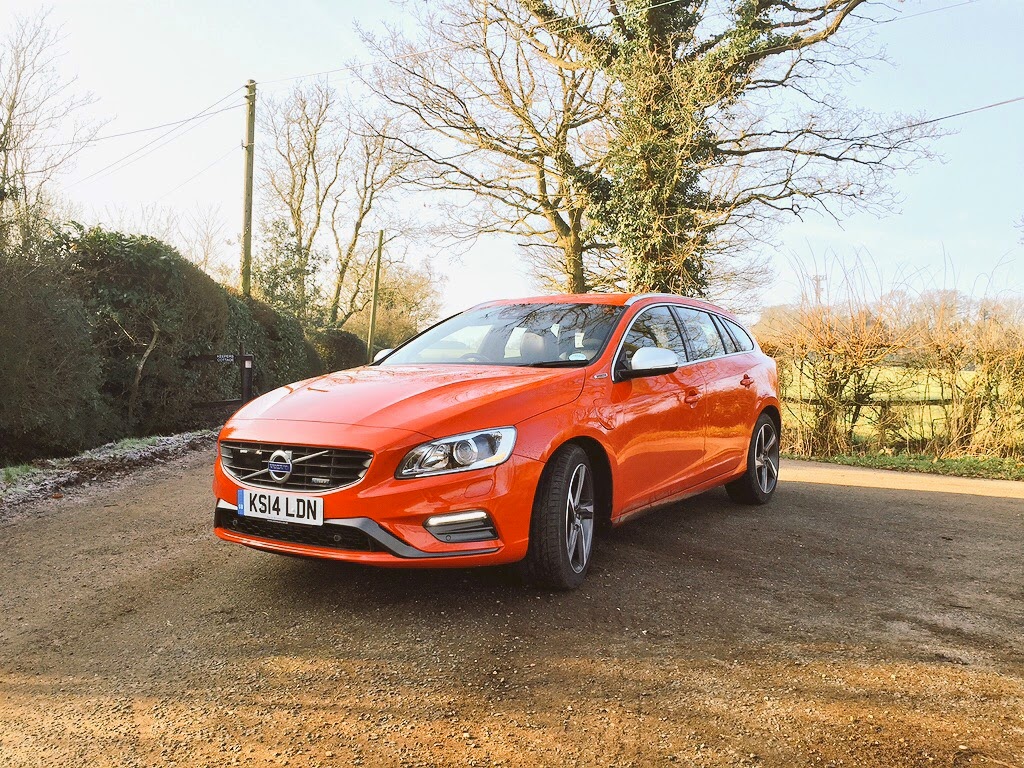
Volvo has taken the approach of making its hybrid V60 look the same as any other V60 - to an almost fanatical degree - but it does cost the earth.

Volvo has also taken the bold approach of giving its hybrid more performance than the rest of the range. Until the V60 Polestar came along the V60 Hybrid was the most powerful, as well as most expensive, V60 you could buy.

If you want to know what the standard car is like read my review of the Volvo V60 D3 here, and you can check out my V60 Polestar review here.

Visually the Hybrid is almost identical to any other V60. The only differentiators are small 'Plug-In Hybrid' badges on the front quarter panels, an extra fuel flap, a much higher boot floor and more badges on the door sills.

The extra fuel flap (under which is a plug) and badges mean this is a plug-in hybrid, which means you can charge the battery up (in around 3 hours) and it'll provide around 30 miles of purely electric motoring. That leads to an official economy figure of155mpg and emissions of 48g/km of CO2. Stunningly low but meaningless in the real world.
2015 Volvo V60 D6 Hybrid

In practice the V60 D6 Hybrid is a sensible, practical, fast, economical, cheap to run car that costs a lot but has a few benefits over a standard car.

The only real inconvenience is the reduced boot area. My border collie came for a ride and wasn't too impressed with having to stoop down low in the boot. A V60's boot floor is quite high in the first place. In the hybrid, with even more height, it looks (and is) a bit ridiculous.

The battery and electric motor live under the boot floor - hence the height - and power the rear wheels which means in certain modes the car is four wheel drive. Of course, the diesel engine up front powers the front wheels.

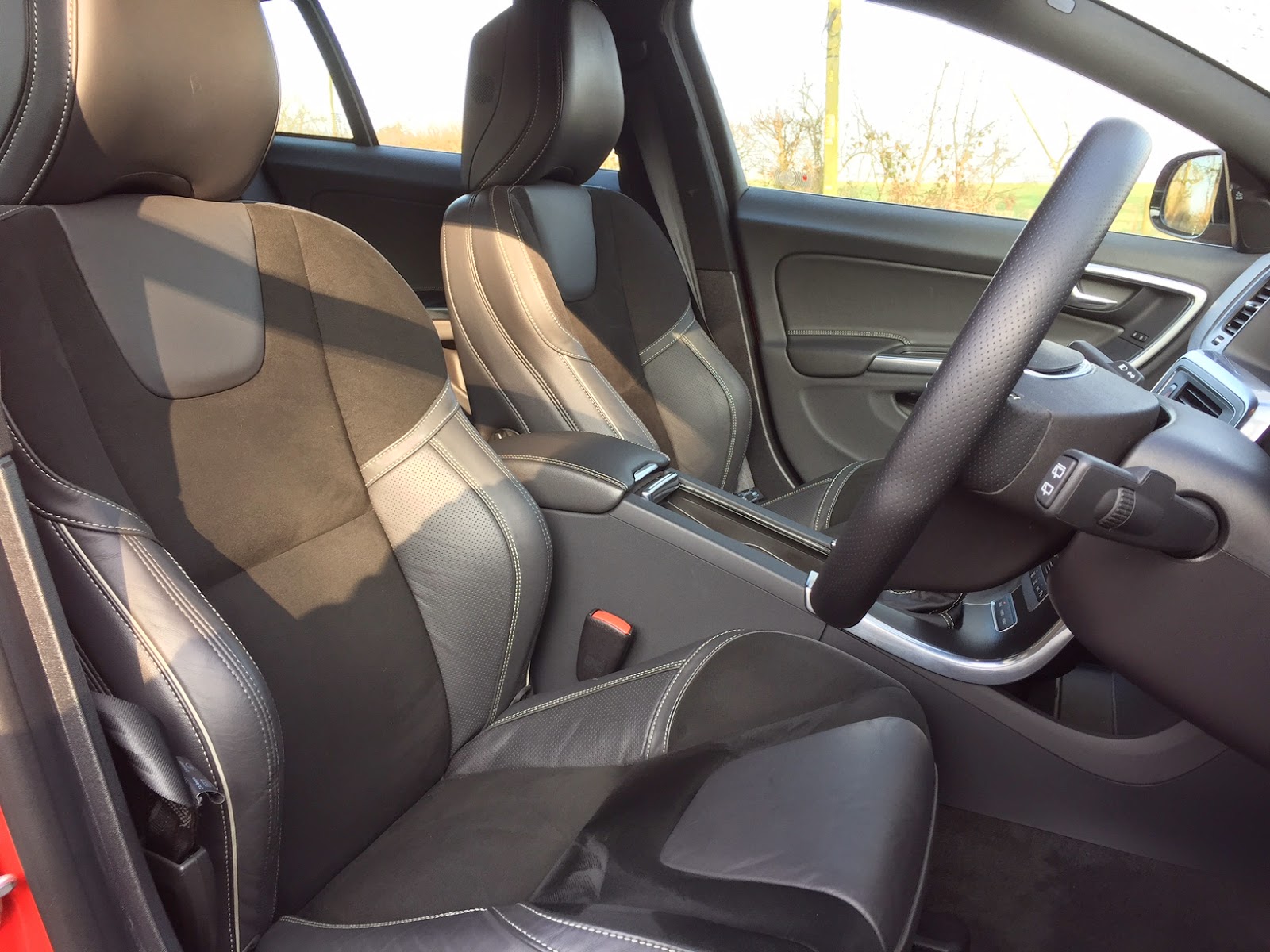
The electric motor has 70bhp and the diesel engine has 215bhp. Select the Power setting and the V60 hybrid is a 275bhp, 471b ft, four wheel drive continent crushing estate car with the comfiest seats in the business and a fabulous interior.

Power and torque are felt from low down, with minimal lag away from the line. The gearbox is sweet and the steering slightly heavier than you'd expect. Steering feedback and handling are lacking in favour of a smooth ride and safe understeer but boot the throttle and it's fast, grippy and great fun.  With all that grunt you can overtake where you couldn't in most cars.

Select the Pure setting and it'll use the electric motor as much as possible, resorting to diesel assistance only when you press the accelerator more than about 50%. I found myself driving in EV mode through towns and villages and pressing POWER when hitting the 60 zones in between.
2015 Volvo V60 D6 Hybrid

Trying not to allow the diesel engine to kick in gives an added dimension to driving the car. Gently does it on the throttle and keep momentum up as much as possible makes boring roads slightly more interesting.

In between Power and Pure you can just drive the V60 as a hybrid, with the diesel and electric engines operating independently or together depending on your speed and heaviness of right foot.

I tested the EV mode and battery capacity on a run. On purely electric power I drove 6 miles round twisting country lanes and 14 miles at 65mph on the motorway before the battery was exhausted and the diesel engine kicked in. After another 20 miles the battery had replenished one third of its capacity which allowed me to cruise another few miles in EV mode.

You can feel the extra 200kg weight of the hybrid system when driving round bends but not so much when braking. The brake pedal feels strange at first as it is both battery regenerator and conventional discs n'pads brake.
Kes in the Volvo V60 D6 Hybrid

The diesel engine is the old 2.4 litre unit which was never the most refined or economical of engines. The Volvo V60 D6 Hybrid is a fantastic car to drive - I'd happily own one if it didn't cost so much - but it could be improved massively by using the new D4 2.0 engine. In Power mode you'll average 35mpg if you drive enthusiastically.

Volvo has shown its hand and that means its hybrids will not be radically different cars from the rest of its range. Instead Volvo acknowledges hybrids as being a mainstream part of the medium-term future of motoring - so why make them different?

We'll see a hybrid in the new XC90 SUV and soon after most of the Volvo range be available with hybrid engines (and probably EVs too).  That this, the first Volvo hybrid, is such a good one bodes well.

As an experiment, and a car that will mostly be bought by early adopters who don't want to look too different, the V60 Hybrid is a resounding success that could be improved in a couple of areas, namely by using a better engine and by packaging the battery better.
2015 Volvo V60 D6 Hybrid

Stats


Price - £46,675 (£54,075 as tested)
Engine - 2.4 litre diesel plus electric motor 
Transmission - 6-speed automatic 
0-60mph - 6.1 seconds 
Top speed - 143mph 
Power - 215bhp diesel, 70bhp electric - 275bhp total
Torque - 324lb ft diesel, 147lb ft electric - 471lb ft/640Nm total
Economy - 155mpg CO2 - 48g/km 
Kerb weight - 2058kg
2015 Volvo V60 D6 Hybrid

2015 Volvo V60 D6 Hybrid

By Matt Hubbard


26 Jan 2015

2015 Volvo V60 D6 Hybrid First Drive Review

V60 Polestar or V60 Hybrid? Which should I request when getting in touch with Volvo? Despite it being closest to my heart in terms of speed and handling I'd already spent a day with the Polestar. I asked for a V60 D6 Hybrid.

Volvo V60 D6 Hybrid
Volvo V60 D6 Hybrid

So a Volvo V60 in Passion Red, visually the same as any other V60 R-Design, rocked up at chez Speedmonkey. Parked alongside the Jaguar XFR-S, which was going back to Jag the day the V60 arrived, it held its own in terms of looks.

Volvo got it right with the S60 and V60. It's a cracking looking car. The interior is better than those from the Germans and the new D4 engine is one of the best new diesels on the market.

But this didn't have the D4. It had the old 215bhp, 2.4 diesel, found in a few other Volvos and known as the D5, plus a 70bhp electric motor.

The diesel engine powers the front axle and the electric motor powers the rear. It can be a four wheel drive, front wheel drive or rear wheel drive car depending on what setting you select.

The settings are Pure, Hybrid or Power. You can also select Save, which saves electricity in the battery, and AWD.

In Power mode you get the full 285bhp and a massive 660Nm/471lb ft of torque. This makes the V60 Hybrid a fast wagon - it'll do 0-60mph in 6.1 seconds. Take-off from 0mph is instant, thanks to the electric motor, and top speed is 143mph.

You don't get anywhere near the claimed 155mpg in Power. The old D5 was never the most refined nor economical engine and in the V60 Hybrid in Power I've averaged 35mpg.
Volvo V60 D6 Hybrid
Volvo V60 D6 Hybrid

Pure is more intriguing. It causes the car to run purely on electricity although the diesel engine kicks in if you apply too much throttle. Despite having driven around a hundred cars a year the only other hybrid I'd driven was the Range Rover and the only electric car was the Renault Zoe.

The V60 is attractive as it has a 30 mile range on the battery and a 500(ish) range on diesel. Despite overnight temperatures dropping to -5℃ the electric range I've seen has been 25 miles. Not too bad.

The driving experience is not too bad either. I can see a whole generation of young drivers learning in cars like this and driving just as I have been doing - easy on the accelerator, try not to brake too much, keep it smooth and flowing. Preserve electricity at all cost and see it as a failure if the diesel engine kicks in.

It's intriguing and it's fun and in real world driving conditions it's entirely relevant.

The V60 Hybrid is a year or so old now. Updated with a D4 and a slightly bigger battery it'd be even better than it is, but the one I'm running right now will do for the moment. I'm enjoying driving it far more than I thought I would.

The only downsides I can see are the price, which at a £47k without options is too expensive, and the 'old' engine.

If this is the future I'll be pretty happy.

Stats


Price - £46,675 (£54,075 as tested)
Engine - 2.4 litre diesel plus electric motor
Transmission - 6-speed automatic
0-60mph - 6.1 seconds
Top speed - 143mph
Power - 215bhp diesel, 70bhp electric - 275bhp
Torque - 324lb ft diesel, 147lb ft electric - 471lb ft/640Nm
Economy - 155mpg
CO2 - 48g/km
Kerb weight - 2058kg
Volvo V60 D6 Hybrid
Volvo V60 D6 Hybrid

Can you guess where the battery is located?

Volvo V60 D6 Hybrid

Volvo V60 D6 Hybrid

By Matt Hubbard