Showing posts with label Ford. Show all posts

6 May 2016

2016 Ford Mustang 2.3 EcoBoost Review


Ford has just launched the latest version of its iconic Mustang. In recent years the Mustang had lost its way. The 80s and 90s weren't kind to it in terms of looks and dynamics and the 2005 Mustang was still a bit too big and basic for European tastes. And the steering wheel stayed stubbornly on the left.

Enter the sixth generation Mustang. This is the first Mustang designed to be sold the world over. It is the first Mustang with independent rear suspension, the first Mustang available in right hand drive and the first Mustang available with a 4-cylinder engine. 

Unlike most Mustang reviews you'll read I paid for mine (well, rented it) and I drove it 3,800 miles in 11 days.

My son and I decided that over Easter 2016 we'd drive from Miami to San Francisco and that we'd do so in a convertible - hopefully a Mustang. In terms of trips to the US I'd only ever been to New York for a weekend before and had never visited southern America or hired a car in the US before. I had heard stories that the choice available at airport rental centres was often limited to whatever was left at any particular time of day.

I was dreading turning up to find that the only car left was a Pontiac Grand Prix or something similarly dire.

As it turned out American car rental is a huge industry that runs extremely smoothly. The rental place at San Francisco airport is a short (free) train ride from the terminal and is located in a massive multi-storey car park. When we arrived we were greeted by a bunch of men wearing shiny jackets, one of whom looked at our paperwork and said we could pick any car from aisle 32.  

Aisle 32 consisted purely of Chevrolet Camaro convertibles and Ford Mustang convertibles. Result. The bad news was all of them were powered by 4-cylinder engines. Oh well. My son picked out a bright orange Mustang and we headed into downtown Miami.

First impressions were given over to getting used to driving on the wrong right side of the road in a left hand drive car. My left elbow had a door in the way and my right elbow had nowhere to rest.

Day 1 involved driving 300 miles north, in the direction Daytona Beach - whilst stopping over to take some photos in front of a very distant Kennedy Space Centre.

As soon as I got used to the excitement of driving on the left side of the car on the right side of the road I started to focus on the car itself. It was a brand new model with only 3,000 miles on the clock. The 2.3 litre inline-4 is shared with the Focus RS where it has garnered much praise. In the Mustang it produces 310bhp and 300lb ft of torque and does 0-60mph in 5.4 seconds and has a top speed of 154mph.

So it's fast. And it feels it.

Our car was fitted with an automatic gearbox. In the best tradition of the muscle car this is not a high tech flappy paddle 'box but a normal 6-speed automatic transmission. Unlike many old-school auto-boxes the Mustang's unit felt tight and quick and didn't feel like it lost any power in between its cogs. 

Even with the supposedly weedy (and derided in the UK press) 2.3 EcoBoost engine the Mustang is a seriously fast car. Put your foot flat to the floor and it gathers its skirts and takes off down the road in a very dramatic fashion. On more than one occasion the satnav, which sat on the dash on a bean bag type thing, flew off the dash.

The Mustang looks the part too. It helped that ours was orange but its designer (a Scotsman called Moray Callum (brother of famed Jaguar designer Ian Callum)) has a fine eye for this kid of thing and has managed to combine traditional muscle car looks and stance with a finer European finesse. 

UK petrolheads love the Mustang but so too do Americans. We were told at gas stations in Florida, Alabama, Louisiana, Texas, New Mexico, Arizona and California that our car looked great, or even "purdy".

The interior is pretty good too. I had expectations of horrendous elephant-hide plastic and overly shiny leather but we mustn't forget that this 'stang was designed with Europeans in mind, and the interior lives up to our expectations. The leather is tolerable and the plastic almost of Volvo standards.

The seats are very comfortable. On our longest day we drove 700 miles in 10 hours, from Dallas to Santa Fe, and I had more trouble from sun burn on the back of my neck than the seats.

The twin dials are big and clear with revs in one and speed in the other, although I do prefer a nice big digital speed readout in these days of nasty electronic policing. There is plenty of room for accoutrements in the cabin with a decent sized glove box and a big bin under the arm rest - which is too low and nowhere near your arm or even elbow.

Whilst the front seats are comfortable the rear seats are only any good for small children and legless adults, although they are fine for storage of rucsacs, multipacks of water (in case of breakdown in the desert) and general junk that two people accumulate over two weeks.

The roof is fabric and will only fold up or down whilst stationary. It doesn't take up much room in the boot, which is big enough for two suitcases with plenty of room either side. The interior is quite quiet with the roof up but noisier and windier than many euro cars with the roof down. We often drove for a few hours and then both agreed the roof should go up to give us a rest from the buffeting. 

The new Mustang has to be up to date in terms of electronics and happily it is. There is a USB charger port under the armrest and two 12v points (which are more useful as they charge iPhones much quicker)  - one near the radio and one under the armrest.

The entertainment system features FM and satellite radio in the US and digital radio in the UK. You can also Bluetooth music from your phone or play a CD. We used the Bluetooth streaming option for up to 7 hours a day every day and it worked almost without fault - dropping out about 5 times in 70 hours of driving.

So that's the specs, looks and interior. How is the new Mustang to drive?

Well, it's damn fine. As mentioned previously it is a fast car - but it doesn't really feel like a sports car, more a grand tourer. I once drove 200 miles in a Porsche Cayman 981 and ended the trip feeling tired and sore but in the Mustang we averaged 350 miles a day for nearly two weeks. The Porsche would be the better car round a track but the Mustang is better for day to day distance driving.

It does have a potentially serious problem though. It generates a kind of hum from around 40mph to 60mph. It's not a really vibration and it's not engine related as it doesn't alter with engine speed but it does seems to come and go depending on conditions. It gets worse when the engine is laboured - say on cruise control at 50mph when the gearbox is in top gear and the engine labouring slightly. But, as I say, it doesn't seem to vary with engine speed. Over nearly two weeks it stayed with us, on and off. I never could put my finger on what caused it. It did get annoying at times but sometimes I didn't notice it. It's certainly not something I've encountered in a car before.

Notwithstanding that the Mustang is a seriously smooth driver. The suspension is plush, which means it does allow a certain amount of lean in corners, and the whole droving experience feels laid back.

What the Mustang has, in abundance, is character. Whether shooting down a dead straight highway through the badlands or crawling along the Las Vegas strip it feels like it has star power and charisma. When in Los Angeles we drove it along Mulholland Drive, where many of the old school Hollywood Stars live, and the Mustang felt right at home.

Many reviews conclude that the 2016 Mustang is a fine car but that the 2.3 litre engine should be ditched in favour of the V8. I haven't driven the V8 but I can tell you that even in its own backyard the 4-cylinder performs superbly, even if it doesn't make the right, or indeed any, noise.

If I were to repeat the trip I would definitely choose the Mustang again. It's a fantastic car. As a convertible I'd choose it above many European models such as the Mercedes E-Class and BMW 3-Series.

I couldn't imagine driving any other car through those vast desert vistas, along crowded Dallas freeways, crawling down characterful New Orleans streets or even splashing through huge thunderstorms in Florida. The Mustang looked after us every step of the way and in return we loved it, despite the odd foible.

The Mustang is a relatively cheap proposition. It's also very good looking, fast, practical, comfortable and easy to live with on a day to day basis.

I just hope Ford look into 'the hum' and come up with a solution.


By Matt Hubbard 


18 Nov 2014

How Does The Ford Mondeo Stack Up Against The Vauxhall Insignia?

Mark Turner of Blacktopmedia recently tested the Vauxhall Insignia and thought it would be appropriate to throw it in the ring with a couple of its usual suspect sparing partners.


Let’s start with the Mondeo.

Since god was a boy the Mondeo has been the staple diet of reps up and down the country.
Why? Because it does what it says on the tin and does it well.

From the first drive of the Mondeo Titanium X Business Edition, I felt completely at home, familiar, comfortable in each other’s company.

I don’t know how Ford do it but it just fits. Everything worked, it made sense, I didn’t need a degree from NASA to work it and I didn’t need to add 20 minutes to each journey to allow me time to figure out how to start it, set the seat position, work out the stereo controls and so on.

Ironically, the only criticism I had of the Mondeo was that it was a little unremarkable to look at.
The styling is a little unexciting. It is undoubtedly a handsome car but the styling, on the outside at least, is reserved. Oh, and the driver’s seat wasn’t fully electric on this £25k model, so what.

The fit and finish is flawless and exudes quality befitting a more prestige marque. The bluetooth integration was a piece of cake, sat nav worked perfectly and the interior is such an agreeable place to be you won’t mind sitting on the M25 all day.
The controls are very well organized and felt familiar and there are enough toys to fulfil your needs but the car still feels balanced. The tech complements the car and doesn’t feel intrusive. You feel like you are in control but the electronics are quietly working away in the background.

So, it looks good, works well and feels right. That’s all fine but if it drives like a dogs dinner it’s all been a waste of time. Well, nothing to worry about there.

The 2014 Mondeo doesn’t disappoint. The driving dynamics are great. The car rides well, taking on our degrading and crumbling city streets without breaking in to a sweat.
The gearbox is near perfect with 6 well-spaced ratios making good use of the power available.
The engine is a gem. The 2.0 TDCi is a great power plant that offers a solid spread of power and torque from low revs. There is little or no turbo lag and the engine is very refined and quiet for a diesel.

In summary, the 2014 Mondeo is a hard act to follow. It sets the bar pretty high. It drives really well, is built well, looks good and is well priced. You could say it does exactly what it says on the tin……and does it well.


14 Oct 2014

Five Alternatives To A VW Transporter

The Volkswagen Transporter is massively popular, but what alternatives are there? Mike Armstrong investigates


Petrol heads and ordinary civilians alike cannot deny their admiration and love for the Volkswagen Camper. Particularly the T2, which has seemingly managed to cross genres and win the hearts of everyone on the planet. Even later T25 and T4 models are appreciating in value at a rate which will exclude the majority of those seeking a budget camper.

Many specialists exist across Britain who will convert just about any form of commercial-ish vehicle into a dayvan or fully blown camper conversion. Let's set ourselves a budget of £10,000 and see which vehicles would be a better alternative for the average lover of the great outdoors. Hopefully we can encourage a few readers to begin projects for next spring/summer!

1 - Mitsubishi Delica


A rather overlooked potential conversion in the UK. The Delica is a robust Japanese van/people carrier with attitude. Firstly, it will go just about anywhere thanks to the world renowned four-wheel drive system, which will be equally as effective in sub-Saharan Africa as a muddy field in Cornwall. £3,000 will buy a MK3 Japanese import with around 100,000 miles and a diesel engine. Sources suggest that a firm in Wigan provides the basic conversion starting from £4,000. In total, this reliable and indestructible Delica will cost as little as £7,000.

2 - Mazda Bongo Friendee/Ford Freda


Another dayvan/camper from Japan joins the list. The Bongo has been a grey import hit in many countries, including: the UK, New Zealand and Russia. Not many vans of the late 90's offered electric sliding doors and air conditioning as standard. Some were even specified with cooking units as an option from the factory, making one of these earlier examples preferable for a budget conversion. Furthermore, they came available in either rear-wheel drive or four-wheel drive formats, with the engine situated in the middle. A mid-engine sports car it is not, however with prices around the £4,000 mark, you would be foolish not to consider a Bongo.

3 - Vauxhall Vivaro/Renault Trafic


Surprisingly overlooked amongst the camper scene. Rather unfortunate that is as these vans drive very well, are plentiful and are fairly modern for the price you pay. Conversion specialists are plentiful too, offering various different types of flatpack and custom designs. Due to their modern credentials, spare parts are cheap and specialists common. Furthermore, the diesel engines will return better MPG on a long run than the Delica or Bongo. Not bad for a van which can be obtained from around £3,000 plus conversion costs.

4 - Chrysler Grand Voyager


No, we haven't gone crazy! The Grand Voyager would make a superb camper, and this is why. Unlike most other conversions, the roofline is lower, meaning that campers can park their Voyager in regular sized car parks or travel with regular vehicles on the Eurotunnel. Also, the width and length of the interior is nigh on identical to a T4 VW Transporter, only costing a fraction of the price. Early examples can be had for under £1,000. We'd obviously recommend spending around £2,000 for peace of mind. Conversion costs may be less too, as the Grand Voyager already has windows, therefore the law does not require any extras fitted for re-classification. Similar projects could feasibly be done with the Renault Grand Espace and Kia Sedona to the same effect.

5 - Ford Transit


Britain's best loved work horse certainly makes the list. Price conscious members of the camper conversion society forever rant about how much better the Transit is than the Transporter. Indeed, with a lower starting price, the argument appears to have weight to it. Not to mention, Transits are far more common, cost less to repair and drive pretty well. With prices starting from £1,000 and rising as to your requirements, the Transit will offer a lot of camper space for your money.

So if building your own camper this winter is the ideal project for you. Take these five vehicles into account, and sleep on it to decide which you'd prefer to sleep in. Also feel free to suggest any other vehicles or feedback on your experiences via Twitter or in the comments section below.


24 Jun 2014

Which Cars Make The Best (And Worst) Sounds

I don't know about you but one of the most important factors when considering a car is the noise it makes.


Engine power can be invigorating and exciting but that pleasure is blunted if not accompanied by a similarly exciting soundtrack.  In cars of old engine sound was just a by-product of the many tiny explosions under the bonnet but nowadays it has to be engineered in.

As cars become more efficient sound is deadened unless actively promoted by the people designing it, which is usually dictated by that company's philosophy.

The sound a car makes comes from two sources - the engine itself and the exhaust.  Engine sound can be spine chillingly good or it can be woeful.  Similarly exhausts can emit a mellifluous note equal to the best music, or they can sound like a wet fart.  Or they can make almost no noise at all.

Sports cars is where we find most decent soundtracks.  Jaguar in particular has decided that its fast cars should not only look fast, they should sound it too.  The F-Type V6S is an angry, snarling thing whose gear change blips could excite even vegetarians.  The F-Type V8 is so sonorous you use twice as much fuel as necessary just so it'll bang, crackle and explode to order.

Modern, efficient hatchbacks make very little noise, usually because they are promoted as slick, modern, reliable, economical, clean and efficient.  A lusty roar from 2 inch tailpipes is not in keeping with the image.

Even when a manufacturer builds a hot hatch variant the noise is often disappointing.  The Renaultsport Clio 200 is a marvellous car but its inline-4 1.6 litre turbocharged engine makes hardly a sound, and neither does its exhaust.  Renault knows this so has fitted an array of sound effects to the stereo system.  Check out the video I made of it here.

Renault's R-Sound system is a bit of a cheeky wink to BMW's Milli Vanilli style Active Sound System which pipes fake engine noise through the stereo. BMW tried to keep the system hush hush so buyers actually thought the car made a more lusty noise than it does.  VW does the same with its Soundaktor in the Golf GTI.

For a proper, raucous engine sound and exhaust note we have to look hard to find decent examples.  A few years ago it wasn't difficult - my own 2004 Audi TT 3.2 V6 makes the most wonderful sounds.  The engine issues a tremendous metallic wail at the higher reaches of the rev range and the exhaust's boom at low revs and snarl at high revs is fantastic.

Most cars with an inline-4 engine sound rubbish but the Fiesta ST and Audi S1 make a decent fist of it whilst Mercedes' A45 AMG makes industrial, brutal noises at full chat.  The Astra VXR, great car that it is, is about as aurally emotive as a food blender.

Amongst the Germans the old 6.2 V8 in some Mercedes AMG models was wondrous but the 5.5 twin-turbo is slightly less so.  BMWs can make a good inline-6 noise if they try hard and with Audi it comes down to whether the engineers developing a particular model had got out of bed on the right side or not.

Porsche stands apart from its German brethren by using flat-6 engines which sound marvellous.  They even engineer in some crackles and pops.  The Boxster S I tested sounded brilliant and you could make it sing like Brian Blessed with a throat full of spittle if you so desired.

Of all the cars I've tested the one that came closest to Jaguar is the Maserati GranTurismo Sport.  Good lord that thing sounds fantastic with its Ferrari-built 4.7 litre V8.

All the above cars are petrol powered.  With the exception of the Range Rover SDV8 every single diesel engine sounds rubbish.  Some sound positively dreadful whilst others are merely crap.  The SDV8 is a fantastic engine, powerful, economical and surprisingly good to listen to.

If you don't care about the sound your car makes then 95% of the market will accommodate you.  If you do then you have to fork out a few extra quid and make your choice carefully.

But it'll be worth it.

By Matt Hubbard


19 May 2014

The Ford Mustang Comes To The UK - A Mustang Owner Contemplates

The 2015 Ford Mustang will be in UK dealers soon. Chris Small owns a 2005 model and wonders if the right hand drive UK version will be able to retain it's unique Mustang cachet.

2014 Ford Mustang
2014 Ford Mustang

After a 50 year wait, the first official right hand drive Ford Mustangs are now only months away from landing on UK soil. For decade after decade we have lusted after this American icon and now our wait is almost over. Soon, you’ll be able to walk in to your local Ford dealer, part-ex your Capri and drive out in a brand new car, sporting that legendary pony emblem on its grill. And this is a good thing of course. Isn’t it?

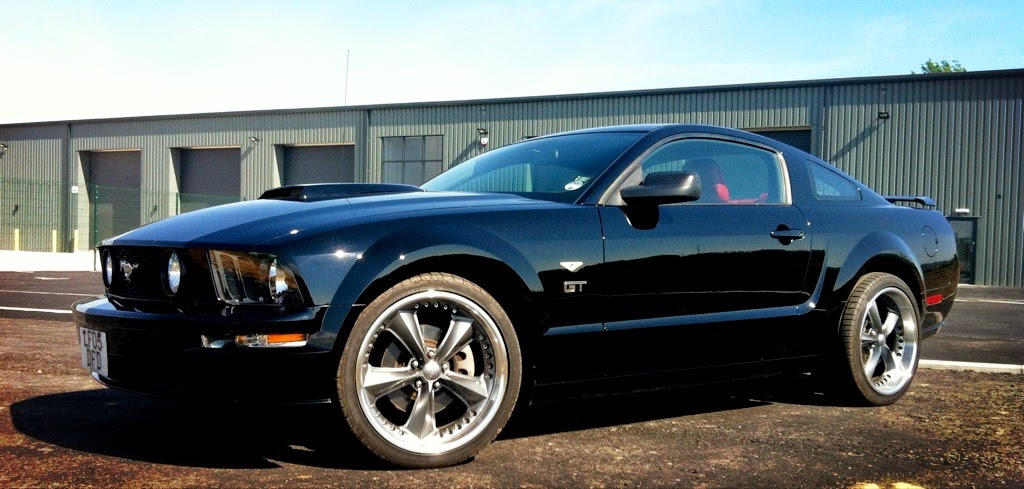
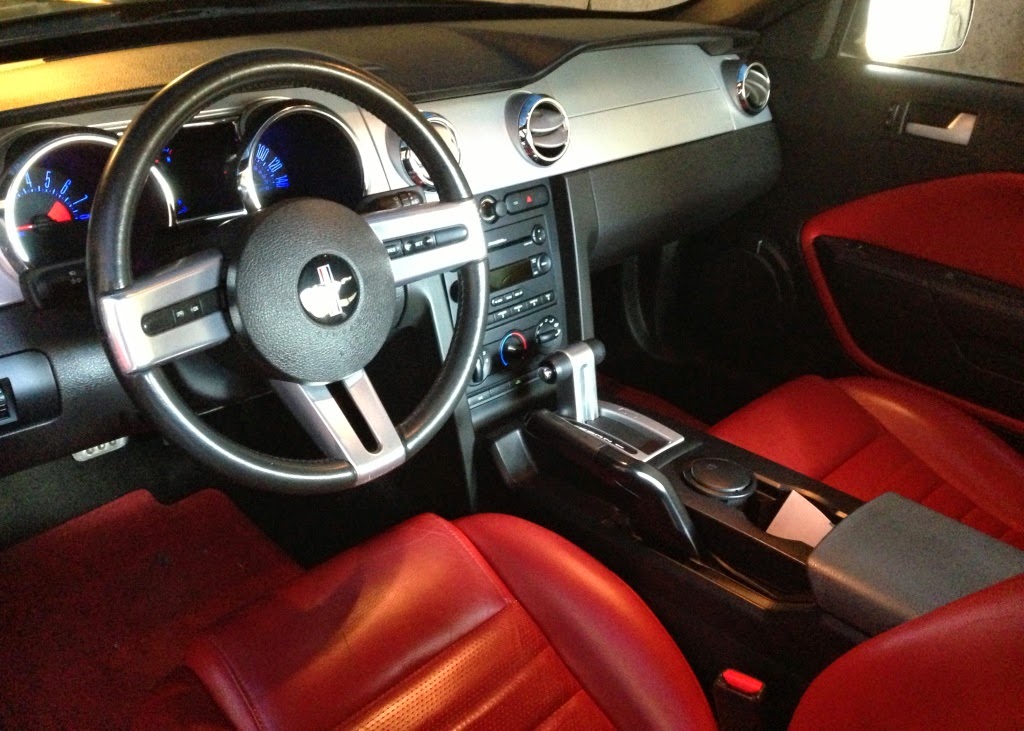
Well, maybe it is, maybe isn’t. You see, I’m just not convinced. I have to make something clear from the outset here; I am a Mustang owner. Currently nestled in my garage, sheltering from the typical English summer rain is a black 2005 GT V8 Coupe. And I adore it. So my opinions of the forthcoming UK car are bound to be somewhat biased to say the least, but please bear with me.
Chris's 2005 Mustang GT V8 Coupe

What makes us so fascinated with Mustangs? Why when we see one in a Hollywood movie do we long to have one so much? And why do people always come over and talk to me when I’m making one of my many trips to the petrol station? Aside from the noise and the general look of it, there are two main, interlinked, underlying reasons. Firstly it’s American and secondly they were never officially sold here.

As a nation of pessimists, weather obsessives, quiet complainers and emotionally reserved individuals, we find anything that comes from across the pond alluring, cool and outlandish in a way that we could never achieve. Factor in the fact that you can’t go to a Ford dealer and buy one and you have a classic case of wanting what you can’t have. Sure there are specialist importers that will bring a Mustang over for you and indeed there are plenty on the used market now. However, to the average Joe in the street, seeing a Mustang invokes all kinds of emotions, topped off with an air of mystery about how the car actually ended up in a sleepy Somerset village in the first place. Ford themselves are clearly well aware of our U.S automotive fixations. A quick glance at the official imagery on the Ford UK website shows the car in a typically non-British setting, reinforcing the American association and glossing over our archaic, narrow, potholed filled byways.
Chris's 2005 Mustang GT V8 Coupe

So, fast forward 12 months when dealer forecourts are littered with them and you can’t go five minutes without seeing one, will we still feel the same? Look at it this way, when the first McDonalds restaurant opened in 1974, us Brits couldn’t get enough of this new fangled, glamorous, American fast food that we had heard so much about and seen in the movies. The more we craved the Big Mac, the more outlets opened. I vividly remember the excitement when the brand first came to my home town in Somerset. Queuing up in the rain to be one of the first to try a Big Mac was like waiting in line to taste a slice of America. So, what about now? Is a trip to the Golden M still as exciting and special? Well unless you’re under the age of ten, probably not.

And this is where my concerns lie. Getting my Mustang out of the garage always feels exciting. Firing up that burbly V8 and trickling out on to the main road never ceases to feel special. The cabin (although not the most tactile) looks like no other, the instantly recognisable exhaust note, the profile of the body, it is all quintessentially American. When I look at it parked up in a street next to all the bland euro-mobiles, it makes me feel just a little bit mischievous and ever so slightly naughty. So, what about when there’s a Mustang around every corner? What about then?
Chris's 2005 Mustang GT V8 Coupe

Well, after spending a few weeks in California last year, I can tell you exactly what that’s like. Mustangs on the ‘west coast’ are as common as Range Rovers outside a private school in the Cotswolds. They are unsurprisingly everywhere. People don’t bat an eyelid when one goes past, and drivers look as glum as any other motorist who’s stuck in an 8 lane LA traffic jam. It is a BMW 3 series, a Ford Mondeo; it is nothing remarkable.

In reality the new 2015 UK Mustang will probably be a cracking car, I don’t doubt that for a minute. Certainly the all new independent rear suspension is the feature that is grabbing most of the automotive headlines. However, I usually find that those who have the most to say about the outgoing car’s rigid axle draw their information more from Top Gear rather than personal experience. Nonetheless, based on what we know about the new car, it stands every chance of being a great drive.
Chris's 2005 Mustang GT V8 Coupe

So, perhaps I’m being unfair. Popularity doesn’t need to be the demise of that magical feeling anyway. Jaguar, for example, are now selling more cars than they ever have done, but that doesn’t make them feel any less special when you get behind the wheel. If Ford have got this right, we could be looking at the most exciting mass market car for a generation. If they’ve got it wrong however, we could be looking at the next Ford Probe; and no one wants that. I just hope that the new car doesn’t do anything to damage the nostalgic affection that we have for one of the most iconic cars of all time.

One final point to note is that the new car will be sold with a built-in burnout mode, that when selected, releases only the rear brakes when you mash the throttle into the carpet. So, at least they haven’t lost their sense of humour. And that bodes well. Very well indeed.

By Chris Small


25 Apr 2014

Ford Escort To Return!

Hear ye, Hear ye! Ford enthusiasts across the length and breadth of the British Isles gather round to the ringing of glorious news to our ears. Wave the Union Flag and gather the Morris Men, for the legendary Ford Escort is back.


Indeed this is neither a misprint nor Doctor Who's automotive time-travelling report, the Escort nameplate will certainly be making a welcome return to the Ford line-up. Ford revealed a new model at the Beijing Motor Show last week that the new Escort will enter production shortly. "Hurrah!" commends the British motoring public, but all readers would be advised to take a seat, place all hot drinks on the table and prepare themselves for a bit of bad news.

The new Escort will not be coming to Britain. Ford states that the upcoming model is destined only for sale in the Chinese market, with design cues to suit the buyers of Beijing instead of Birmingham. For instance, readers of Mike Armstrong's recent post will be fully aware of the flat-lining demand for compact saloon cars in the British Isles, therefore news that the new model will be available as a four-door saloon would deter most would-be consumers in Blighty if it were to reach our showrooms.
Escort, Orion or Focus?
The Chinese market typically is a large consumer of small saloon cars, therefore Ford's choice to offer the new Escort in this body form will surely prove intelligent. Traditionalists will immediately notice a problem with this though, as typical Escort saloons were branded Orion until the last couple of years of production. Notably, the Mk1 and Mk2 Escort were available in saloon format too. Some would deem this a continuity error or patronising of the Chinese market's blissful unawareness of the car's history. Others would disagree with the notion of a continuity error, as Ford are simply picking up where they left off with the previous batch of Escort badged Orions.

Regardless of traditionalist views, the Chinese market Escort will share a chassis with the current Focus and borrows styling cues from other worldwide offerings. The front grill is stylistically similar to the current Fiesta, the headlights are inspired by the B-Max and some of the body akin to the Focus on which it is based. But is it simply a badge engineered Focus saloon? Apparently not, as the interior is reportedly downmarket to Ford's global offerings, according to some western journalists. Though Ford themselves hint the Escort to providing more upmarket appeal than the Focus currently on sale in China. Also, it appears that interior space may have been increased to cater to the market's expectations.
The last Escort available in the British Market, 1995-2000

"Even as the Ford Focus remains the best-selling nameplate in China, we recognize that many consumers in China are looking for something else in a compact car," said Luo Minggang, Executive President, Changan Ford Automobile. "The Ford Escort is the answer to the question of what these consumers really want and value in a car for themselves and their families." Presumably these values consist of more interior room for rear seat occupants and plenty of gadgetry; including MP3 compatibility and Bluetooth connectivity. Six airbags will also be standard in a bid to provide above average safety equipment for Chinese motorists.

Power will come from a 1.5-litre four-cylinder Ti-VCT petrol unit, supposedly providing smooth power delivery and high efficiency. No diesel variant has been announced, mainly due to the market's preference towards petrol powered units.

China is now recognised as the largest market for new car sales in the world, and Ford's recognition of this has encouraged a strategy to release 15 new blue oval vehicles to the market before 2015. Ford's global strategy of One Ford, which has seen the Mustang introduced to Europe and the Fiesta to the USA, has certainly echoed well in this instance. Despite the Escort name, the use of the global C-Car platform used in the current Focus, input from Australia's Asia Pacific design team and local efforts from the Ford Research and Engineering Center in Nanjing assure that not only are consumers in the Chinese markets catered for, but also costs are cut as successful knowledge and technology from a worldwide standpoint are utilised efficiently.

Is it truly an Escort though? Probably not, although this shall remain ambiguous for now. But equally a Mustang with an EcoBoost engine is a break from a similarly upheld tradition. However most can agree that Ford's latest offering is certainly demonstrating a trend towards superior market awareness to previous generations and shall be worthy of commendation.

By Mike (Saloon) Armstrong


17 Apr 2014

Are Car-based Pick-ups Extinct in the UK?

Since the beginning, the motor industry has been endlessly evolving. New concepts arrived and caught on like a drought fuelled wildfire, whilst others dithered and face extinction. Adding substance to Darwin's theory of evolution, albeit in a different context, is a brilliant example by David Ross about the extinction of car-based vans in the UK market. To summarise, a once affluent market sector dwindled and became extinct, with the exception of the novelty Mini Clubvan.

Another sector of the market which faces similar problems is the car-based pick-up. Once upon a time, manufacturers loved to subject their hatchbacks to a Frankenstein style metamorphosis into a hybrid hatchback-come-pick-up truck. These 'Hick-Ups' tended to display great practicality, ideal low-loading ride heights and the driver appeal from the model which it butchered. All of the following were inspired by key American designs, including the Chevrolet El Camino and Ford Ranchero.
Ford P100 Pickup-up
Although sometimes awkward in proportions, Hick-Ups and Sick-Ups (Saloon-based pick-ups) were rather popular among business users. A perfect example of the popularity of these vehicles was the Ford P100. Originally based on a Mk5 Cortina, the later Sierra based design became a sales sensation between 1988 and 1992. Until recent years, many wandered the streets of Britain far-and-wide, however rust and age has finally began to diminish their frequency.
Volkswagen Caddy

Volkswagen also had their own variation based on the legendary Mk1 Golf chassis. Originally a design experiment, also featuring an estate version, the US market demanded the pick-up. Once arriving in Europe with the Caddy nameplate, the handy man´s Golf enjoyed undeniable success. Similarly to Ford's P100, the Caddy has enjoyed a fond modifying following and would later become and outright van model.
Subaru 284
Subaru fans will fondly remember the Subaru 284, an all-wheel-drive saloon/hatchback based pick-up, which exists in ridiculously small numbers to this day. A lesser-known spiritual successor to the Subaru 284 was the short-lived Proton Persona-based Jumbuck.
Vauxhall VXR8 Maloo


Past examples need-not just be mundane and utilitarian, for the recently deceased Vauxhall VXR8 Maloo was enough to blow anyone's mind. Based upon General Motors Australian division's Holden HSV Maloo Ute, Vauxhall's import created what became a final hurrah for this entire genre of Hick-Ups and Sick-Ups. No sensible business user could ever justify 425bhp from a thirsty V8 with a £50,000 price tag. Bonkers as it was, the VXR8 Maloo was certainly iconic in Britain - although extremely rare. Indeed Australia too, whereby the shifting of production of the Commodore to China on a front-wheel drive platform forces global extinction of the Holden Ute.

Many will wonder what caused this species to die out. An asteroid? Disease? A great flood? Similarly to the Honest John article from last August, the development in commercial vehicles is squarely to blame. Nowadays, van design has evolved to be on-par with regular no-commercial models. Interior qualities have increased, driver comfort has become more plush and road handling has become safer and infinitely more enjoyable. As Darwin theorised, it's simply survival of the fittest. Hick-ups and Sick-ups were becoming dodos in a world of eagles.

You might also like: Spotted - BMW 3-Series Pick-up

By Mike Armstrong


10 Apr 2014

2014 Ford Fiesta ST-2 Review

Colin Hubbard reviews the Ford Fiesta ST-2

2014 Ford Fiesta ST-2

It all came good for the Fiesta in 1981 when the XR2 was launched, a light little hatchback with sporting potential and a sweet, carb-fed 1600cc engine. The Fiesta progressed through various shapes to one of it's most iconic incarnations, the RS Turbo, in Mk3 guise. This 1.6 turbo featured a tidy bodykit, 3 spoke wheels and the all important Recaro seats trimmed in grey velour. Ford didn't make a sporty Mk4 Fiesta as such -  the 1.6 Zetec was the closest they came and that was nothing special. For the Mk5 Ford dropped in a 2 litre engine but this was a little heavy, gutless and didn't handle well.

In 2012 Ford followed the rest of the competition and Fitted it's Mk6 Fiesta with a 1.6 turbocharged engine, not any old turbo engine but one with Ecoboost. This uses variable valve timing to combine decent power levels but also low'ish fuel consumption so it was back to cheap thrills motoring again.

The test car was delivered on a Friday when I was at work.  My Wife described its colour as a kind of red and I couldn't wait to get home to have a go. At exactly 5pm I drove onto our drive and was met with a deep metallic Molten Orange Fiesta ST.

I parked up, gave the kids and wife a kiss then grabbed the keys for a quick drive before tea. I just intended to go the end of the road, around the large roundabout a few times and return home for Cottage Pie. After about half a mile I knew I was going to love this car, it just felt right so quickly. Whereas some cars need to grow on you, this didn't.  It was instant. The intended little ramble turned into a 10 mile run out with some fast A roads, industrial estates and tight country lanes. It was great fun and I couldn't wait to see how it coped over the next week.
2014 Ford Fiesta ST-2

Saturday morning and I woke early, made a cup of tea and strolled around the car soaking in the details. Okay, first off it's a small car, less than 4m long, but packaged well with high a roofline so it feels roomy and spacious inside. That height is obvious from the side profile as the rear three quarter panel is very tall with a shallow glass area which has the look of an early Civic Type-R - no bad thing. There are two horizontal body lines running front to back, one through the door handle and a lower one just above the sill. These, along with some fairly rounded arches, help to break-up the vast expanse of bodywork.

From the front the car could pass for a baby Aston Martin, certainly more so than a Cygnet if you were to remove both car's badges. The headlights are very long and thin and line up nicely with the lines down the side car.

Its stance looks very low at the front and high at the back, a trick done by positioning a small side window just above the front wings with the glass line then constantly rising toward the rear. At the back it isn't that high - it's just a clever illusion. A fairly big rear spoiler sits on top of the tailgate which looks like it could actually add some downforce rather than be just for show.

The only bodywork I don't like is the rear valance. There's a large black cut-out in the back bumper, where many manufacturers have started putting faux diffusers, but Ford have chosen to install a colour coded plastic spoiler which to me looks out of place. This needs a little work to put right, simply painting the spoiler would make it easier on the eye.

The wheels are standard size 17' alloys finished in anthracite. As standard they come in silver but the 'Radio Grey' finish is a £275 option which also includes red calipers and illuminated sill plates. The tyres are surprisingly low profile 205/40/17, which I will pick up on later.
2014 Ford Fiesta ST-2

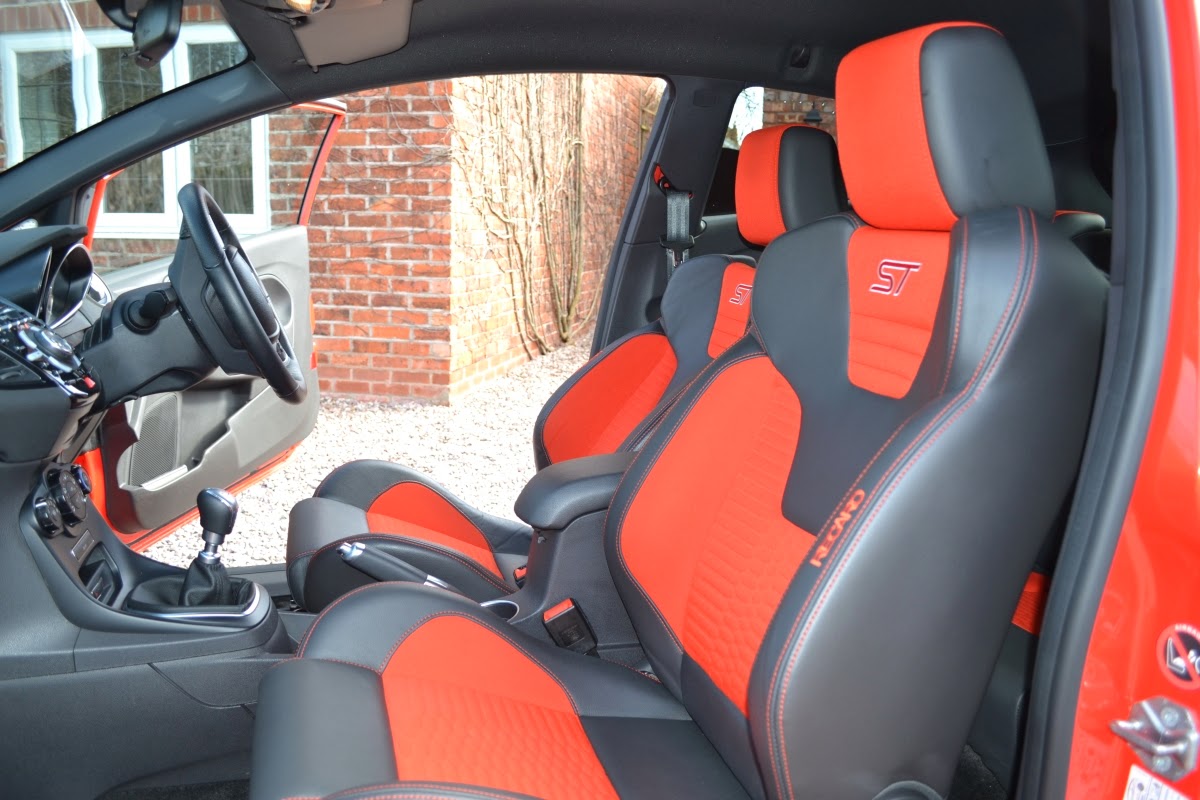
The interior is a nice place to be, highlighted massively by the standard fit Recaro seats finished in a very unsubtle hue of bright orange cloth and dark grey leather. The moment you sit in the car you know it means business, the heavy side bolstering has a grip like a large baseball glove and clasps you firmly in place

The dash is standard Ford fodder with some flimsy and scratchy plastics and the ST equipped Sony hifi has far too many buttons, I counted 28 individual buttons and also a rotary dial. It's nice to see a modern car with both a proper hand brake and a manual gearlever and the ST is so equipped. The steering wheel could be lifted straight from a Mondeo with it's fairly ugly boss but whilst it is fairly large the rim has a chunky feel and is a good fit in your palms.

In the back there's room for 2 adults even with the driver's seat adjusted for me at 5'9. The driving position is excellent, the wheel has long reach and rake adjustment so can be set up just right for a rally style position with arms bent and close to the body but legs stretched out.

On start up and it has a light rasp of induction noise which gets bassier the higher it revs. On paper the engine is down on power compared to its rivals but it has the highest torque levels and lowest kerb weight in its class so remains a strong contender.

On the road it's supremely confident, it does have a hard ride but the damping and bushing have been perfected by Ford's chassis engineers so is really chuckable and confidence inspiring. I don't use the term 'handles like a go kart' lightly but this really does feel like a grown-up sized 4 seater go-kart. 

Ford didn't need to resort to flashy names for its chassis components to achieve this excellent handling, they just selected the right off-the-shelf components, geometries and tyre sizes until they were happy with the results. This is very much like the Ferrari engineers who were seconded to Fiat to develop the Panda 100 HP into such an entertaining little car, just experience, trial and error and an eye for detail.
2014 Ford Fiesta ST-2

I noted the tyres were very low profile at 205/40/17 and I think the 40 side profile over most of its rivals 45 profiles helps with the agility, yes its ride is hard but the shorter profile seems easier to damp and control hence it is so forgiving.

When really going for it I was thankful for the support afforded by the Recaros, their vice like grip holds you in place during hard cornering and the depth of the side support is obvious in the pictures. The headrests sit forward and you can always feel them on the back of your head like they are sat up ready for an impact to protect your neck from too much movement.
The clutch is light but apparent that it has the same fault as the 208 GTI in that it doesn't have enough clearance to manouvre your left foot in between gear changes. It's not the alloy pedal covers but the actual clutch arm which juts out by about an inch to the left. It's not as bad the 208 but still annoying considering these are mass market cars.

The gear change is springy and positive in action and one that you will enjoy on a daily basis.  A manual gearbox being quintessential to the hot hatch, it has to be involving as well as fun and an auto just doesn't give you that satisfaction. The likes of RenaultSport and VAG should drive an ST to see how it's done, no boring double clutch gearboxes here just a fun, involving gearchange experience.

The engine is the ST's ace card, the EcoBoost unit features variable valve timing and is tuned for power and economy which equates to a very strong midrange so you rarely need to rev it to get the most out of it. At just past tickover there's a slight lull when you plant your foot but it rapidly builds torque and there's a very healthy surge from 3,000rpm which tapers off toward its redline just south of 7,000rpm. That torque is key to the experience and contributes towards the claimed high fuel economy as you can make good progress using the sweet spot from 2,500 and change up at 5,000rpm. Whilst it is down on power next to its key rivals the torque more than makes up for it and pulls stronger and cleaner than its rivals. It would be interesting to put the ST on a rolling road as the claimed 179bhp feels under estimated.
2014 Ford Fiesta ST-2

The power is put down cleanly on the road thanks to a torque vectoring system.  The modest power output doesn't warrant a mechanical LSD. The system works by braking the inside front wheel so it effectively pulls the car round out of junctions and works with surprising results. The systems shines particularly in the wet when wheels would otherwise scrabble out of slow speed corners.  Instead they pull through cleanly with limited spin and in the direction you want to go.

As a package the Fiesta ST comes together brilliantly.  The engine's tirelessly torquey and the slug of midrange at 3,000 quite addictive. The engine has been allowed to sing a little in the ST, there's some healthy induction noise and a little exhaust rasp, nothing too much but enough for you to appreciate it. The chassis is exceptionally controlled and so much fun. It is just so chuckable and entirely predictable and if you could drive blindfolded on a track it could be a hatchback with a Lotus badge on the boot. The hard ride feels right in a hot hatch, like it means business and the steering offers some delicate feedback, again I put this down partly to those 40 profile tyres.

Considering there's no special names in the brake department and it doesn't have massive discs it has good stopping power to keep you out of trouble and fade free on some demanding country roads on test.

I personally found the ST to be an exceptional driver's car and one where its performance can be accessed on a daily basis, but there was someone who wasn't a fan - my wife. She liked the little touches like the illuminated sills which glow red at night and the fillerless fuel cap (why don't all manufacturers fit them?) but as a passenger the hard and bumpy ride agitated her motion sickness and she complained the headrest constantly banged her head. She did have a point, especially in the headrest positioning but as a driver you can ignore these trivialities and concentrate on enjoying your driving.

The ST starts at just under £18k and comes with a range of standard fit features such as heated half leather Recaros, Sony hifi with ipod control and DAB radio, two cupholders and obligatory electric windows, remote central locking etc. You really could drive away the standard car without any options and be perfectly happy and not need to worry about resale for not picking certain options.

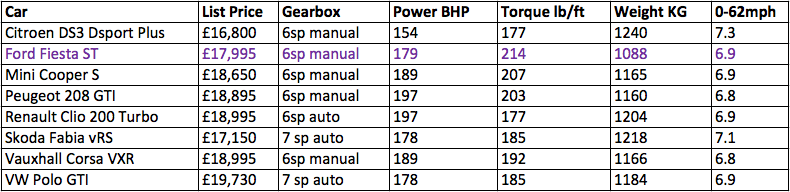
There's a raft of competition in this segment, so much so that for ease I have listed them in a table below.


For me a hot hatch must have a manual gearbox, this is not supercar territory where shaving 0.1 seconds of the acceleration figures helps sell a few more cars, we want the broad driving experience and an auto can't deliver that. That takes out three cars from the competition. Next out is the D3S - it's a little down on power and the weight is up over the others, plus it looks a little childish with bright graphics and flashy wheels. Next I would rule out the Mini, yes its starting price is competitive but a few 'essential' options will see that rise considerably. The final three are the Fiesta, Corsa VXR and 208 GTI. The Corsa needs more work in the chassis department to shine in this company, a hard ride is no good without control.

This just leaves the 208GTi and Fiesta ST, both excellent hot hatches and if it were down to looks alone the 208 would get the nod, but it does have some flaws such as its wheel control, slightly squashy seats and the engine isn't as perky as the Ecoboost unit.

For me the Fiesta ST is the best in class, not quite the best looking but such an engulfing drive, a delectable chassis and a well equipped interior. It also happens to be the best value.

Stats


Car - Ford Fiesta ST-2 1.6 EcoBoost SCTI
Price - £17,995 (£18,995 as tested)
Engine - 1.6 litre, turbocharged inLine 4 cylinder, petrol
Transmission - 6 Speed Manual
0-62mph - 6.9 seconds
Top speed - 139 mph
Power - 179bhp
Torque - 214lb ft
Economy - 47.9mpg combined
CO2 - 138 g/km
Kerb weight - 1163kg unladen
2014 Ford Fiesta ST-2

2014 Ford Fiesta ST-2

2014 Ford Fiesta ST-2

Review by Colin Hubbard


24 Feb 2014

The New Ford Focus - Some Interesting Details

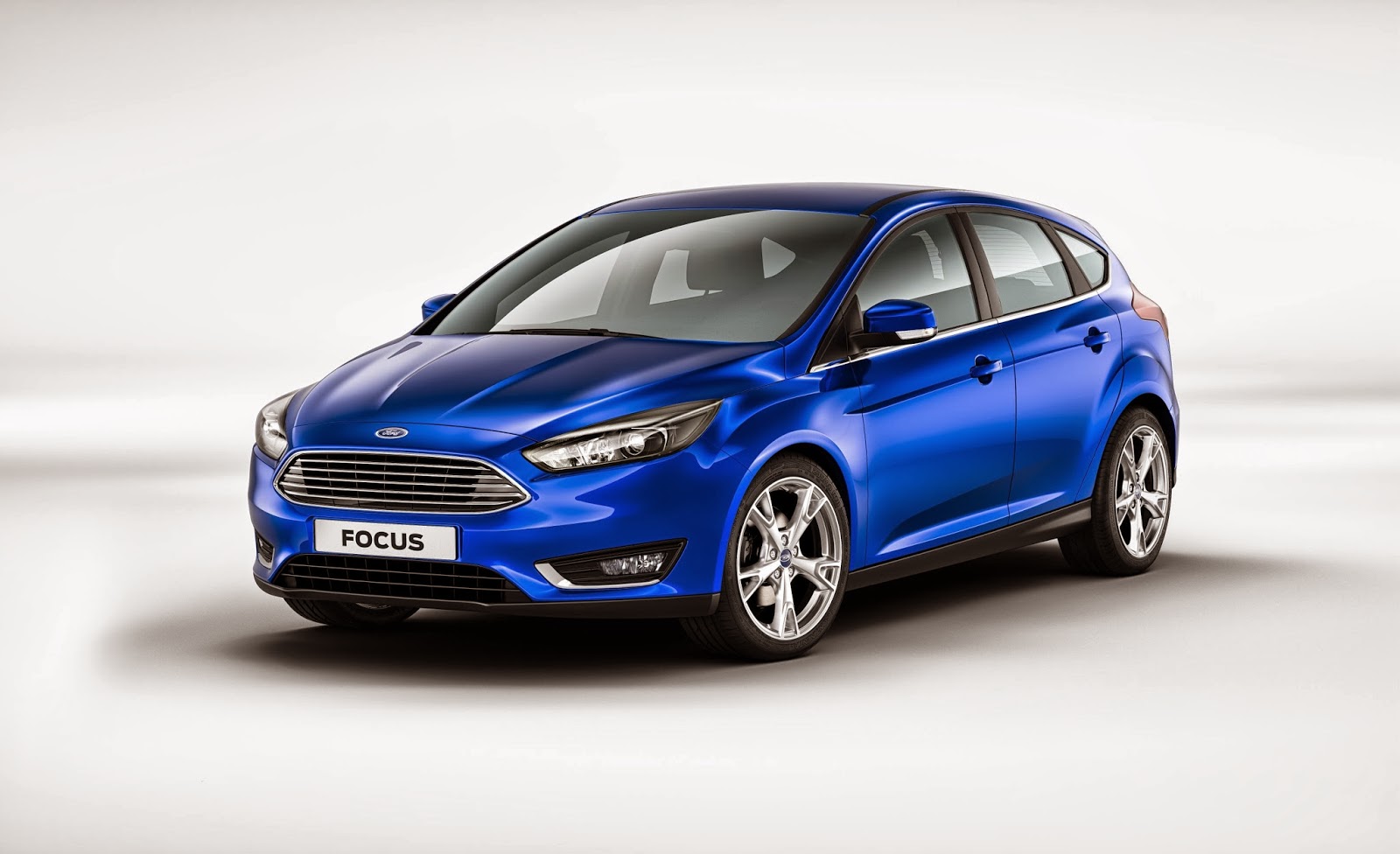
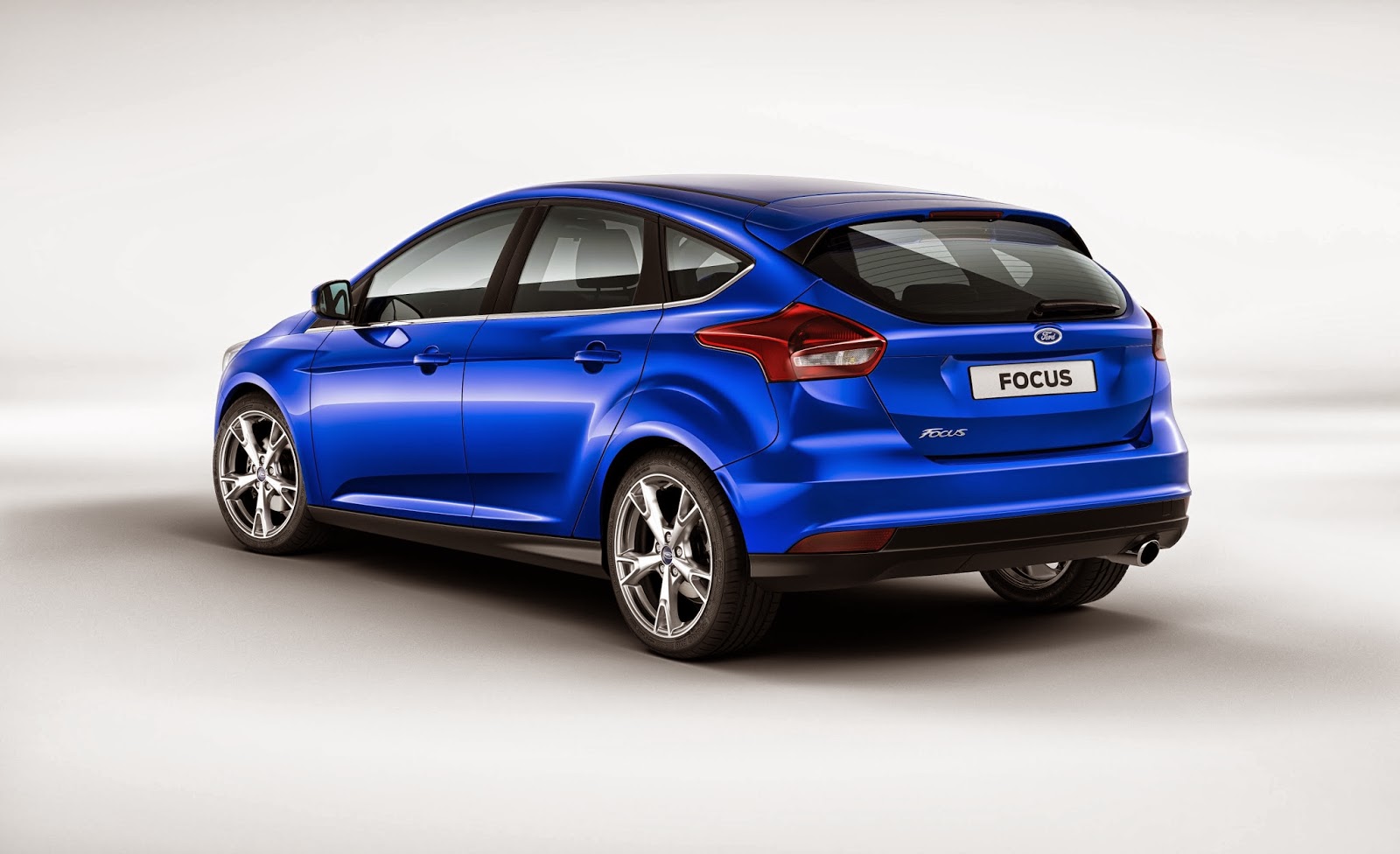
The 2014 Ford Focus has just been announced.  It's quite an important car for Ford, the previous generations having sold 12 million units worldwide since 1998, and will be on sale later this year.  You'll be able to see it at the Geneva Motor Show in a couple of weeks time.


The press release is quite long and lists all of the features and enhancements on the new Focus over the old one.

Driving enthusiasts will be happy that a mainstream car focuses on driving dynamics to such an extent.  The engines on offer include the excellent 1.0 EcoBoost with 125bhp, and a 180bhp 1.5 litre EcoBoost.  There are some diesels too.

The suspension, steering, electronic stability and chassis stiffness have all been improved and tweaked to make the new Focus a better driver's car than the old one - which was pretty good in the first place.

The new Focus is packed to the gills with technology, some of which is helpful to drivers and will make roads safer and some of which is bound to bewilder some drivers.

The Focus will get Ford's MyKey technology.  In essence this means if your children use the car then they have their own key.  This key can be programmed to control various aspects of the car, for example it can limit the volume of the audio system, limit the top speed and prevent the stability control being turned off.

The car gets the latest lighting technology including Bi-Xenon HID headlights which adapt to the surrounding conditions to shine as much light as possible on the road without blinding other drivers.

The sheer amount of safety and info tech is of Volvo proportions.  The Focus gets Ford's SYNC-2 system with a new satnav and voice controls, although in my experience voice controls rarely work properly and in the long term sensibly placed buttons do a better job.

The Focus will be able to parallel park by itself, and will use aids to help reversing into spaces.  Neither of these are particularly useful in the real world but a few other aids are genuinely useful.  Cross Traffic Alert is used when reversing out of a parking space and warns the driver of approaching hazards.  Also, Park-Out Assist takes control of the steering whilst the driver is manoeuvring out of a parallel parking space.  This is useful for people who are unable to judge distance and speed.

The Focus will be able to brake itself at low and high speed should the need arise.  Using similar technology the car has adaptive cruise control and, if the ACC is not engaged, it can still detect, warn and brake itself if the traffic ahead has slowed but the driver hasn't responded.

If a manufacturer is to sell a mainstream car to a worldwide market it has to include the latest safety and entertainment kit.  The Focus has a decent balance of the latest technology even if a lot of it will go unused.


By Matt Hubbard


22 Jan 2014

Why We All Love Rally Cars

Audi has won Le Mans 12 times and it has won the World Rally Championship twice.  Which one influences your perception of the brand more, the various Rs that have won Le Mans or the Quattro that won the WRC in 1982 and 1984?


In all probability it's the Quattro.  Had Audi never built the Quattro and competed in world rallying would we still hold the brand in such deference, despite 12 Le Mans victories?

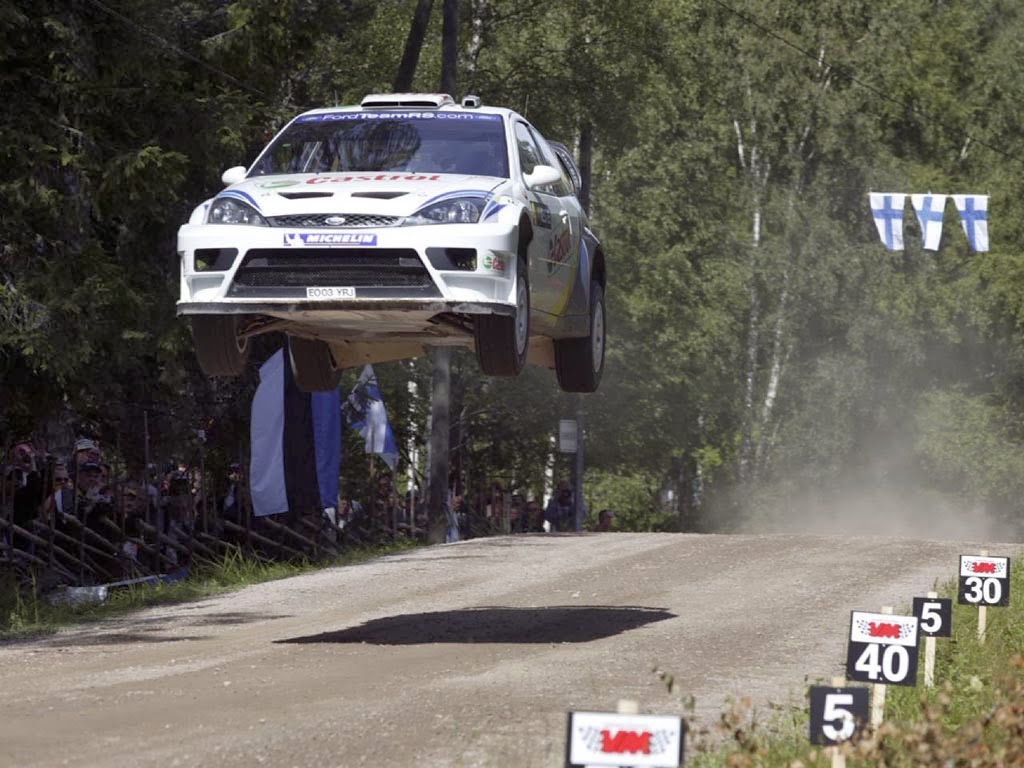
Same goes for Ford.  10 F1 world constructors championships have been won with Ford as engine suppliers but Ford's motorsport heritage in terms of customer impact rests largely on its rally successes.  Who can forget Colin McRae, Carlos Sainz, Marcus Gronholm or Marko Martin battling Focus RS's on the international rally stages.

Sure, the F1 victories don't hurt but would you buy a Mondeo on the back of those F1 wins?  Maybe, but probably not.  But it's a sure fire certainty that thousands and thousands of Focuses were bought directly as a result of its rallying campaigns.

Rallying directly transformed Subaru and Mitsubishi from niche brands into mainstream manufacturers and, despite their lack of participation in recent years, they are both still living off that legacy.

Rallying gives a brand coolness, a glow that no other form of competition can match.  The cars look the same as the cars we can buy in showrooms but stick them on a 14 mile rally stage full of jumps, gravel, snow, mud and sheer drops and they look epic.

No-one who bought a Subaru Impreza did so because it was a sensible, reliable saloon with a fruity exhaust note and a reasonable amount of boot space.  They bought one because they wanted to be Colin McRae.

Audi release concept after concept and SUV after SUV but the only time we become excited about them is when they contain the name Quattro, because we hope some of the DNA of that original rally car might be carried over.  And when we see the latest Quattro concept we are disappointed because it is nothing like a rally car.

You would think BTCC should do the same, given the cars are silhouettes of those we can buy.  But it isn't.  Touring car racing can be fun and spectacular but the focus is on the drivers rather than the cars.  Jason Plato has won 20 BTCC races in the past two years in an MG6.  In that time MG has sold just over 1,000 MG6s.  A pitiful record.

But rallying has fallen on hard times recently.  No-one watches it because it's hardly on the TV, and the stages and the events themselves are too short, and not in the right places, and the cars don't look spectacular enough.  And Sebastian Loeb won so many championships we all got bored and watched something else instead.

Volkswagen won the 2014 World Rally Championship with a Polo R, but nobody noticed.  More's the pity.  Car enthusiasts need WRC to bridge the gap from competition to street car.  The fact that the general public don't care about WRC any more means that not one Polo will be bought off the back of their world championship.  And that is a bad thing.

Supercars are all well and good but nobody normal can buy them.  WRC transforms normal cars into superstars that we can all lust after.  Where will the next truly iconic but affordable car come from if WRC is ignored?

The Renaultsport Megane 265 is a brilliant car.  If Renault were to campaign it at World Rally level and win, it could become legend.  But the fact they haven't means it will forever be respected amongst petrol heads, and unknown by the general public.

World Rallying needs to rise once again to become the spectacular, popular showpiece it once was.  Then manufacturers will be willing to throw huge amounts of budget at it to transform their humdrum machinery into the wider public's eye, and to create a modern day equivalent of the Lancia Stratos, Audi Quattro, Subaru Impreza, Mitsubishi Evo, or even Talbot Sunbeam Lotus.

By Matt Hubbard


19 Dec 2013

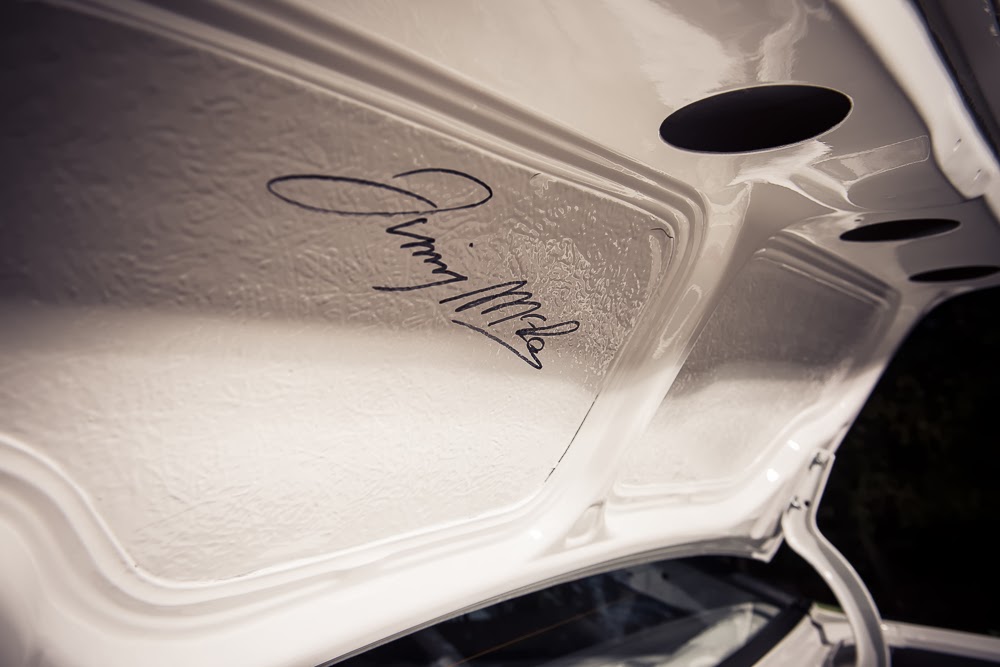
Jimmy McRae's Ford Escort Mk2 RS1800 Coming Up For Sale

Jimmy McRae, father of Colin, took this 1977 Escort RS1800 to victory in the 2006 Roger Albert Clark rally.  And now it's coming up for sale.

Jimmy McRae's Escort Mk2 RS1800

The Escort is coming up for auction on 22 February 2014 by Silverstone Auctions.  Colin McRae tested it before Jimmy drove it to victory in 2006.

The car won the 2007 British Historic Championship and in 2008 Alistair McRae won the Colin McRae Memorial Rally in it.

Check out the auction catalogue here.  The guide price is £65,000 to £85,000.

By Matt Hubbard

15 Dec 2013

Meeke and Evans to compete in 2014 WRC - Finally some Brits to cheer

Kris Meeke and Elfyn Evans will compete in the World Rally Championship next year, driving for Citroen and Ford respectively. They will be the first Brits who could challenge for the title in over a decade.


The last great era of British drivers in the WRC was the Burns vs McRae wars of the late Nineties and early Two-thousands. That was forced to close at the end of the 2003 season when the Citroen team dropped McRae and Burns showed the first symptoms of the brain tumor that would ultimately take his life in 2005. McRae made three more appearances, twice for Skoda in '05 (a late clutch failure denied him a podium in Australia) and a single outing in Turkey in '06, driving a Citroen (again, he retired). He was killed in a helicopter crash in '07 with his son and two family friends.

Since then other British drivers have competed in rallying's top flight, but none have ever been in a position to fight for wins and titles. Now we have two who should be able to.
Kris Meeke
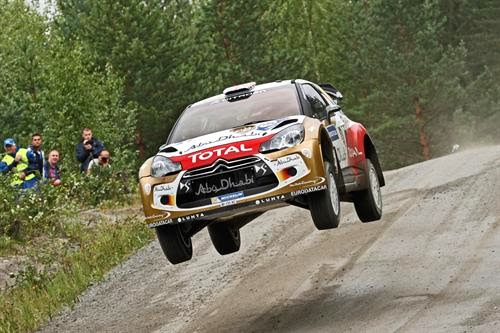
Northern Irishman Meeke has finally caught his big WRC break, being signed to lead Citroen's attack on the championship. He should have been signed by one of the big teams years ago, but lack of budget meant he was never really in the frame. It looked like he got the break in 2011 when he drove Prodrive's promising Mini John Cooper Works, but BMW pulled the funding rug from under the project. He was taken on by the PSA Group as a development driver for its various Citroen and Peugeot projects, which led to two outings with the factory Abu Dhabi Citroen team in 2013. He showed huge speed in Finland and Australia but crashed out on both occassions, a theme throughout his career. But Citroen was clearly impressed with the 34 year-old's performance and potential regardless. After all, the security of a full-time drive with Peugeot UK resulted in claiming the 2009 Intercontinental Rally Challenge. Hopefully he can perform a similar turnaround driving his new DS3 WRC.

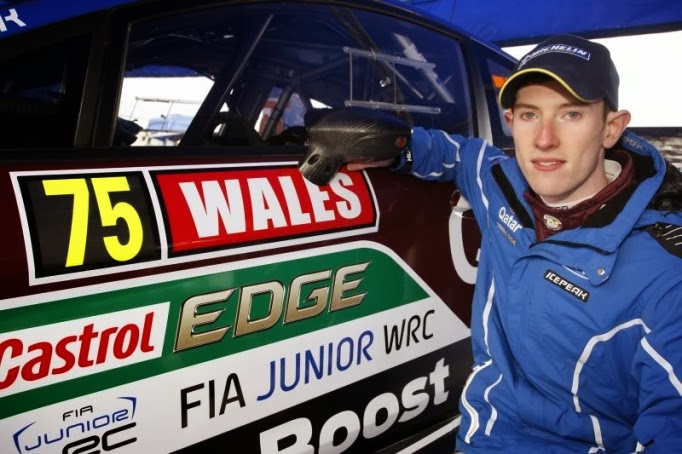
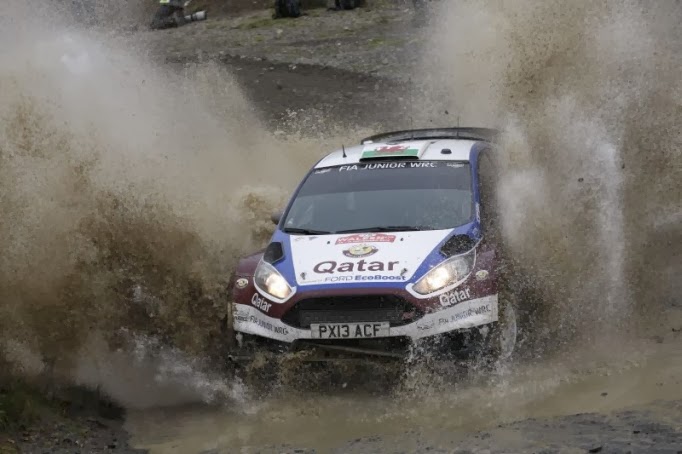
While Meeke has been on the fringes of the WRC for years, Welshman Evans is a complete newcomer, driving for the Qatar M-Sport Ford team. The son of 1996 British rally champion and sometime WRC driver Gwyndaf Evans, 24 year-old Elfyn claimed the 2012 WRC Academy title driving a Fiesta R2. That led to a funded drive in a four-wheel-drive Fiesta R5 in the second-tier WRC2 category during 2013. He had to play second fiddle to the dominant Robert Kubica, but took an emphatic victory on the season-closing Wales Rally GB. A single drive in Italy in the full-fat Fiesta RS WRC normally used by Nasser al-Attiyah netted an impressive sixth place.
Elfyn Evans
Though Meeke and Evans will be driving cars with the speed to claim the championship (indeed the DS3 has already won two), they will be in for a very tough fight. Volkswagen and Sebastien Ogier steamrollered the WRC in 2013, winning 10 of the 13 events, Ogier taking nine of those. Ford had to settle for second, while Citroen looked rudderless without Sebastien Loeb. Few would bet against VW continuing its form into 2014.

Meeke knows the Citroen team well and is apparently very popular with the mechanics. But it will still be a challenge to galvanise the team around him, whilst finding consistency in his driving. At least his teammate, the sporadically fast Mads Ostberg, is unlikely to pose much of a threat. However, Citroen's resources will be split between the WRC and its new World Touring Car Championship program in 2014. Will rallying suffer with favoured son Loeb driving for the WTCC team? Time will tell.

Evans faces less pressure as M-Sport Ford's number two driver. Team leader Mikko Hirvonen returns to the Cumbrian squad after two seasons with Citroen. Evans' pure speed might outstrip Hirvonen's, but the youngster's consistency is unproven. There's also a big unknown from within Ford's own ranks, as F1 refugee and 2013 WRC2 champion Robert Kubica will contest a full season in a Lotos-backed Fiesta. Kubica's speed is undoubted, but he is still only getting used to gravel and has never competed on snow. He could prove devastating as he gains more experience. Evans will have to work very hard to gain the upper hand in the fight to be fastest Ford.

Both Meeke and Evans will face huge challenges both within their own teams and in the battle to overcome the might of Volkswagen. But whatever happens on the stages, the United Kingdom's rally fans now have two drivers who will battle at the front to cheer on.

That's a victory in itself.

Article by Graham King
Check out Graham's Facebook page, Headboltz